.png)

What defines a collector's timepiece? Value guide 2026
- lewisvrichards3
- Apr 11
- 7 min read
TL;DR:
A true collector’s watch is characterized by scarcity, mechanical complexity, provenance, and design innovation.
Market performance shows top-tier collector watches can yield 150-550% returns over ten years.
Successful collecting requires research, verified authenticity, strategic sourcing, and patience over impulse purchases.
Owning a luxury watch and owning a collector’s timepiece are not the same thing. Many buyers assume that a five-figure price tag or a prestigious Swiss name automatically elevates a watch into investment territory. The reality is far more nuanced. Even respected maisons produce models that sit on wrists for decades without ever attracting serious collector interest. Understanding what genuinely separates a sought-after timepiece from a merely expensive one is the difference between building real long-term value and simply spending a great deal of money.
Table of Contents
Key Takeaways
Point | Details |
True collectability factors | Scarcity, mechanical complexity, and provenance distinguish collector’s timepieces from ordinary luxury watches. |
Investment performance | Top collector watches outperformed real estate with 5-8% annual returns and lower risk than equities last decade. |
Successful collecting strategy | Pros focus on expert sourcing, authentication, and timing over following trends or making emotional buys. |
Common pitfalls | Most mistakes stem from confusing price for collectability and neglecting authenticity or market research. |
Defining a collector’s timepiece: Beyond luxury labels
A collector’s timepiece is not defined by retail price or brand recognition alone. It earns its status through a combination of historical significance, mechanical ingenuity, scarcity, and provenance. These are the qualities that make a watch genuinely desirable to serious buyers, not just aspirational shoppers.
Several key attributes consistently separate collector-grade pieces from the rest:
Low production numbers: Limited runs create genuine scarcity, which underpins long-term demand.
Mechanical movements: Hand-wound or automatic calibres, particularly grand complications such as perpetual calendars or minute repeaters, signal craftsmanship that mass production cannot replicate.
Provenance: A documented ownership history, especially a connection to a notable figure or historical event, adds a layer of desirability that no amount of marketing can manufacture.
Design innovation: Watches that introduced a new case shape, dial configuration, or complication at the time of their release carry an enduring relevance.
Original accessories: Box, papers, and service records are not mere paperwork. They are evidence of a watch’s life and authenticity.
The common pitfall for new collectors is overpaying for mass-produced quartz pieces from otherwise reputable houses. Mass-produced quartz and common models lack collector appeal, and the focus should remain on mechanical, scarce pieces from brands such as Patek Philippe, Rolex, and Audemars Piguet. Understanding the difference is the foundation of identifying true value in any piece you consider.
Pro Tip: Before you buy any watch as a collector’s piece, ask yourself three questions. Is it mechanical? Is it scarce? Does it have documented provenance? If the answer to any of those is no, reconsider your position carefully.
The nuance of craftsmanship and prestige is what separates a watch that holds its value from one that depreciates the moment it leaves the boutique.
Features and signatures of investment-grade watches
Once you recognise collectability’s core ingredients, it’s crucial to examine the precise features separating investment pieces from the rest.
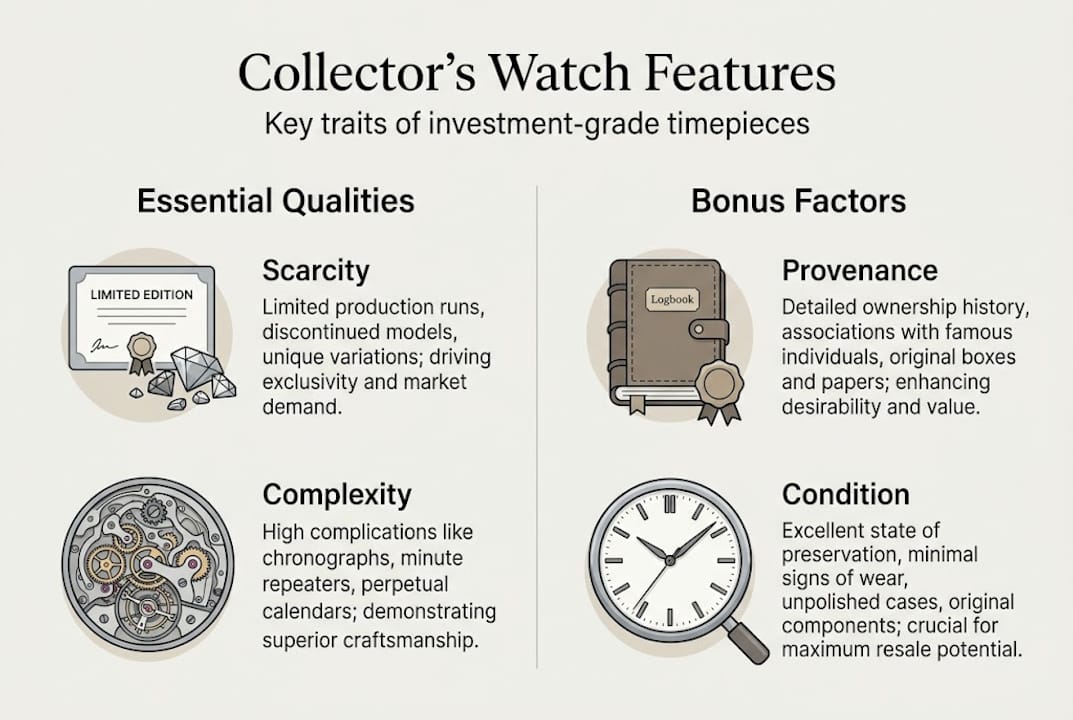
Grand complications are among the most powerful drivers of collector demand. A perpetual calendar, a tourbillon, or a split-seconds chronograph represents hundreds of hours of skilled labour and engineering. These are not features you can replicate at scale. The value of mechanical watches lies precisely in this irreproducibility.
Certain models have become benchmarks for the entire market:
Patek Philippe Ref. 2499: A perpetual calendar chronograph produced in only 349 examples across four series. Each sale sets a new reference point.
Rolex Daytona ‘Paul Newman’: The exotic dial variants of the early Daytona, once overlooked, now command extraordinary premiums at auction results in 2026.
Audemars Piguet Royal Oak (Ref. 5402): The original 1972 Gerald Genta design disrupted fine watchmaking and created an entirely new category.
Model | Key feature | Collector appeal |
Patek Philippe Ref. 2499 | Perpetual calendar chronograph | Extremely high |
Rolex Daytona ‘Paul Newman’ | Exotic dial, limited variants | Very high |
Audemars Piguet Royal Oak Ref. 5402 | Pioneering integrated bracelet design | Very high |
Omega Speedmaster Professional | Moon-worn, NASA heritage | High |
Cartier Santos (original 1904) | First men’s wristwatch, historical significance | Moderate to high |
Condition is equally decisive. A watch with its original dial, unpolished case, and full set of accessories will always command a premium over the same reference in lesser condition. Luxury watches average 5 to 8% annual returns, outperforming real estate but sitting below equities, with notably lower volatility.
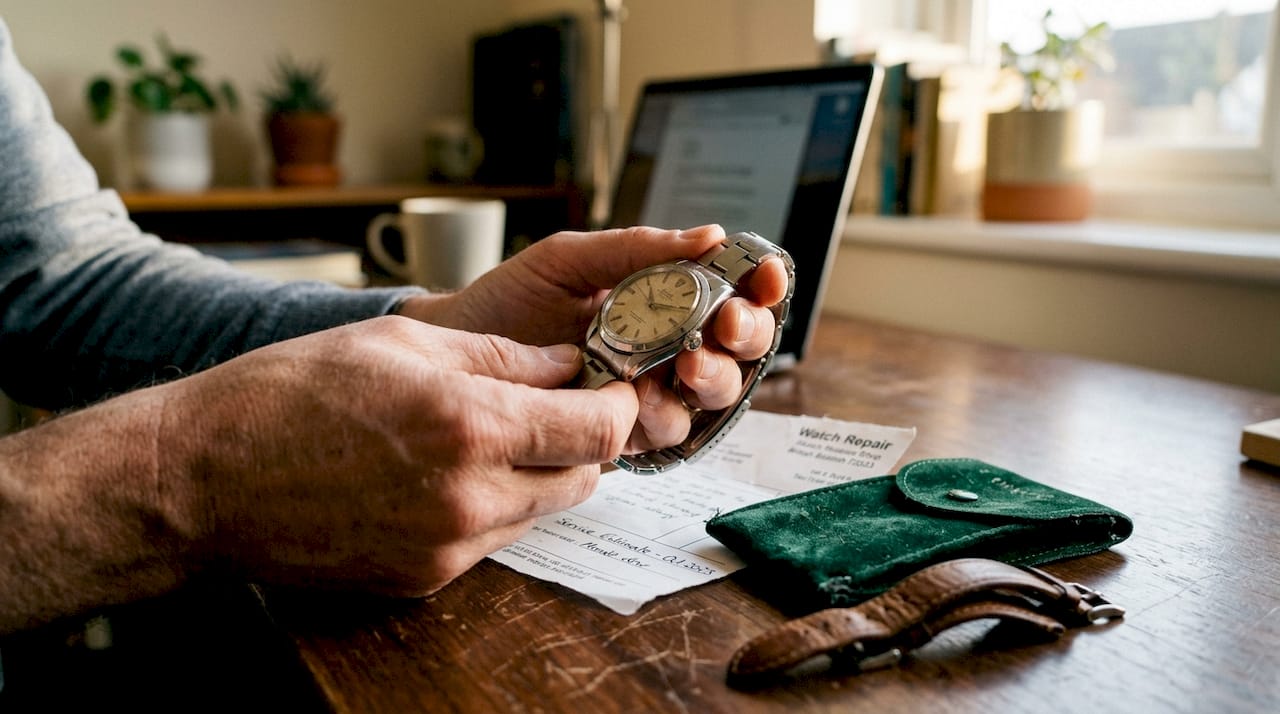
Pro Tip: Never polish a collector’s watch unless absolutely necessary. Original patina and case sharpness are evidence of authenticity and are priced accordingly by serious buyers.
Market performance: How collector’s timepieces fare as investments
Understanding physical and brand attributes is only half the story. Now, let’s see how collector’s timepieces have performed in the market.
The numbers are compelling. Rolex average prices rose 550% between 2010 and 2025, moving from approximately £1,600 to over £10,000 on the secondary market. Patek Philippe complications such as the Ref. 2499 and Ref. 1518 have fetched millions at notable auction sales, with the Ref. 1518 in stainless steel achieving over £9 million at Phillips in 2016.
“The watch market rewards patience, provenance, and precision. Impulse buys rarely become heirlooms.”
Asset class | Approximate 10-year return | Volatility |
Collector watches (top tier) | 150 to 550% | Low to moderate |
Prime residential property (UK) | 40 to 70% | Low |
Global equities (MSCI World) | 150 to 200% | High |
Gold | 60 to 80% | Moderate |
The key distinction from equities is liquidity and emotional resilience. Watch markets do not crash overnight in the way stock markets can. Corrections happen, as seen in 2022 and 2023 when secondary Rolex prices softened after a post-pandemic spike, but the long-term trajectory for investment-grade references has remained upward.
Risks do remain. Counterfeit pieces, over-restored watches, and hype-driven models without genuine scarcity can all erode value quickly. The collector who understands the difference between enduring demand and short-term fashion will consistently outperform one who simply follows headlines.
Collector’s strategy: Sourcing, authenticating, and selling
With an understanding of market dynamics, it’s essential to translate knowledge into action. Here is how experienced collectors approach sourcing and selling.
Source from reputable channels. Established dealers, major auction houses such as Phillips, Christie’s, and Sotheby’s, and trusted peer networks are your safest starting points. Avoid private sales without thorough verification.
Verify the movement. A specialist watchmaker should inspect the calibre to confirm it matches the reference and has not been tampered with. Serial numbers must align with brand records.
Authenticate provenance. Request all available documentation, including original purchase receipts, service records, and any correspondence relating to ownership history.
Preserve condition actively. Store pieces in stable conditions, away from magnetic fields and extreme temperatures. Service only when necessary, and always use brand-authorised or specialist independent watchmakers.
Time your sale intelligently. Selling immediately after a high-profile auction result for the same reference maximises proceeds. Scarcity, mechanics, provenance, and auctions all directly shape the value and future prospects of any piece you bring to market.
A well-structured collecting workflow makes the difference between reactive and strategic acquisitions. For rarer references, sourcing rare pieces through specialist networks often yields better results than waiting for public listings. When the time comes to sell, understanding discreet sales processes protects both your privacy and your final proceeds.
Pro Tip: Keep a personal catalogue of every watch you own, including photographs, service receipts, and purchase documentation. This record dramatically increases resale value and buyer confidence.
Why the conventional wisdom on collecting watches fails new investors
The phrase “buy what you love” is repeated endlessly in collector circles, and it is not entirely wrong. But as a standalone strategy for building a valuable collection, it is dangerously incomplete. Emotional attachment to a piece can cloud judgement about condition, provenance, and fair pricing. We have seen buyers pay significant premiums for watches they adored, only to discover the secondary market did not share their enthusiasm.
Serious collectors operate differently. They develop clear acquisition criteria before they ever enter a negotiation. They build networks of dealers, auctioneers, and fellow collectors who provide real market intelligence rather than retail optimism. Patience is not passive. It is an active discipline of waiting for the right piece at the right price rather than settling for availability.
Resisting market fads is equally important. Hype cycles around certain references inflate prices temporarily, and those who buy at the peak often wait years to recover their outlay. The collectors who consistently build value understand negotiating sales wisely as a skill in itself, not an afterthought. Genuine expertise, not passion alone, is what separates a collection that grows in value from one that simply grows in size.
Find and secure your next collector’s timepiece
Knowledge is the foundation, but access is what turns insight into acquisition. At Horology Kings, we specialise in helping serious collectors and investors source rare watches that rarely appear on open markets, with full authentication and transparent provenance documentation.
Whether you are looking to acquire a specific reference, receive a professional appraisal, or explore expert servicing to preserve a piece in your existing collection, our team in Hertfordshire is equipped to assist. We handle every transaction with discretion, security, and the depth of knowledge that serious collectors expect. Visit us to buy and sell luxury watches with confidence, knowing every piece has been verified by specialists who understand what genuine collector value looks like.
Frequently asked questions
What distinguishes a collector’s timepiece from an ordinary luxury watch?
Collector’s watches are defined by scarcity, mechanical complexity, provenance, and lasting demand. Mass-produced quartz models from even respected brands rarely qualify, regardless of their retail price.
Are collector’s timepieces a good investment in 2026?
Well-chosen collector’s watches have averaged 5 to 8% annual returns over the past decade, outperforming many physical assets with lower volatility than equities, though careful selection remains essential.
Which brands and models are most sought after by collectors?
Patek Philippe, Rolex, and Audemars Piguet dominate collector wish-lists, with references such as the Patek Philippe Ref. 2499 and the Rolex Daytona ‘Paul Newman’ consistently commanding the strongest premiums at auction.
How do I authenticate a collector’s timepiece before purchase?
Buy from established dealers or auction houses, have a specialist inspect the movement, verify serial numbers against brand records, and request all original paperwork and service documentation before committing.
What mistakes should new collectors avoid?
Avoid purchasing on emotion alone, never assume a high price guarantees collectable status, and always research the specific reference rather than relying on brand reputation as a proxy for investment quality.
Recommended
Comments