.png)

What is a vintage watch: the collector's guide
- lewisvrichards3
- May 22
- 9 min read
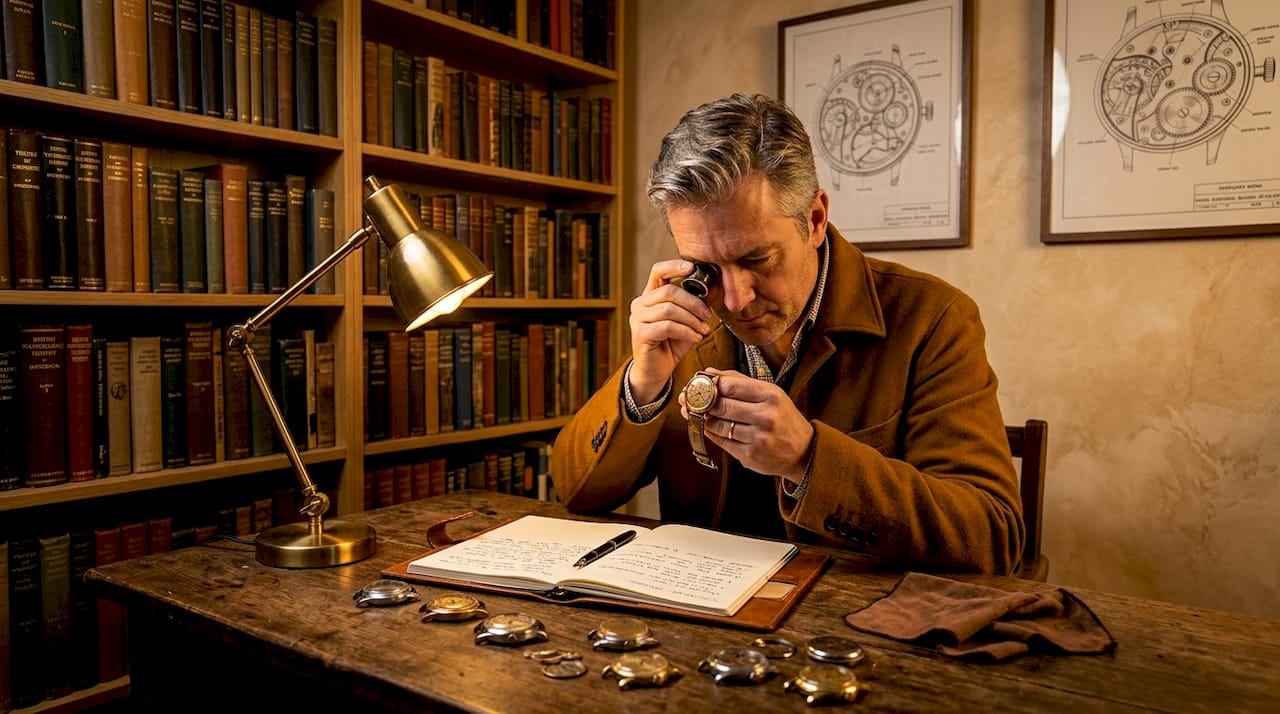
TL;DR:
Vintage watches are defined by a combination of age, originality, and cultural significance, not just years. Authenticity is proven through original parts, correct case geometry, and natural patina, while market growth reflects their connection to craftsmanship and sustainability. Successful collecting relies on thorough research, prioritizing condition, and engaging deeply with each piece over time.
Few subjects in the luxury watch world generate as much confusion as the question of what is a vintage watch. Ask ten collectors and you will likely get ten different answers. Some point to a specific decade, others to a particular aesthetic. The reality is that age is only part of the story. Vintage watches are defined by a combination of era, originality, mechanical character, and cultural resonance, and understanding that distinction is what separates a knowledgeable buyer from someone paying a premium for the wrong reasons. This guide covers everything you need to know.
Table of Contents
Key takeaways
Point | Details |
Age is just the starting point | Industry consensus places vintage at 20 to 30 years or older, but age alone does not determine collectibility. |
Originality drives value | Watches retaining original dials, hands, and movements command significantly higher prices than restored examples. |
Patina is not a flaw | Natural ageing on dials and cases signals authenticity and increases desirability among serious collectors. |
The market is growing fast | The pre-owned luxury watch market is projected to reach $35 billion by 2026, driven by heritage and sustainability interest. |
Authentication requires expertise | Spotting genuine vintage watches demands knowledge of case geometry, dial typography, and correct period parts. |
What is a vintage watch, exactly?
The phrase gets used loosely, so it is worth establishing a working definition. The industry standard places vintage watches at roughly 20 to 30 years old, with antique watches crossing the 100-year threshold. Anything more recent tends to fall under the broader category of pre-owned, regardless of how it is marketed.
Those three categories matter because they carry different implications for buyers.
Category | Age range | Defining characteristics |
Pre-owned | Any age | Previously worn; no age requirement |
Vintage | Approx. 20 to 100 years | Heritage design, original parts, collector interest |
Antique | 100 years or older | Historical rarity; mechanical pocket watches often qualify |
Context matters as much as raw age, though. A watch produced in 1995 qualifies as vintage by the numbers, but whether it carries genuine collector interest depends on its design era, model significance, and originality. The Rolex Submariner references from the 1960s and early 1970s, for example, are universally recognised as vintage not just because of their age but because they represent a formative chapter in sports watch design. A generic quartz watch from the same decade does not carry the same weight.
The distinction between vintage and antique is equally misunderstood. Antique watches are genuinely rare objects, often pocket watches or early wristwatches from the early 20th century. Their value comes from extreme scarcity and historical significance rather than wearability. Vintage watches, by contrast, occupy a more accessible middle ground. They are old enough to have character and historical identity, but modern enough to service and wear regularly.
What makes a watch truly vintage
Age qualifies a watch for the category. Originality is what makes it valuable.
Collectors prioritise watches that retain their original dial, hands, bezel, case shape, and movement above almost everything else. When any of these components have been swapped, refinished, or replaced, the watch loses a layer of authenticity that cannot be recovered by price adjustment alone.
Here is what to look for when assessing whether a watch is genuinely representative of its era:
Original dial. The dial is the face the watch was born with. Repainted, re-lacquered, or refinished dials are a significant downgrade in collector terms, even when the work is visually convincing.
Correct handset. Hands should match the period specification for the reference. Many restorers fit period-incorrect hands from donor watches, which trained eyes spot immediately.
Case geometry. Each reference has a specific profile. Polishing removes metal, and over-polishing permanently alters the case geometry in ways that cannot be undone.
Movement condition. The calibre inside should ideally be unmodified and correctly serviced without non-original parts.
Honest wear and patina. Tropical dials, faded chapter rings, and aged luminous plots are not defects. Natural ageing on original components signals authenticity and often increases desirability.
Pro Tip: When examining a potential purchase, carry a loupe and compare the dial printing under magnification. Period-correct text has specific characteristics in weight, font, and depth that reprints rarely replicate convincingly.
Rarity and design identity also contribute. Certain dial variations have become significantly more valuable simply through collector interest over time, such as the Buckley Dial found on specific Rolex Datejust references. A watch can be mechanically identical to a common variant but worth multiples more because of a printing variation. That is the kind of nuance that separates serious collectors from casual buyers.
Why vintage watches matter
There is a reason the vintage watch market has grown from a niche collector pursuit into a global financial category. Vintage watches connect wearers to craftsmanship, history, and design sensibility that modern production rarely replicates. That emotional dimension is not nostalgia for its own sake. It is a genuine response to objects made with a different set of priorities.
“Quality vintage watches represent long-term craftsmanship and value retention compared to cheap disposable gadgets.” Time is wealth preservation
The financial picture reinforces the cultural one. The pre-owned luxury watch market is projected to reach $35 billion by the end of 2026, driven by rising demand for heritage pieces and growing awareness of sustainability. Buying a vintage watch rather than a new one extends the life of an object that required significant resources to produce. For a generation attentive to consumption, that matters.
There is also something irreplaceable about wearing an analogue mechanical watch that has existed for fifty years. It has stories attached. It has lived through decades of human history. That texture is absent from even the most technically impressive modern release. Understanding what drives luxury watch value helps clarify why certain references hold or grow in price while others stagnate. Heritage, original condition, and cultural relevance consistently outperform novelty.
How to identify genuine vintage watches
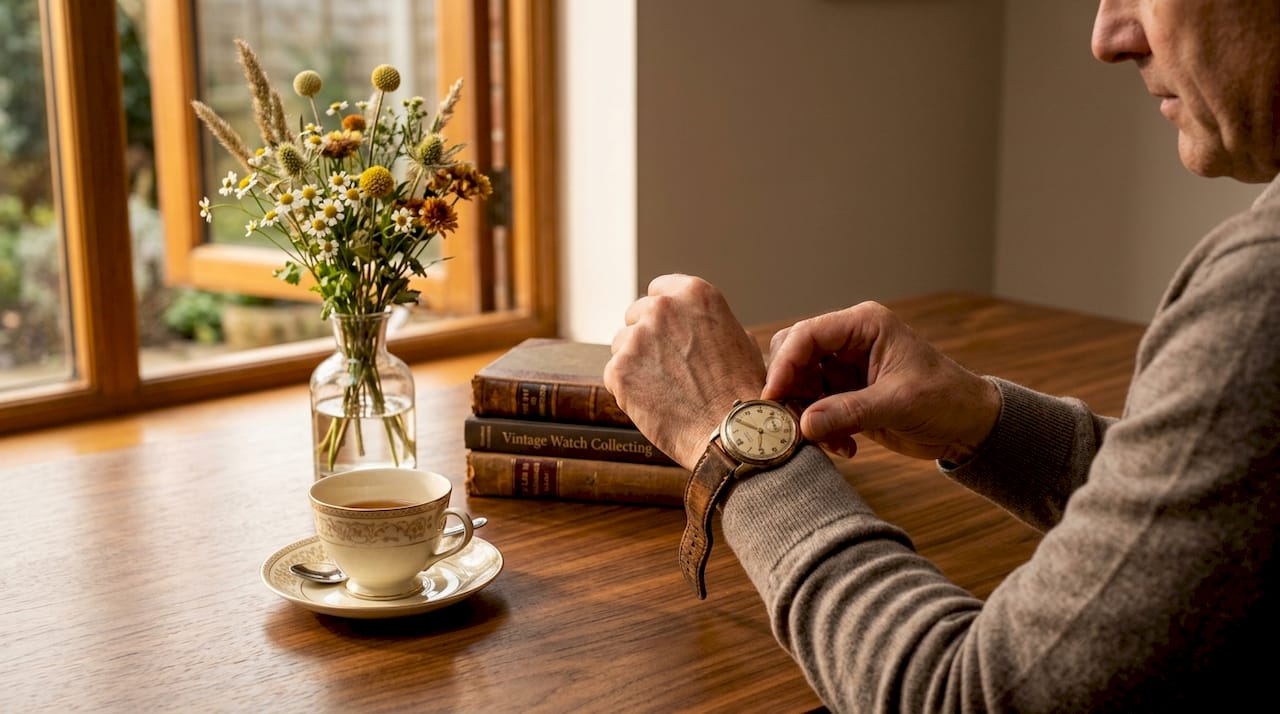
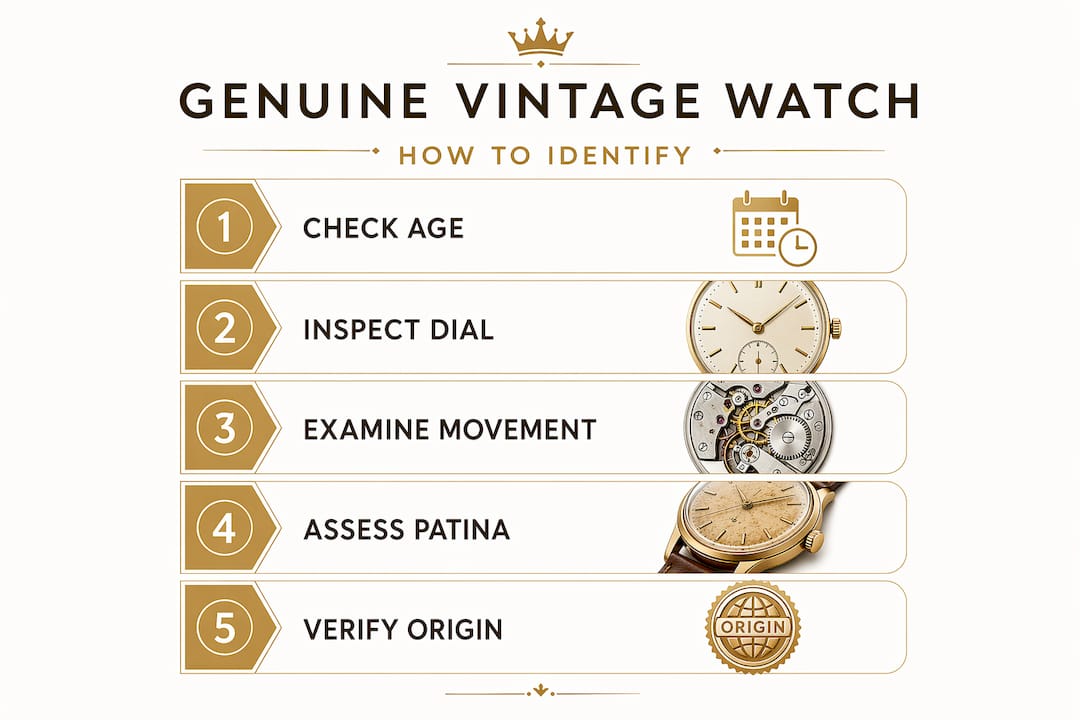
Identifying an authentic vintage watch requires more than a cursory glance at the dial. The market contains altered, misrepresented, and cosmetically manipulated pieces at every price point, and a confident buyer needs a structured approach.
Research the reference first. Before handling any watch, understand what the correct configuration looks like. Verify the correct dial variant, case dimensions, movement calibre, and period-correct crown, pushers, and crystal for that specific reference and approximate production year.
Examine the case for polishing damage. Run a fingernail along the lugs and check whether the edges remain sharp. Excessive polishing removes the metal from these areas first, blurring the profile into something rounded and indistinct. This is one of the clearest indicators of heavy restoration.
Check the dial under magnification. Look for signs of repainting: uneven texture, incorrectly weighted fonts, or luminous material that does not match the period application method. Many redials look convincing at a distance but reveal themselves under a loupe.
Inspect the movement. Request caseback access where possible. The calibre should correspond to the production era of the case reference. Non-original movements or evidence of parts swapping should prompt further questioning.
Verify the documentation without over-relying on it. Originality and preservation define value more than paperwork does. An unworn watch with a box and papers is desirable, but a correctly original watch without documentation is far preferable to a documented example with a refinished dial.
Pro Tip: Learn the specific typography used on your target reference by studying auction catalogues from major houses. Sotheby’s, Phillips, and Christie’s archive their watch sales in detail, and the lot descriptions for important vintage references are among the most reliable educational resources available.
The most common pitfall collectors encounter is prioritising cosmetic appearance over mechanical and componential integrity. A glossy, polished case and a bright dial often signal the opposite of originality. Learn to recognise authenticity markers early, and you will avoid the most expensive mistakes.
Building a collection and investment strategy
Collecting vintage watches works best when you treat it as a long-term pursuit rather than a series of transactions. The collectors who fare well financially are almost always those who collected for passion first and allowed the investment dimension to follow naturally.
A few principles that hold up consistently:
Start with the brands that have the deepest collector communities. Rolex, Patek Philippe, Omega, and Audemars Piguet have the most thoroughly documented reference histories, the most active secondary markets, and the greatest depth of available expertise. For a first vintage purchase, that research infrastructure matters.
Prioritise condition and originality over price. A correctly original example at a higher price will almost always outperform a heavily restored piece at a discount over a five to ten year horizon.
Watch market trends carefully. Regional preferences and collector fashion shift. Rose gold models have seen strong recent demand, while certain steel sports references have cooled after a period of extreme pricing. Understanding these cycles helps you buy intelligently rather than reactively.
Service watches properly. A vintage movement needs periodic servicing from a specialist who understands period-correct methods. Improper servicing with incorrect lubricants or non-original parts damages both function and value. Premium care for vintage watches extends longevity without compromising originality.
Keep records. Provenance documentation builds over time. Even if a watch arrives without original papers, your own purchase receipts, service records, and correspondence add to its story and support future resale.
For guidance on finding rare pieces, Horology Kings has published practical watch sourcing advice specifically for collectors in the UK market.
My honest perspective on collecting vintage watches
In my experience, the most damaging belief in this market is that a clean, shiny watch is a good watch. I have seen buyers overlook genuinely important pieces because the patina made them nervous, and pay significant premiums for heavily refinished examples that looked impressive in photographs. The surface presentation is almost never the real story.
What I have come to believe is that originality and condition are the twin pillars that everything else rests on. Not provenance paperwork. Not hype around a particular reference at a particular moment. The watch either retains what it was born with or it does not, and no amount of presentation changes that fundamental fact.
I also think collectors do themselves a disservice by treating vintage watches purely as assets. The ones I have seen appreciate most meaningfully over time are almost always the pieces their owners wore and understood deeply. Engagement with a watch, learning its history, wearing it regularly, appreciating its mechanical character, tends to produce better decisions than spreadsheet-driven thinking ever does. Buy what genuinely interests you, learn everything about it, and the financial dimension tends to take care of itself.
— Lewis
Explore vintage watches with Horology Kings

At Horology Kings, we work with collectors and first-time buyers across the UK who want access to properly authenticated vintage and luxury watches. Based in Hertfordshire, our team specialises in sourcing, valuing, and trading timepieces from Rolex, Patek Philippe, Audemars Piguet, Omega, and Cartier. Every piece we handle is assessed for originality and condition before it reaches a buyer.
Whether you are looking to buy or sell watches or want us to source a specific reference on your behalf, we offer a discreet, expert service backed by secure UK bank transfers and genuine horological knowledge. If you have a particular model in mind, our watch sourcing service connects you with our network to find it.
FAQ
What is the standard definition of a vintage watch?
A vintage watch is generally considered to be at least 20 to 30 years old. Many experts treat watches produced before 1990 as vintage, while anything over 100 years old is classified as antique.
What is the difference between vintage and antique watches?
Vintage watches typically fall between 20 and 100 years old and are often wearable collector pieces. Antique watches are over 100 years old and tend to be rarer, historically significant objects rather than everyday timepieces.
Does a vintage watch need its original box and papers?
Not necessarily. Originality and preservation of the watch itself carries more weight than accompanying documentation. A correctly original watch without papers is preferable to a documented example with replaced components.
Which brands are most popular for vintage watch collecting?
Rolex, Patek Philippe, Omega, and Audemars Piguet consistently attract the strongest collector interest, due to their documented reference histories, active secondary markets, and long-term value retention.
Why do collectors value patina on vintage watches?
Natural ageing on original dials and cases signals authenticity. Collectors regard honest wear as evidence that the watch retains its original components, which is more desirable than a cosmetically restored but compromised example.
Recommended
Comments