.png)
What is a watch bezel? Function and types explained
TL;DR:
Many collectors mistakenly see bezels as merely decorative, but they serve vital structural, aesthetic, and functional purposes in watches. Fixed bezels are static and primarily enhance design, while rotating bezels enable measurement, navigation, or calculations, with safety features like unidirectional turns for divers. The material quality of bezels, especially ceramic and engraved scales, significantly impacts durability, water resistance, and resale value, reflecting their importance beyond style.
Most collectors, when they first get serious about watches, assume the bezel is decorative. It frames the dial, it catches the light, and on dress watches it can carry diamonds worth more than the movement itself. But that assumption misses the point entirely. Understanding what is a watch bezel means recognising it as one of the most functionally diverse components in horology. It secures the crystal, contributes directly to water resistance, and on the right watch, replaces an entire toolkit. This guide covers every dimension of the bezel: its anatomy, its many types, how to use it, and why material quality matters more than most buyers realise.
Table of Contents
Key takeaways
Point | Details |
Bezel definition and role | The bezel is the ring surrounding the dial and crystal, serving protective, aesthetic, and functional purposes simultaneously. |
Fixed vs rotating | Fixed bezels prioritise structure and style; rotating bezels offer measurable, practical tool functions for divers, pilots, and travellers. |
Safety by design | Unidirectional dive bezels can only rotate counterclockwise, a deliberate fail-safe that prevents dangerous underestimation of dive time. |
Material determines value | Ceramic and engraved bezels offer superior longevity and are strongly associated with collector desirability and higher resale value. |
Lifestyle alignment matters | Choosing a bezel type to match your activities transforms a watch from an accessory into a genuinely useful instrument. |
What is a watch bezel and what does it actually do?
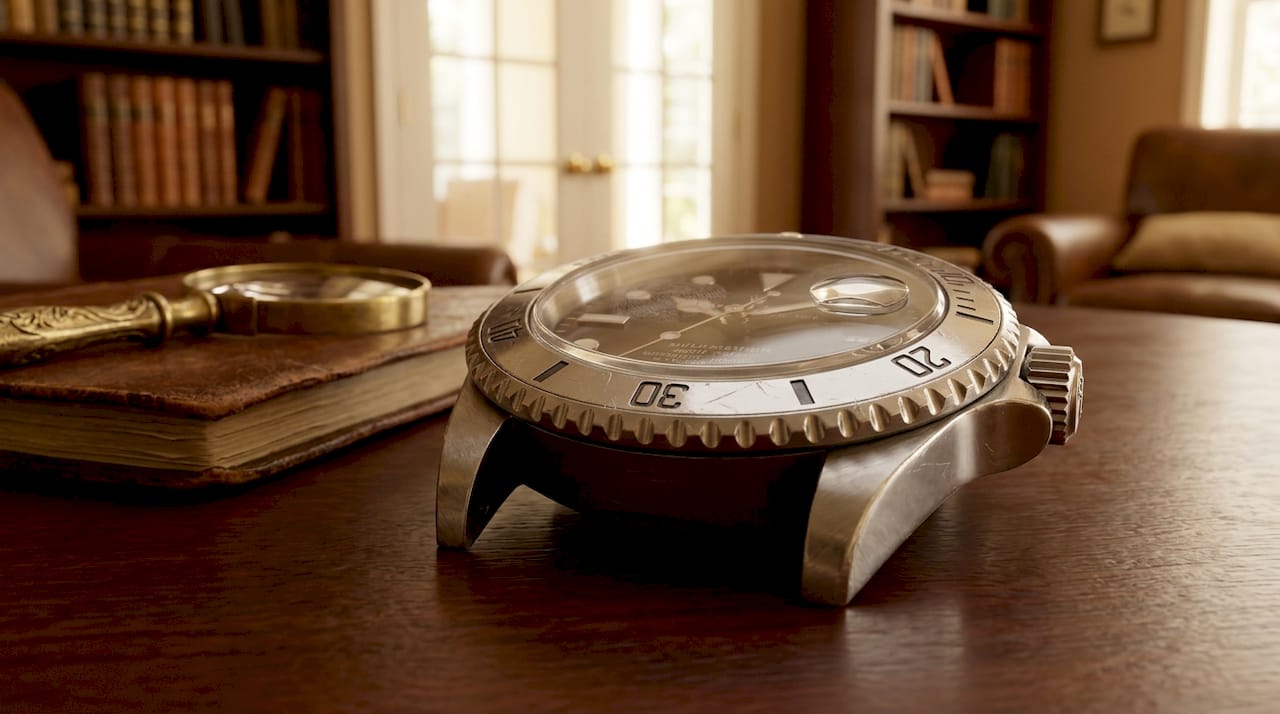
The bezel is the circular outer ring that surrounds the watch dial and crystal. It sits between the case and the crystal, holding the latter firmly in place and defining the watch’s visual perimeter. That mechanical role alone makes it indispensable. Without a properly fitted bezel, the crystal is vulnerable, and the sealed environment that protects the movement from moisture and dust is compromised.
Beyond structure, the bezel shapes the character of a watch more than any other external component. A polished, gem-set bezel signals formal elegance. A matte ceramic bezel with engraved markings communicates tool watch heritage. The same movement can feel entirely different depending on what surrounds it.
The primary functions of a watch bezel are:
Structural protection: Holds the crystal firmly against the case, absorbing shocks that might otherwise crack or dislodge the glass
Aesthetic definition: Frames the dial and contributes heavily to the watch’s overall proportional feel
Functional utility: On rotating bezels, provides a mechanical scale for timing, navigation, or calculation
Sealing contribution: Works in conjunction with gaskets to maintain water resistance
Pro Tip: When examining a pre-owned luxury watch, inspect the bezel carefully for wear on its edges and on any engraved or printed scale. Uneven wear can indicate rough handling, and on a gem-set bezel, check that every stone is secure before purchase.
Watch bezel types and their specific purposes
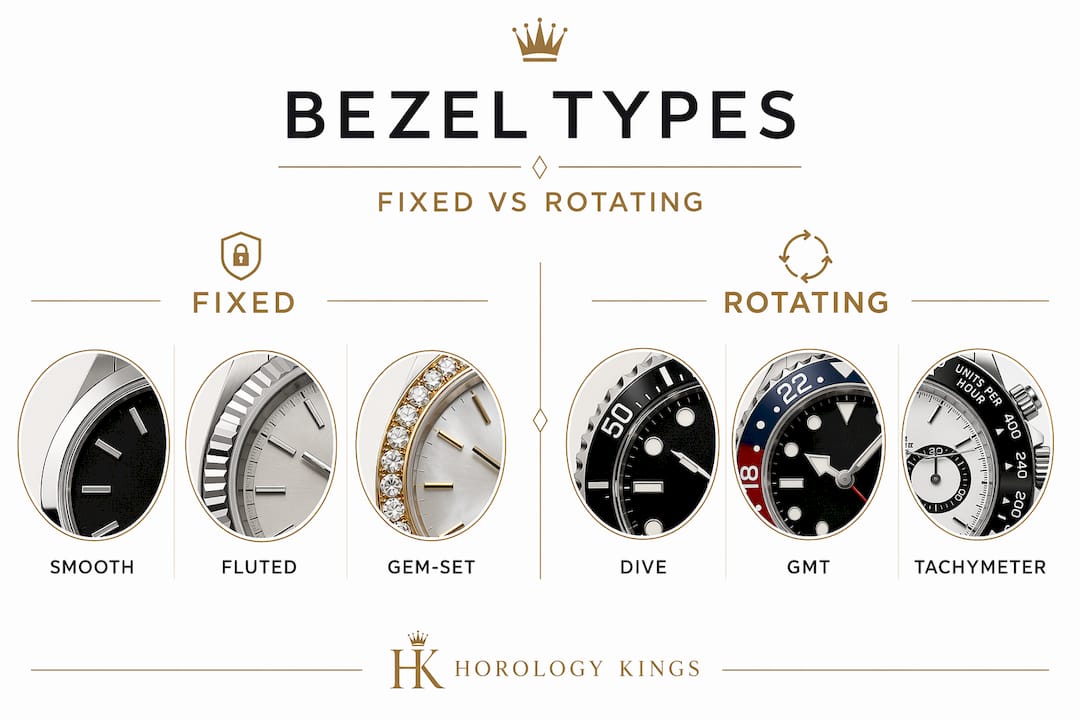
Bezels fall into two primary categories: fixed and rotating. Each category contains several distinct styles, and understanding these distinctions is what separates a serious collector from a casual buyer.

Fixed bezels
Fixed bezels do not move. They are locked to the case and serve structural and aesthetic purposes. The three most common fixed styles are:
Smooth (plain) bezel: No markings, minimal detail. Common on dress watches and slim dress pieces from Patek Philippe or Cartier.
Fluted bezel: Characterised by vertical grooves cut into the bezel’s edge. Rolex made this style iconic on the Datejust. Originally functional for tightening the bezel onto the case by hand, it now serves primarily as a design signature.
Gem-set bezel: Diamonds or sapphires are pavé or channel-set into the bezel. Found on high jewellery watches and complications from houses like Audemars Piguet and Patek Philippe.
Rotating bezels
Rotating bezels are the workhorses of the tool watch world. They turn on the case and carry calibrated scales designed for specific tasks. Here is how the main functional types compare:
Bezel type | Direction of rotation | Primary use |
Dive bezel | Unidirectional (counterclockwise only) | Measuring elapsed underwater time |
GMT bezel | Bidirectional | Tracking a second time zone using a 24-hour scale |
Tachymeter bezel | Fixed (scale on fixed bezel) | Calculating speed over a known distance |
Slide rule bezel | Bidirectional | Performing multiplication, division, and aviation calculations |
Pulsometer bezel | Fixed | Measuring heart rate against a timed pulse count |
Compass bezel | Bidirectional | Orienting a watch face for rudimentary direction finding |
Each of these represents a complete analogue instrument built into the watch itself. That is the point collectors often underestimate: a slide rule bezel on a Breitling Navitimer is not decorative complexity. It is a mechanical calculator worn on the wrist.
Dive bezels and the ISO 6425 standard
The dive bezel deserves its own section, not only because it is the most widely recognised functional bezel, but because its design is governed by a genuine safety rationale backed by international standards.
ISO 6425 mandates that any watch certified as a diver must have a unidirectional rotating bezel. The rotation must be counterclockwise only. This is not an arbitrary design choice. Here is why it matters in practice:
A diver aligns the bezel’s zero marker with the minute hand at the start of a dive.
As time passes, the minute hand moves away from the zero marker, showing elapsed minutes.
If the bezel is accidentally knocked during a dive, a unidirectional bezel can only move counterclockwise.
This means the zero marker shifts to before the minute hand, not after it. The diver now reads more elapsed time than is true, not less.
The fail-safe ensures a diver always believes they have less air remaining than they may actually have, prompting them to surface sooner.
That single design decision has genuine life-saving implications. Unidirectional rotation prevents any scenario where a diver could accidentally underestimate how long they have been underwater.
“The brilliance of the unidirectional bezel is that its only possible error mode is the safe one. If it is bumped, it makes you more cautious, not less.”
ISO 6425 also requires a minimum of 100 metres water resistance, anti-magnetic properties, and minimum luminosity standards for all markings. The bezel’s legibility at depth is not optional; it is codified.
Watches with internal rotating bezels, operated by a secondary crown rather than by rotating the bezel ring directly, carry an additional advantage. Internal bezels protect the rotating mechanism from corrosion and accidental movement while also contributing to water resistance by eliminating an external gap in the case.
Pro Tip: When buying a dive watch, check whether the bezel action is crisp and detented. A loose or over-smooth bezel is a warning sign that the click mechanism is worn, which can compromise both safety and long-term reliability.
How to use functional bezels in practice
Knowing that bezels perform functions is one thing. Knowing how to use them confidently is another. Here is a practical breakdown of the most common scenarios.
Timing elapsed time with a dive bezel: Rotate the bezel so the triangle or zero marker aligns with the minute hand. Read elapsed time directly from the scale as the minute hand advances. No calculation needed.
Tracking a second time zone with a GMT bezel: A GMT watch has a fourth hand that completes one full revolution every 24 hours. Set the rotating bezel’s 24-hour scale so that the reference city’s hour aligns with the GMT hand. The dial still shows local time; the bezel handles the second zone.
Tachymeter: Start the chronograph when you begin travelling a known distance (typically one kilometre or one mile). Stop it when you complete that distance. The seconds hand’s position on the tachymeter scale reads out your speed directly in units per hour.
Slide rule bezel: Used in aviation to calculate fuel consumption, airspeed conversions, and flight times. The outer and inner rings rotate relative to each other, functioning as a circular slide rule. Breitling’s Navitimer is the canonical example, and pilots still train with it.
Pulsometer bezel: Count 15 or 30 beats of a patient’s pulse while the chronograph seconds hand runs. When you stop at the prescribed beat count, the hand’s position on the pulsometer scale reads the beats per minute directly. Physicians once relied on these in clinical settings.
Compass bezel: Point the hour hand toward the sun. The midpoint between the hour hand and the 12 o’clock position indicates south in the Northern Hemisphere. A compass bezel lets you mark that midpoint precisely for navigational use.
Analogue bezels provide this functionality without any battery, app, or signal dependency. That self-contained reliability is precisely why serious watch enthusiasts still value bezel complexity decades into the smartphone era.
Pro Tip: Matching your bezel choice to your lifestyle is not just about preference. Lifestyle alignment in bezel choice transforms the watch into a genuine daily instrument rather than a passive accessory.
Bezel materials and their impact on value
Material choice in bezel construction affects durability, water resistance, aesthetics, and ultimately, collector desirability. The differences are more significant than most buyers initially appreciate.
Material | Durability | Scratch resistance | Typical use |
Stainless steel | High | Moderate | Sports, dive, and dress watches across all price points |
Ceramic | Very high | Excellent | Premium tool watches; Rolex Submariner, Omega Seamaster |
Aluminium (anodised) | Moderate | Low to moderate | Vintage dive bezels; affordable sports watches |
Precious metals (gold, platinum) | High | Low to moderate | Dress and luxury watches; jewellery complications |
Sapphire crystal inserts | Extremely high | Superior | Ultra-premium sports watches |
Bezel construction and sealing are directly linked to a watch’s overall water resistance performance. A poorly fitted or corroded bezel compromises the gasket system that keeps moisture out of the movement.
On functional bezels, the distinction between engraved and printed scales carries real long-term consequences. Engraved scales maintain legibility far better than printed ones, resisting wear from daily use. On a tachymeter or dive bezel you intend to rely on, engraving is a mark of genuine quality, not just a cosmetic preference. Collectors have recognised this for decades, and it is reflected in the premium that properly finished luxury watch components command at resale.
The connection between bezel quality and overall watch value drivers is direct. A ceramic bezel in excellent condition on a Rolex Submariner sustains value far better than an aluminium insert showing heavy fade or scratching.
My take on bezels in an age of smart devices
I have handled hundreds of watches over the years, and the question I hear most often is some version of: “Why bother with a bezel function when my phone does all of this?” It is a fair question, and I understand it. But I think it misses something important about why we are drawn to mechanical watches in the first place.
The bezel is a tactile interface. When you rotate a dive bezel to mark the start of a swim, or align a GMT scale before boarding a flight, you are doing something deliberate and physical. There is no screen involved. No notifications, no menus. Just you and a calibrated ring of steel or ceramic. That directness is genuinely satisfying in a way that tapping a phone app is not.
What I have also found is that bezels reveal a great deal about a collector’s self-awareness. The person who chooses a tachymeter bezel because they actually use it, rather than because it looks technical, understands what watches are for. The person who learns to read a slide rule bezel and practises with it has a relationship with their watch that goes well beyond ownership.
I think the craftsmanship argument is equally compelling. An engraved ceramic bezel on a modern Rolex represents genuinely advanced manufacturing. The precision required to engrave crisp numerals into sintered zirconia, fill them cleanly with lacquer, and maintain dimensional tolerance across thousands of units is not trivial. When you buy that watch, part of what you are paying for is that accumulated industrial knowledge. That does not become irrelevant because a smartwatch exists.
Bezels are, in many ways, the most expressive part of a watch. They tell you where a watch was meant to go and what it was meant to do. That context makes them fascinating objects in their own right.
— Lewis
Find your perfect watch at Horology Kings
Whether you are drawn to the unidirectional precision of a dive bezel, the dual-zone intelligence of a GMT, or the jewelled elegance of a gem-set dress bezel, the bezel you choose says something real about how you use and appreciate a watch.

At Horology Kings, we specialise in sourcing and selling authenticated luxury timepieces from Rolex, Patek Philippe, Audemars Piguet, Omega, and Cartier. Every watch in our collection is available with full expert assessment, so you know exactly what condition the bezel and case are in before you commit. If you have a specific reference in mind, our watch sourcing service draws on an expert network to locate it for you. For watches already in your collection, our watch servicing team maintains bezel function and finish to the highest standard.
FAQ
What is a watch bezel?
The watch bezel is the circular ring that surrounds and frames the watch dial and crystal. It secures the crystal to the case, contributes to water resistance, and depending on its type, provides functional scales for timing, navigation, or calculation.
What does a watch bezel do?
A bezel performs several roles simultaneously: it holds the crystal in place, protects the dial’s outer edge, contributes to the watch’s seal against moisture, and on rotating bezels, provides a mechanical tool for measuring elapsed time, second time zones, or speed.
What are the main watch bezel types?
Bezels are broadly divided into fixed types (smooth, fluted, gem-set) and rotating types (dive, GMT, tachymeter, slide rule, pulsometer, compass). Fixed bezels are primarily structural and aesthetic; rotating bezels add specific measurable functions to the watch.
Why are dive bezels unidirectional?
ISO 6425 requires dive watch bezels to rotate counterclockwise only. This means any accidental knock can only make the elapsed time reading higher, never lower, which always errs on the side of caution for the diver’s safety.
Which bezel material is best for longevity?
Ceramic bezels offer the strongest combination of scratch resistance and colour stability, making them the preferred choice for serious collectors and daily-wear tool watches. Engraved scales on bezels outlast printed ones significantly, regardless of the base material.
Recommended
Comments