.png)
What is a watch certificate? Guide for luxury collectors
TL;DR:
Watch certificates verify factory origin details but do not guarantee current condition or authenticity.
Forged certificates and Frankenwatches present significant risks, requiring physical inspection and cross-checking.
Certificates are essential but should be complemented by expert evaluation and trustworthy dealer relationships.
A watch certificate feels like the ultimate seal of approval. Yet countless collectors have paid premiums for beautifully documented watches, only to discover that the paperwork told only part of the story. Certificates are far more nuanced than they appear, and understanding exactly what they prove, what they cannot prove, and how forgeries muddy the water is essential knowledge for anyone serious about collecting or investing in luxury timepieces. This guide cuts through the confusion so you can approach every transaction with clear eyes and genuine confidence.
Table of Contents
Key Takeaways
Point | Details |
Not all certificates equal | Different certificates verify different aspects, so collectors must know what each proves. |
Forgeries and fakes exist | Relying solely on a certificate can expose you to counterfeits without expert validation. |
Certificates impact value | A trustworthy certificate boosts value and facilitates insurance, provided information is complete and authentic. |
Expert checks essential | Physical inspection and trusted dealer networks remain crucial for serious collectors. |
What is a watch certificate?
A watch certificate is an official document that verifies specific details about a timepiece. It typically confirms the reference number, serial number, movement calibre, material specifications, and the date of manufacture or sale. Most importantly, it links a particular watch to its original manufacturer or a recognised authority, establishing provenance and authenticity in one document.
What it is not is equally important to understand. A certificate is not a warranty, not a service record, and not an unconditional guarantee of current condition. Collectors often conflate these documents, assuming a manufacturer certificate covers everything. It does not. It confirms what left the factory, not what happened after.
Certificates also differ sharply from quality seals. For example, COSC chronometer precision testing runs over 15 days and certifies accuracy within a range of -4 to +6 seconds per day. The Geneva Seal certifies high standards of craftsmanship. These are performance and quality benchmarks, not authentication documents. Mixing the two up leads to costly misunderstandings.
Here is what a standard manufacturer certificate usually contains:
Reference and serial number matched to factory records
Movement calibre and complication details
Case and bracelet materials
Date of sale or manufacture
Authorised retailer details where applicable
For collectors, this information is critical because it enables authenticating luxury watches against factory records, confirming originality before committing significant funds. For investors, a verified certificate can meaningfully affect a watch’s market value and its appeal to future buyers.
Types of certificates and what they prove
Not every certificate carries the same weight. Understanding what each type actually guarantees prevents you from placing too much faith in the wrong document.
Manufacturer certificates are issued by the brand itself, typically at the point of sale. They confirm origin and original specifications. Rolex, Patek Philippe, and Audemars Piguet all issue these, and they are among the most trusted documents in the secondary market.
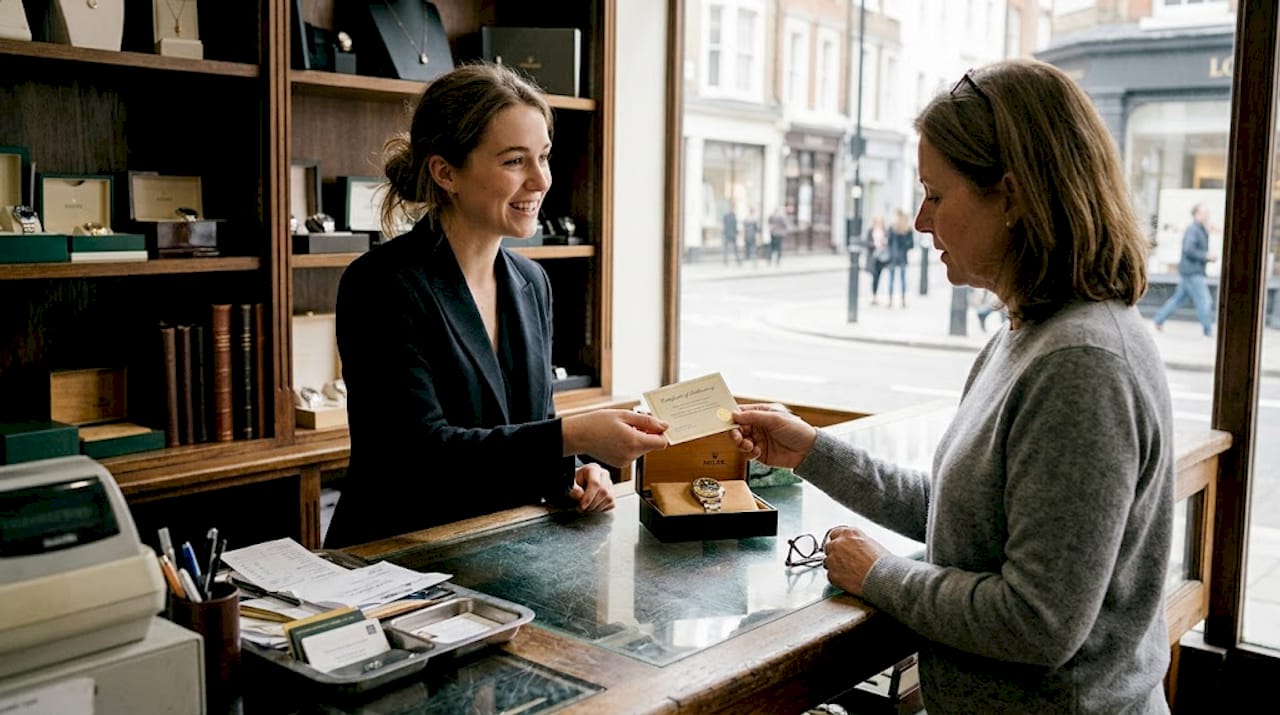
Third-party authentication certificates are issued by independent experts or auction houses such as Christie’s or Phillips. These confirm that a watch appears original and unmodified at the time of inspection. They are valuable but only reflect the watch’s condition on one specific date.
Provenance certificates document ownership history, which is particularly relevant for historically significant pieces. Wristwatch provenance can add enormous value when the ownership chain includes notable individuals or connects a watch to a defining moment in horological history.
Service certificates record when a watch was serviced, which parts were replaced, and by whom. These matter greatly for mechanical condition but say nothing about originality.
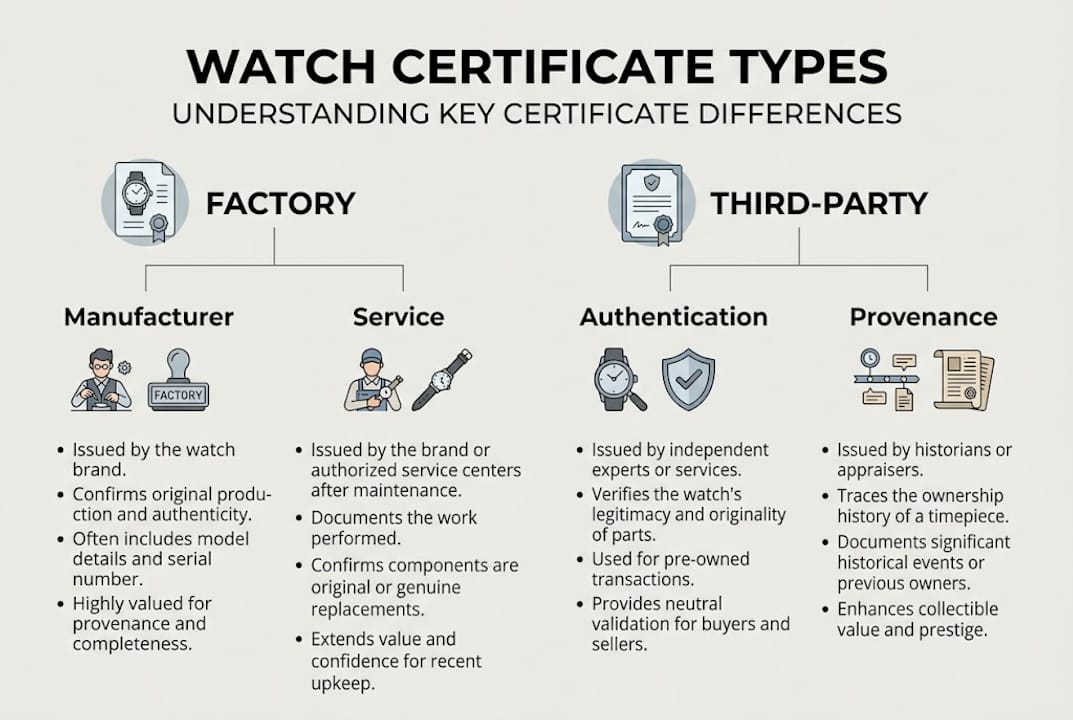
The table below summarises what each type covers:
Certificate type | Confirms origin | Confirms condition | Records ownership | Notes modifications |
Manufacturer | Yes | No | No | Sometimes |
Third-party authentication | Partially | Yes | No | Yes |
Provenance | No | No | Yes | No |
Service | No | Partially | No | Yes |
A critical insight: a watch valuation process that relies on certificates alone is incomplete. Valuers who understand the market combine documents with physical scrutiny and comparable sales data. One document rarely tells the whole story, and the most valuable collections are supported by several types of documentation working together.
Authenticity pitfalls: fakes, forgeries, and Frankenwatches
The uncomfortable reality is that certificates can be faked. The paperwork accompanying a watch can look impeccable and still be entirely fraudulent. Understanding this changes how you should approach every purchase.
Forged certificates are more prevalent than many buyers realise. High-quality printing technology means that a convincing fake document can be produced for very little money. Worse still, Frankenwatches passing authentication is a recognised problem: watches assembled from genuine parts belonging to different eras or references can slip past basic checks because each individual component is technically authentic. They fail only when someone runs a coherence check across all parts simultaneously.
Brands have responded differently to the forgery problem. Patek Philippe does not reissue certificates under any circumstances, which means a missing Patek certificate cannot be replaced and significantly impacts resale value. Zenith will verify and reissue documentation, but the process requires a physical examination costing around CHF 400.
Here are the key warning signs to watch for:
Serial numbers that do not match across the case, movement, and certificate
Font inconsistencies or unusual paper quality compared to authentic examples
Reference numbers that do not correspond to the listed specifications
Suspiciously pristine certificates accompanying heavily worn cases
For identifying counterfeit certificates, cross-referencing the serial number directly with the manufacturer’s records is the most reliable first step.
“A certificate without a coherent physical watch behind it is just expensive paper.”
Pro Tip: Before purchasing any high-value piece, use the watch valuation checklist to verify that all documentation, serial numbers, and physical components align consistently. If anything feels mismatched, trust that instinct.
How to use certificates in buying, selling, and insuring watches
Knowing how certificates function in real transactions is where theory becomes profitable practice. Here is a stepwise approach for collectors and investors:
Request the certificate before negotiations begin. Examine it alongside the watch, not separately.
Cross-reference serial numbers on the certificate with the case back, movement (if visible), and any service records.
Contact the manufacturer’s archive service if you have doubts. Several brands offer extract services that confirm original specifications.
Commission a third-party authentication for pieces above £10,000. The cost is minimal relative to the protection it provides.
Store all documentation together in a dedicated folder or safe. Buyers pay measurably more for complete documentation sets.
For resale, certificates directly affect negotiating power. Certificates affect pricing and trust in watch resale, particularly in retail and auction settings, and a complete set of original papers consistently commands stronger bids and higher final prices.
Insurers also scrutinise documentation carefully. The table below outlines what major insurer categories typically require:
Scenario | Certificate needed | Additional documentation |
New policy for pre-owned watch | Manufacturer or third-party auth | Professional valuation |
Claim following theft | Any certificate plus photos | Purchase receipt |
Annual review | Valuation update | Service records if available |
Pro Tip: Keep your documentation alongside identifying true watch value records from a specialist. Insurers and future buyers respond better to a cohesive documentation package than to a lone certificate without context. When selling, reviewing the secure sales process ensures you present your documentation correctly from the outset.
Why certificates are only half the story in luxury watch collecting
Here is an opinion that might surprise you: certificates, for all their importance, are among the most overrated tools in a collector’s arsenal when used in isolation. We have seen experienced investors, people with decades of collecting behind them, pay well above market for watches because the paperwork was immaculate. The physical watch told a very different story.
A certificate is a historical record. It describes what a watch was at the moment it left the manufacturer. It cannot tell you what has happened since: which parts were swapped, how the movement was modified, or whether the case has been repolished so aggressively that it has lost its original character. That knowledge comes from hands-on scrutiny and, frankly, from knowing the right people.
Building relationships with specialist dealers who handle significant volumes of authenticated pieces gives you something no certificate can: pattern recognition. When you have held fifty examples of the same reference, you notice immediately when one feels wrong, regardless of what its paperwork claims.
The collectors who build the most resilient portfolios treat certificates as a starting point for investigation, not a conclusion. Documentation multiplies in value when paired with physical expertise and trustworthy networks. Without those layers, even the most impressive certificate is simply a piece of paper.
Explore trusted watch services for peace of mind
You now understand the real weight and limitations of a watch certificate. The natural next step is ensuring that every piece you buy, sell, or insure is backed by more than just paperwork.
At Horology Kings, we combine expert physical authentication with thorough documentation review on every transaction. Whether you want to source a specific watch from our trusted network or need professional watch repair and servicing to accompany your service records, our Hertfordshire-based team provides the scrutiny and transparency that serious collectors deserve. We handle Rolex, Patek Philippe, Audemars Piguet, Omega, and Cartier, ensuring your investment is protected at every stage.
Frequently asked questions
Does a watch certificate always mean a watch is genuine?
No. Certificates can be forged or misapplied to mismatched watches, so physical inspection and expert scrutiny remain essential alongside any documentation.
Is a COSC certificate the same as a watch certificate?
No. COSC certifies chronometer accuracy over 15 days to a precision of -4 to +6 seconds per day, while a watch certificate confirms provenance, originality, and factory specifications.
How do certificates influence a watch’s insurance or resale value?
Certificates affect pricing and trust in the resale market, and insurers use them to establish value, but only complete and verifiable certificates carry meaningful weight.
Can lost certificates be replaced?
Policies vary considerably by brand. Patek Philippe does not reissue certificates under any circumstances, while Zenith requires a physical examination costing around CHF 400 before issuing replacement documentation.
Recommended
Comments