.png)
What is a watch investor? Roles, risks and rewards explained
TL;DR:
High-end watches are increasingly viewed as serious alternative investments alongside traditional assets.
Successful watch investing relies on factors like scarcity, provenance, and brand prestige.
Buying from trusted dealers and understanding market cycles are essential for maximizing returns.
Luxury watches are far more than wrist adornments. In the UK, a growing number of financially astute individuals treat high-end timepieces as serious alternative assets, sitting alongside property, equities, and fine art in diversified portfolios. The brands commanding attention, Rolex, Patek Philippe, and Audemars Piguet, have delivered returns that surprised even seasoned fund managers over the past two decades. Whether you are new to the concept or already own a few pieces and want to sharpen your approach, this guide covers who watch investors are, how the UK market operates, which strategies work, and where the real risks hide.
Table of Contents
Key Takeaways
Point | Details |
Profile of a watch investor | A watch investor seeks wealth preservation and growth in tangible assets rather than simple collecting. |
Market mechanics matter | UK tax benefits, provenance authenticity, and scarcity drive long-term investment returns. |
Strategies for success | Allocate a small portfolio percentage, buy well-documented pieces, and plan exits. |
Physical vs. financial | Owning watches and investing in linked markets offer different risk and reward profiles. |
Expert insight | Under-the-radar opportunities often outperform crowded ‘hype’ brands for savvy UK investors. |
Defining the watch investor: profiles, motives and myths
A watch investor is someone who acquires timepieces primarily to preserve wealth, generate growth, or diversify a broader portfolio. That definition sounds simple, but the reality is layered. Most watch investors are not purely financial operators sitting behind spreadsheets. They tend to be high-net-worth individuals, alternative asset enthusiasts, or passionate collectors who have recognised that their hobby carries genuine financial logic.
The typical profiles break down like this:
The passionate collector turned investor: Buys watches for love first, but gradually becomes aware of resale values and starts making more deliberate acquisition decisions.
The portfolio diversifier: A seasoned investor seeking assets with low correlation to equities and bonds, drawn by tangibility and cultural cachet.
The active trader: Focuses on buying undervalued pieces and flipping them for profit, treating the watch market like a specialist commodity exchange.
The long-term wealth preserver: Buys iconic references and holds them for a decade or more, banking on scarcity and brand prestige to do the heavy lifting.
One of the most persistent myths is that watch investing simply means buying expensive pieces. Price alone does not make a watch investable. A £15,000 fashion watch from a lesser brand may depreciate sharply, while a pre-owned Rolex Submariner at a similar price point holds or appreciates. Another myth is that only ultra-rare watches qualify. In practice, well-chosen production models from the right brands perform consistently.
“Buy what you love, but ensure a proven track record. The current market stabilisation post-correction offers genuine entry points for disciplined buyers.”
As GQ Magazine notes, there is an important contrast between physical watches, which are tangible but illiquid, and luxury watch stocks or ETFs, which offer liquid exposure without the tactile pleasure. Understanding the difference between dealers and investors is equally important before committing capital. The collector focuses on the love of horology; the investor focuses on net returns. The best watch investors tend to operate in both camps simultaneously, which is precisely what makes them formidable. Browsing a curated list of investable timepieces is a practical starting point for anyone building their first investment-grade selection.
How the UK watch investment market works
The British watch investment scene has its own mechanics, legal quirks, and hazards that set it apart from other markets.
Value in this market is driven by three core forces:
Scarcity: Limited production runs, discontinued references, and waitlists create genuine supply constraints.
Provenance: Full box and papers, original service records, and documented ownership history add measurable premium.
Iconic design: Cultural recognition, such as the Rolex Daytona’s motorsport heritage or the Patek Philippe Nautilus’s controversial origin story, sustains demand across generations.
As Tip For Investing highlights, focusing on scarcity via limited production models, iconic designs with cultural recognition, and full provenance including box, papers, and service history are the key mechanics that drive long-term value.
Factor | Impact on value | UK relevance |
Scarcity | High | Waitlists at authorised dealers remain long |
Full provenance | Medium to high | Adds 10 to 30% premium at auction |
Brand prestige | High | Rolex, Patek, AP dominate resale |
Condition | High | Unpolished cases command premiums |
CGT status | Significant | Most watches qualify as wasting assets |
On the tax side, watches often qualify as wasting assets under UK law, meaning they are typically exempt from Capital Gains Tax provided their useful life does not exceed 50 years. This is a meaningful structural advantage over other alternative assets such as fine art or classic cars, which do not always enjoy the same treatment.
Counterfeiting is a serious concern. There are over one million fakes circulating in the UK market at any given time. Knowing how to go about spotting fakes in the UK is not optional knowledge for an investor; it is essential. Buying exclusively from trusted luxury dealers is the most reliable safeguard against acquiring a counterfeit that is worthless on resale.
Pro Tip: Always request an independent authentication report when buying outside of an established dealer relationship, particularly at auction or through private sales.
Core strategies for successful watch investing
Knowing which watches to buy is only part of the equation. Executing a coherent strategy separates disciplined investors from enthusiastic amateurs.
Set a realistic allocation. Allocate between 0.5 and 3% of your total investable portfolio to watches as an illiquid alternative asset. Treating them as a core holding is a mistake; they work best as a diversifying satellite position.
Specialise deliberately. Investors who focus on a category, such as pre-owned Rolex sports models or vintage Patek dress watches, build genuine expertise and spot mispriced opportunities faster than generalists.
Buy below recent comparables. Use auction results and dealer data to establish fair value before transacting. Overpaying at peak hype cycles is the single most common error.
Maintain provenance obsessively. Keep all original documentation, avoid unnecessary polishing, and retain service records. These details translate directly into resale premiums.
Service strategically. Luxury watch maintenance keeps a timepiece in peak mechanical condition without compromising originality. Use only manufacturer-approved service centres.
Plan your exit before you buy. Whether you intend to sell via auction, a specialist dealer, or private treaty, understanding fees and timelines in advance protects your margin.
Exit route | Typical fee | Speed | Best for |
Auction house | 15 to 25% buyer’s premium | Weeks to months | Rare, high-value pieces |
Specialist dealer | Negotiable | Days to weeks | Mid-range investable models |
Private sale | Minimal | Variable | Trusted network transactions |
If you want to understand trading for higher returns, active flipping requires tighter margins and deeper market knowledge. For most investors, a hold-and-sell approach over three to seven years is more practical and less stressful. Access to professional repair and servicing ensures your asset remains in optimal condition throughout the holding period.

Pro Tip: Specialising in one brand or era dramatically accelerates your ability to spot value. Generalists rarely outperform specialists in niche markets like this one.
Physical watches vs. watch ETFs and stocks: what really performs?
Direct ownership and indirect financial exposure both have a place in a sophisticated investor’s toolkit, but they serve very different purposes.
Physical watches offer:
Tangibility and personal enjoyment during the holding period
Potential CGT exemption under UK wasting asset rules
Genuine scarcity-driven appreciation for the right references
No counterparty risk
Watch-related stocks and ETFs offer:
Liquidity you can access within a trading day
Lower transaction costs and no storage or insurance burden
Exposure to brand revenue growth rather than secondary market dynamics
Ease of portfolio rebalancing
The trade-offs are real. Physical watches carry high carrying costs: insurance, secure storage, and servicing add up. They are also illiquid, meaning you cannot exit quickly without accepting a discount. Research published on SSRN presents contrasting views: watches from the Big Three brands act as a strong long-term store of value, but they are sensitive to market cycles and can sit as dead assets with high carrying costs during downturns. Over the long run, watches tend to outperform bonds and real estate but lag behind equities in pure return terms.
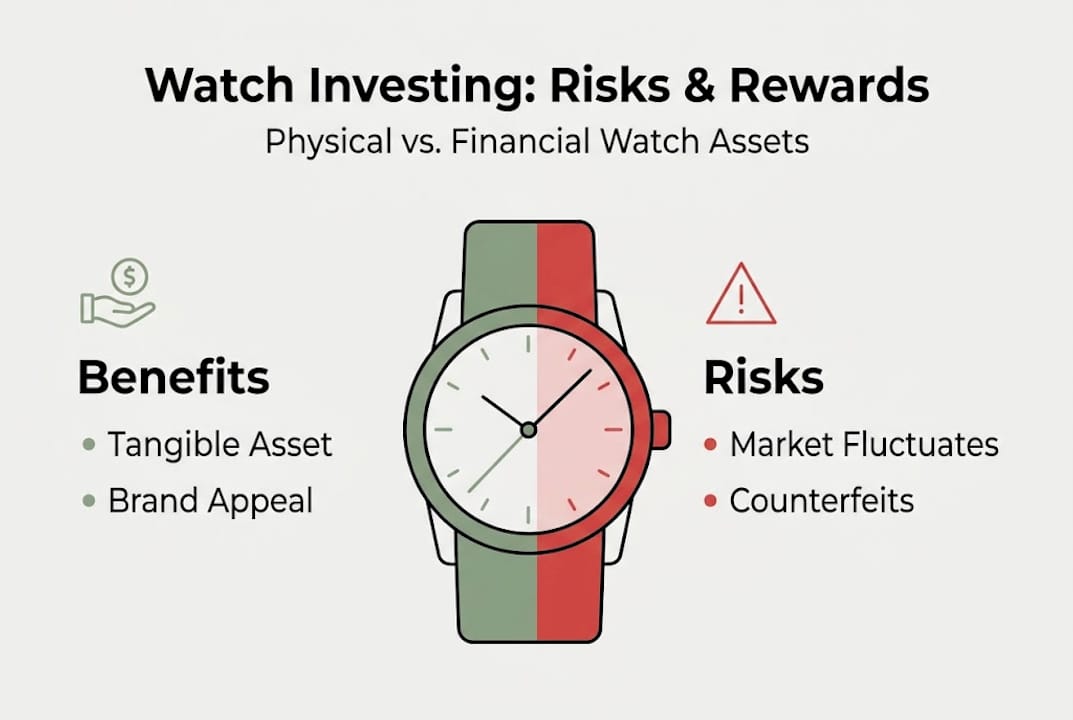
The practical answer for most UK investors is a blended approach. Use physical watches for the portion of your portfolio where you want tangibility, cultural engagement, and CGT efficiency. Use watch-related equities or luxury goods ETFs for the portion where you need liquidity and lower friction. Reviewing the best physical timepieces available right now helps you identify where direct ownership makes the most financial sense.
A key insight: A Rolex Daytona in steel held for ten years has historically outperformed most bond portfolios. But a poorly chosen fashion piece from a second-tier brand held for the same period can lose 40% of its value. Selection is everything.
A contrarian view: why the best watch investments are rarely obvious
Here is something most watch investment guides will not tell you: chasing the hottest references almost always backfires. When a particular model dominates headlines and social media, the premium is already baked into the price. You are not investing at that point; you are speculating on continued momentum.
At Horology Kings, we have seen this pattern repeat across market cycles. The investors who genuinely outperform are the ones who act counter-cyclically, buying quality during periods of market correction when sentiment is low and prices have pulled back. The post-2022 correction in the secondary watch market was a textbook example. Prices on certain Rolex and Patek references dropped 20 to 30% from peak levels, creating entry points that patient, informed buyers capitalised on.
Personal connection to a watch also matters more than most financial frameworks acknowledge. If you genuinely enjoy wearing and studying a piece, you are far less likely to make a panic sale during a temporary dip. That emotional resilience is a genuine edge in an illiquid market where timing an exit poorly can cost you significantly. Focusing on investment-worthy watches that you would be proud to own regardless of market conditions is, counterintuitively, one of the soundest financial strategies available.
Next steps: how Horology Kings supports UK watch investors
Ready to level up your own journey as a watch investor? Take the next step with help from experienced market specialists.
Horology Kings is a Hertfordshire-based specialist with deep expertise in the UK luxury watch market. Whether you are looking to source rare watches that are difficult to find through conventional channels, need professional watch servicing to protect your asset’s condition and value, or simply want guidance on building a credible investment-grade collection, we are here to help.

Our team handles every transaction with transparency, discretion, and secure UK bank transfers. We work with both first-time buyers and seasoned collectors, offering bespoke sourcing, expert valuations, and honest market insight. Get in touch today to discuss your investment goals and discover how we can help you build a watch portfolio with genuine long-term potential.
Frequently asked questions
Is watch investing profitable in 2026?
Watch investing can outperform bonds and real estate over the long term, but results depend heavily on brand selection, timing, and market cycles, as research indicates the asset class lags equities in pure return terms.
Do UK watch investors pay Capital Gains Tax on sales?
Most valuable watches qualify as wasting assets under UK tax law and are typically exempt from Capital Gains Tax, making them structurally advantageous compared to many other alternative investments.
How can I reduce the risk of buying a fake luxury watch?
Always purchase from reputable dealers, verify full provenance including box and papers, and use independent authentication services, particularly given that over one million fakes circulate in the UK market.
What are the most investable watch brands in the UK?
Rolex, Patek Philippe, and Audemars Piguet consistently lead on resale demand, driven by scarcity and iconic design that sustains collector interest across economic cycles.
Recommended
Comments