.png)
What is a watch selling fee? Your 2026 guide
TL;DR:
Watch selling fees are charges deducted from the final sale price by platforms, brokers, or auction houses. These fees, including additional costs like shipping and authentication, significantly impact net proceeds. Carefully calculating total costs and matching the watch to the appropriate channel maximize net returns.
A watch selling fee is a commission or charge levied by a marketplace, broker, or auction house on the sale price of your watch. The industry term for this is a “seller’s commission,” and it directly determines how much money you actually receive after a sale. Understanding the full cost of selling luxury watches, whether a Rolex Submariner or a Patek Philippe Nautilus, is the difference between a satisfying transaction and a disappointing one. Horology-kings works with sellers every week who are surprised by how much fees can erode their net proceeds. This guide breaks down every fee type you are likely to encounter.
What is a watch selling fee and how does it work?
A watch selling fee, or seller’s commission, is the percentage of your watch’s sale price that a platform or intermediary retains as payment for facilitating the transaction. The fee is almost always calculated on the final sale price, not your asking price. That distinction matters because a negotiated sale at a lower price still generates a fee, reducing your net return further.

Fee structures vary significantly across selling channels. Online marketplaces use tiered percentage models. Auction houses charge seller commissions plus additional production costs. Brokers and specialist dealers typically work on a fixed commission or a net price model, where they quote you a guaranteed amount and retain the margin above it. Knowing which model applies to your chosen channel is the first step in calculating your real return.
The practical impact is substantial. A seller expecting £10,000 for a pre-owned Omega Seamaster who faces a 15% commission walks away with £8,500 before any additional costs. Factor in shipping, insurance, and authentication, and the net figure drops further. Sellers who calculate fees before listing, not after, protect their returns.
How are watch selling fees structured on major online platforms?
Online marketplaces use tiered fee structures that reward higher-value sales with lower effective rates. eBay’s fee model for watches charges 15% on the first £1,000, 6.5% on amounts between £1,000 and £7,500, and 3% on any amount above £7,500, plus a small fixed fee per transaction. That tiered approach means the effective rate falls as the sale price rises.
The savings on high-value watches are meaningful. A watch selling for £10,000 on eBay incurs approximately £647.50 in fees under the tiered model, compared to roughly £1,359 under a flat rate. That difference of over £700 is significant for any serious seller. You can use an eBay fee calculator to model your specific sale price before committing to a listing.
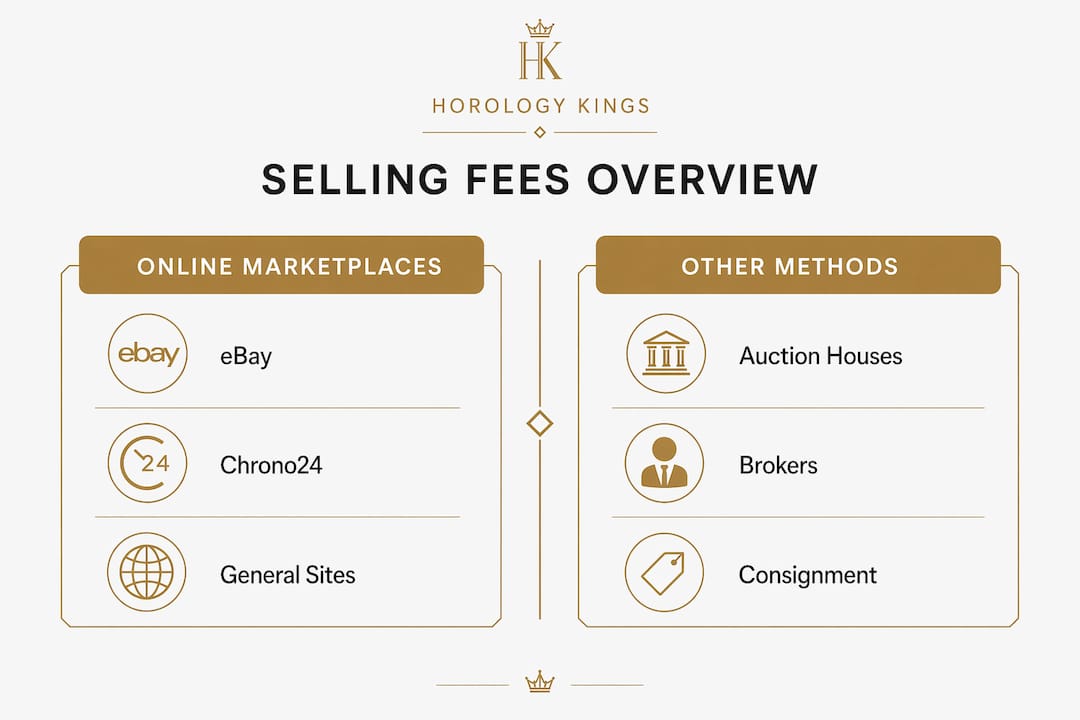
Specialist watch platforms operate differently. Chrono24, for example, charges sellers approximately 6.5% as a transaction fee, with buyers paying a separate 2.5% protection fee. The combined platform cost sits at around 9%, which is lower than many general marketplace rates for mid-range watches. The trade-off is that specialist platforms attract a more targeted audience, which can support stronger sale prices for recognised references.
Fee elements beyond the headline commission
Listing fees are charged by some platforms before a sale completes. Promotional or featured listing upgrades cost extra and are often presented as optional, but sellers on competitive platforms frequently find them necessary to generate visibility. Fixed per-transaction fees are added on top of percentage commissions on most major marketplaces. Subscription or store status can reduce per-listing costs on platforms like eBay, but only if your volume justifies the monthly outlay.
Selling channel | Typical seller commission | Key additional costs |
General online marketplace | 6.5%–15% tiered | Listing fees, fixed transaction fee |
Specialist watch platform | ~6.5% | Buyer protection fee (paid by buyer) |
Auction house | 10%–15% seller commission | Photography, insurance, catalogue production |
Consignment dealer | 10%–20% | Possible minimum net or storage fees |
Private broker | Negotiable margin | Minimal, often included in net price |
What additional costs may sellers face when selling luxury watches?
The headline commission is rarely the only cost. Additional costs for sellers include shipping, insurance, authentication, servicing, and potential listing or promotional fees. Each of these can reduce your net proceeds in ways that are easy to overlook when you focus only on the commission rate.
Shipping a luxury watch requires tracked, insured courier services. Specialist watch couriers charge a premium, and the cost rises with the declared value of the piece. Authentication services, where a third party verifies the watch’s provenance and condition, add further cost but are increasingly expected by buyers on peer-to-peer platforms. A service or polish before sale can improve the final price, but the cost must be weighed against the likely uplift.
Shipping and insurance: Specialist insured courier services for watches valued above £5,000 carry meaningful premiums. Always declare the full value.
Authentication: Third-party authentication services charge per watch and are often required on peer-to-peer platforms to attract serious buyers.
Servicing and presentation: A full service from an authorised watchmaker can cost several hundred pounds. Only commission one if the expected price increase justifies it.
Promotional fees: Featured listings, priority placement, and advertising upgrades are optional but frequently necessary on crowded platforms.
Dispute handling: Buyer protection schemes on major platforms can result in forced refunds or dispute costs if a buyer raises a claim, even an unfounded one.
Pro Tip: Read the full terms and conditions of any platform before listing. Hidden fees, such as reserve price penalties at auction or dispute resolution charges, are buried in the small print and can materially affect your net return.
How do selling fees vary across different selling methods?
The selling method you choose determines not just the fee rate but also the speed of sale, the risk you carry, and the effort required. Peer-to-peer platforms incur lower fees but shift logistical and risk burdens entirely to the seller. Lower commission does not always mean a better outcome.
Auction houses suit rare, collectible references where competitive bidding can drive prices above market value. However, auction seller commissions typically range from 10%–15%, with additional charges for photography, insurance, and catalogue production. Buyer premiums of 25%–30% are paid by the buyer, but they affect the final hammer price a buyer is willing to bid. Auctions also carry the risk of a watch failing to sell if the reserve price is not met, and some houses charge a fee even in that scenario. You can read more about auction costs for collectors to understand when this route makes sense.
Brokers and specialist dealers offer a different model. They quote a net price, retain their margin, and handle the entire transaction. The seller’s commission is embedded in the spread rather than charged explicitly. This model suits sellers who prioritise speed and certainty over maximising the gross sale price. For context on when a broker is the right choice, the broker selling guide for UK collectors covers the key considerations.
Consignment arrangements typically charge commissions between 10%–20%. The watch remains with the consignee until sold, which means the seller waits for payment and carries the risk of the watch sitting unsold for months. Storage fees may apply on extended consignments.
How can sellers minimise watch selling fees and maximise net proceeds?
The most effective way to protect your net return is to calculate the full cost of selling before you set your asking price. Factoring in fees of 6.5%–15% plus shipping, insurance, and authentication prevents underpricing. Sellers who work backwards from their target net figure, adding all costs to arrive at the listing price, avoid the most common mistake in watch resale.
Choosing the right channel for your specific watch is equally important. A Rolex Daytona in full set condition will attract strong demand on specialist platforms and through private brokers. A less recognised reference may perform better at auction where competitive bidding can surprise on the upside. Matching the watch to the channel reduces the risk of a slow sale or a forced price reduction.
Calculate net proceeds first: Add all fees, shipping, and authentication costs to your target net figure to set your listing price.
Match the watch to the channel: High-demand references sell well through brokers and specialist platforms. Rare or collectible pieces may justify auction costs.
Negotiate with brokers: Broker commissions are often negotiable, particularly for high-value watches. Ask for a net price guarantee before agreeing to terms.
Limit dealer exposure: Offering a watch to multiple dealers simultaneously damages your reputation in private networks and reduces offers. Approach one dealer at a time.
Read the terms before listing: Reserve price penalties, dispute fees, and promotional charges are rarely highlighted upfront.
Pro Tip: For watches valued above £15,000, a specialist broker or dealer will almost always deliver a better net return than a general online marketplace, even accounting for the broker’s margin. The audience quality and transaction security justify the cost.
For further guidance on negotiating your sale, Horology-kings has published a practical guide for UK collectors covering pricing strategy and fee management.
Key takeaways
Watch selling fees range from approximately 6.5% on specialist platforms to over 20% at auction when all additional costs are included. Sellers who calculate total costs before listing, and match their watch to the right channel, consistently achieve better net returns.
Point | Details |
Seller’s commission defined | A watch selling fee is the percentage of the sale price retained by the platform, broker, or auction house. |
Tiered rates favour high values | Marketplace fees drop significantly above £7,500, making tiered platforms more cost-effective for premium watches. |
Additional costs add up | Shipping, insurance, authentication, and promotional fees can add several percentage points beyond the headline commission. |
Channel choice drives net return | Brokers suit speed and certainty; auctions suit rare pieces; peer-to-peer suits sellers willing to manage logistics. |
Calculate before you list | Work backwards from your target net figure, adding all fees, to set a realistic asking price. |
Fees, trust, and the real cost of selling a watch
The watch market in 2026 has more selling channels than ever, but the proliferation of options has not made the fee picture simpler. What I see consistently is sellers fixating on the headline commission rate and ignoring the full cost stack. A platform charging 6.5% with mandatory authentication, insured shipping, and a promotional listing fee can easily cost more than a broker charging 12% with everything included.
The other pattern I notice is sellers overestimating what a general marketplace will deliver for a genuinely rare piece. A Patek Philippe ref. 5711 or an Audemars Piguet Royal Oak in excellent condition deserves an audience of serious collectors, not a general marketplace where buyers are comparing it to replicas and grey market listings. The fee you pay to access the right audience is almost always worth it.
My honest advice is to treat the fee conversation as a proxy for the quality of the transaction. A channel that is transparent about every cost, guarantees a net figure, and handles the logistics is worth more than a low headline rate with hidden charges and seller-borne risk. Disciplined planning before you list, not regret after the sale completes, is what separates experienced sellers from first-timers.
— Lewis
Selling your watch with Horology-kings
Horology-kings is a specialist luxury watch dealer based in Hertfordshire, offering a transparent, straightforward selling process for owners of Rolex, Patek Philippe, Audemars Piguet, Omega, Cartier, and other high-end timepieces.

When you sell your watch through Horology-kings, you receive a clear, expert valuation with no hidden charges. Payment is made by secure UK bank transfer, and the entire process is handled with discretion. There are no listing fees, no promotional charges, and no dispute risks. If you are ready to understand exactly what your watch is worth and what you will receive, contact Horology-kings for a no-obligation valuation today.
FAQ
What is a watch selling fee?
A watch selling fee, or seller’s commission, is the percentage of the final sale price retained by a marketplace, broker, or auction house for facilitating the transaction. It directly reduces the net amount the seller receives.
How much does it cost to sell a watch online?
Online marketplace fees for watches typically range from 6.5% to 15% of the sale price, with additional costs for shipping, insurance, and authentication. Specialist watch platforms such as Chrono24 charge approximately 6.5% to sellers.
Are watch selling fees negotiable?
Broker and dealer commissions are often negotiable, particularly for high-value watches. Marketplace fees on platforms like eBay are fixed by the platform’s fee schedule and cannot be individually negotiated.
What is a buyer’s premium and does it affect me as a seller?
A buyer’s premium is an additional charge paid by the buyer on top of the hammer price at auction, typically 25%–30%. It affects sellers indirectly because it limits how high buyers are willing to bid, which can suppress the final hammer price.
How do I calculate my net proceeds after selling fees?
Add all applicable fees, including the seller’s commission, shipping, insurance, and authentication costs, then subtract the total from your expected sale price. Working backwards from your target net figure gives you the minimum listing price you should accept.
Recommended
Comments