.png)
Chronometer certification explained: the collector's guide
TL;DR:
A chronometer certification confirms that a watch movement meets strict precision standards tested independently over 15 days. Only about 3% of Swiss watches are certified, indicating a high level of manufacturing quality. Certification verifies the movement was tested when new but does not guarantee long-term accuracy without proper maintenance.
A chronometer certification is the official confirmation that a watch movement meets exacting standards of precision and accuracy, tested independently against the ISO 3159 standard. The Contrôle Officiel Suisse des Chronomètres, known universally as COSC, is the primary body that issues this designation in Switzerland. Earning it is not a formality. A movement must survive a gruelling 15-day testing programme across multiple positions and temperatures before it qualifies. For collectors and enthusiasts, understanding what is a chronometer certification separates marketing language from genuine manufacturing achievement.
What does the chronometer certification process involve?
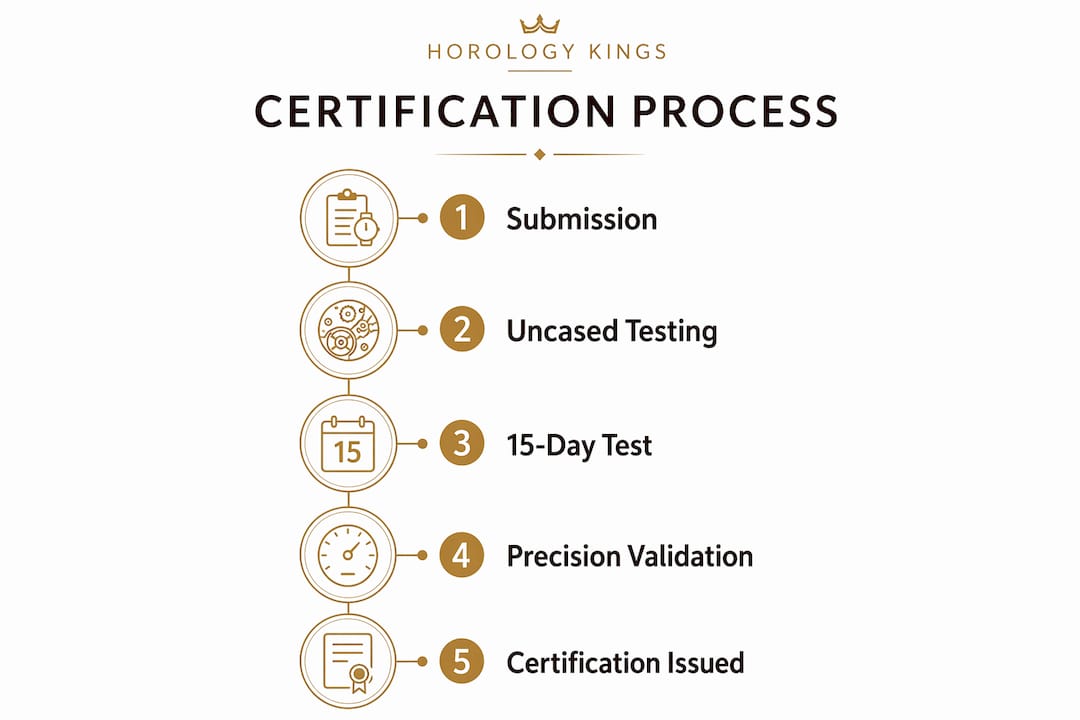
The COSC testing process is one of the most demanding quality checks in Swiss watchmaking. The movement, not the finished watch, is the subject of the test. It must perform within strict tolerances across a range of real-world conditions before a certificate is issued.
The 15-day testing process works as follows:
Five positions tested. The movement is placed in five different orientations: crown up, crown down, crown left, crown right, and dial up. Each position mimics how a watch sits on the wrist or rests on a surface during daily life.
Three temperature ranges. Testing occurs at 8°C, 23°C, and 38°C. Temperature affects the viscosity of lubricating oils and the elasticity of the balance spring, so this range captures realistic extremes from a cold morning to a warm room.
Accuracy tolerance applied. The movement must maintain an average daily rate of between -4 and +6 seconds. That asymmetric window exists because mechanical movements tend to run slightly fast rather than slow.
Multiple criteria measured. Examiners record the mean daily rate, the mean variation in rates, the greatest variation in rates, the difference between rates in two positions, the greatest variation due to temperature, and the rate variation after a positional change.
Independent verification. COSC operates independently of the watch brands it certifies. That independence is what gives the designation credibility.
The movement is tested uncased throughout. This matters because casing a movement can alter its performance. A movement that passes COSC testing may behave slightly differently once it is enclosed in a case, fitted with a dial, and worn on a wrist.
Pro Tip: If you are buying a pre-owned certified watch, ask the seller whether the movement has been serviced since purchase. A watch that passed COSC testing at manufacture may drift outside tolerance after years without servicing.

Quartz movements face a different standard. COSC certifies quartz calibres to a tolerance of 0.07 seconds per day, a far tighter window than the mechanical standard. That figure reflects the inherent accuracy advantage of quartz oscillation over a mechanical balance wheel.
How exclusive is chronometer certification in Swiss watchmaking?
Certification is genuinely rare. Over 1 million certificates are issued annually, yet that figure represents only about 3% of total Swiss watch production. Roughly 1 in 5 mechanical Swiss watches achieves this status. That context matters enormously when a brand uses the word “chronometer” on a dial.
The exclusivity of certification tells you something about a brand’s priorities:
Submitting movements for independent testing costs time and money.
Brands that certify consistently have built quality control systems capable of producing movements that pass at scale.
A brand that certifies a high proportion of its mechanical output is making a public commitment to precision that can be independently verified.
Non-certified watches from respected manufacturers can still be accurate, but their performance is not independently confirmed.
COSC certification is increasingly viewed as a statement of manufacturing seriousness, representing a flawless quality system in movement development and production. That framing is useful for collectors. Certification does not simply mean the movement is accurate. It means the brand has invested in a quality system capable of producing accuracy at a consistent level, then submitted that system to external scrutiny.
The contrast with non-certified watches is worth understanding clearly. A well-regulated non-certified movement from a respected manufacturer may keep time within two seconds per day in normal use. That outperforms the COSC tolerance. But the key difference is verification. The certified movement has been independently tested. The non-certified one has not, regardless of how accurate it may be in practice.
What are the common misconceptions about chronometer certification?
Several misunderstandings circulate about what certification does and does not mean. Clearing them up helps collectors make better decisions.
Certification applies to the movement, not the finished watch. COSC tests uncased movements. Other certification bodies, such as METAS, test assembled watches and apply stricter standards including resistance to magnetic fields of 15,000 Gauss. These are different designations with different scopes.
Certification is not a permanent performance guarantee. It is a snapshot of performance at the time of testing. Mechanical watches need regular servicing to maintain accuracy, and a vintage piece may no longer meet its original certification standard without a full service.
The term “chronometer” is legally protected in Switzerland. Only movements tested to ISO 3159 may carry the designation “Chronometer Officially Certified.” Misuse of the term can lead to legal action. That protection gives the word genuine weight on a dial.
A physical certificate is not always provided. The official COSC certificate is optional to include with the watch. Its absence does not mean the watch is uncertified. You can verify certification status through dial markings or by contacting the manufacturer directly.
A chronometer is not a chronograph. A chronograph is a watch with a stopwatch complication. A chronometer is a watch whose movement has passed precision testing. A watch can be both, neither, or one without the other.
Pro Tip: When authenticating a pre-owned watch, check the dial for the words “Officially Certified Chronometer” or “Superlative Chronometer.” These phrases indicate certification, though the specific standard behind them may differ by brand. For a thorough verification process, the complete authentication guide from Horology-kings covers every step in detail.
A non-certified watch can outperform a certified chronometer in daily wear. COSC protocols are benchmarks, not ultimate guarantees of real-world precision. That nuance is worth holding onto. Certification confirms a standard was met under controlled conditions. It does not promise the watch will perform identically on your wrist for the next decade without attention.
Why does chronometer certification matter to collectors?
For collectors, certification carries weight on several levels. The most direct is assurance. When you buy a certified watch, you know its movement was independently tested and met a defined standard at the point of manufacture. That is a meaningful baseline, particularly when buying pre-owned.
The impact on resale value is real. Certified movements are associated with higher manufacturing standards, and that association supports price. For a deeper look at how documentation affects value, the role of certificates in resale is worth reading before you buy or sell. Collectors who understand this connection make sharper decisions at auction and in private sales.
Certification also distinguishes luxury timepieces from mass-market watches in a way that is difficult to fake. The legal protection of the “chronometer” term in Switzerland means a dial carrying that word has been through a verifiable process. That is not true of marketing language like “high precision” or “superior accuracy,” which carry no independent verification.
How to verify certification status when buying:
Check the dial for “Chronometer Officially Certified” or equivalent wording.
Look for a COSC serial number on the movement, visible during servicing.
Contact the manufacturer with the watch’s serial number for confirmation.
Request service records that reference the movement’s certified calibre.
Certification as a quality indicator reflects a brand’s commitment to precision at the manufacturing stage. That commitment does not expire, but it does require maintenance to remain meaningful in practice. A certified movement that has never been serviced after 20 years of wear is not performing to its original standard, regardless of what the dial says.
For collectors interested in the broader context of Swiss precision, the collector’s guide to Swiss chronometry provides useful background on how chronometry developed as a discipline and why it remains central to luxury watchmaking today.
Key takeaways
Chronometer certification is an independently verified precision standard, not a marketing claim, and its value to collectors depends on understanding exactly what it confirms and what it does not.
Point | Details |
What certification confirms | A movement passed 15-day COSC testing across five positions and three temperatures at manufacture. |
Rarity in production | Only about 3% of Swiss watches are certified, making the designation genuinely selective. |
Certification scope | COSC tests uncased movements only; assembled watch standards like METAS apply different criteria. |
Not a permanent guarantee | Regular servicing is required to maintain the accuracy that earned certification originally. |
Verification without a certificate | Dial markings and a manufacturer query confirm certification status when no physical certificate exists. |
The certification tells you something, but not everything
Collectors sometimes treat chronometer certification as the final word on a watch’s quality. I understand why. It is one of the few independently verified claims in an industry full of superlatives. But after years of handling certified and non-certified pieces, I have come to see it differently.
Certification tells you a brand cared enough to submit its movements to independent scrutiny at the time of production. That matters. It reflects a quality system, not just a lucky movement. But it does not tell you how the watch has been treated since leaving the factory, whether the lubricants are still viable, or whether the movement has been opened by someone who should not have touched it.
The watches I find most impressive are those where certification is one part of a broader story of care. A certified movement that has been serviced on schedule, kept away from strong magnets, and stored properly is a genuinely reliable instrument. A certified movement that has been neglected for fifteen years is not. The certification is the starting point, not the conclusion.
My advice to collectors is this: use certification as a filter, not a verdict. It narrows the field to watches whose manufacturers took precision seriously. From there, look at service history, condition, and provenance. A certified watch with a clean service record from a reputable specialist is worth considerably more than a certified watch with no history at all.
— Lewis
Certified chronometers at Horology-kings
Horology-kings specialises in sourcing, buying, and selling certified luxury watches from brands including Rolex, Patek Philippe, Audemars Piguet, Omega, and Cartier. Every watch handled by the team is assessed for authenticity and condition, with certification status verified as part of the process. Collectors looking for a specific certified model can use the watch sourcing service to find rare or sought-after pieces through an expert network. For watches already in your collection, the servicing team maintains certified movements to the standards they were built to meet. Browse the full selection at Horology-kings and buy with confidence.
FAQ
What is a chronometer certification in simple terms?
A chronometer certification is an official confirmation that a watch movement has passed independent precision testing to the ISO 3159 standard, typically conducted by COSC over 15 days. It confirms the movement keeps time within a daily rate of -4 to +6 seconds.
Does every luxury watch come with chronometer certification?
No. Only about 3% of Swiss watches carry chronometer certification, meaning the majority of luxury watches, including many highly regarded models, are not certified.
Is a chronometer more accurate than a regular watch?
A certified chronometer has been independently verified to meet a defined accuracy standard. A non-certified watch may be equally accurate in practice, but its performance has not been confirmed by an independent body.
What is the difference between a chronometer and a chronograph?
A chronometer is a watch whose movement has passed precision certification testing. A chronograph is a watch with a built-in stopwatch function. The two terms describe entirely different features and are frequently confused.
How can I check if my watch is chronometer certified?
Look for “Chronometer Officially Certified” or similar wording on the dial, or contact the manufacturer with the serial number. The official COSC certificate is optional and its absence does not mean the watch is uncertified.
Recommended
Comments