.png)

What is resale value for luxury watches?
- lewisvrichards3
- Jul 4
- 8 min read

TL;DR:
Resale value is the current sale price an item can fetch, based on its condition and market demand.
It differs from asking or retail prices and relies on real completed transactions across multiple channels.
Resale value is the current market-clearing price at which an item can realistically be sold given its condition and the channel through which it is sold. For luxury watch buyers and sellers, understanding resale value is the difference between a profitable transaction and a costly mistake. It is not the asking price, not the original retail price, and not what a dealer has listed in a showroom window. It is what a willing buyer will actually pay today.
What factors affect the resale value of luxury watches?
Condition is the single most direct factor in any resale valuation. Research shows that like-new items retain roughly 50% of their original retail price, gently used items retain around 30%, and well-worn pieces retain approximately 10%. For a Rolex Submariner with an original retail price of £10,000, that gap between like-new and well-worn is the difference between £5,000 and £1,000.

Market demand and production volume shape value just as powerfully as condition. Scarcity and sustained collector interest drive prices well above retail for certain references. A Patek Philippe Nautilus or an Audemars Piguet Royal Oak in steel commands premiums precisely because production volumes are deliberately limited and demand from collectors remains strong year after year.
Brand reputation and model desirability create a two-tier market within luxury watches. Rolex, Patek Philippe, Audemars Piguet, Omega, and Cartier all hold value better than lesser-known Swiss brands, but even within those houses, specific references outperform others. The Rolex Daytona in steel, for example, consistently trades above its retail price on the secondary market.
Several additional factors influence the final figure:
Timing. New model releases can depress the value of outgoing references. Buying just before a major product update is a common and avoidable mistake.
Transaction friction. Platform fees around 13.25% reduce net proceeds significantly. A watch sold for £8,000 through a fee-charging marketplace may net the seller closer to £6,940 after costs.
Provenance and documentation. Original box, papers, and service history all support a higher achievable price. Missing paperwork narrows the pool of buyers willing to pay full market value.
Authentication status. A watch that has been independently verified commands more confidence and, therefore, a higher price.
Pro Tip: Always calculate your net resale value after fees, not the gross sale price. The number that matters is what lands in your account.
How is resale value determined for luxury watches?
The most reliable method for determining resale value is to study completed, sold transactions rather than active listings. Analysing sold data from the past 30–90 days and using median pricing filters out outliers and gives the most accurate picture of what buyers are actually paying. An active listing tells you what a seller hopes to achieve. A completed sale tells you what the market decided.
Cross-referencing multiple sources is equally important. Resale values vary by 30–100% depending on the sales channel. A watch sold at auction may achieve a very different price from the same reference sold privately or through a specialist dealer. Accurate valuation requires comparing 3–5 comparable sold transactions across different channels before settling on a figure.
The practical steps for determining resale value are:
Identify the exact reference. Model name, reference number, dial colour, bracelet type, and year of production all affect price. A Rolex Submariner 116610LN is not the same as a 126610LN.
Gather sold transaction data. Use completed sales from auction records, specialist dealer sold listings, and reputable online marketplaces. Focus on the past 30–90 days.
Calculate the median price. Ignore the highest and lowest outliers. The median of 3–5 comparable sales is your baseline.
Adjust for condition. Apply a condition premium or discount relative to the comparable sales you found.
Account for provenance. Add value for original box and papers, subtract for missing documentation or unverified service history.
Deduct transaction costs. Subtract fees, authentication costs, and any preparation expenses to arrive at your net resale value.
Resale value and residual value are not the same thing. Resale value is the current achievable price, while residual value is a forecasted, hypothetical figure used in leasing and finance agreements. Residual value is an estimate of what something might be worth at a future date. Resale value is what it is worth right now. Confusing the two leads to mispriced watches and failed sales.
Professional appraisals from specialist dealers offer the most reliable single-source valuations, particularly for rare or unusual pieces. For more guidance on the appraisal process, Horology-kings publishes a detailed watch valuation guide covering comparable sales methodology and market trends for luxury collectors.
Pro Tip: For rare references with few recent comparable sales, consult a specialist dealer directly. Thin data means wider price ranges, and a professional eye is worth more than an algorithm in those cases.
What are the common misconceptions about resale value?
The most damaging misconception is treating asking price as resale value. A dealer listing a pre-owned Omega Speedmaster at £4,500 does not mean that watch is worth £4,500 to a private seller. Dealer prices include markups of 30–100% to cover authentication, servicing, warranties, and business overheads. A private seller will rarely achieve the same figure.
Several other misconceptions regularly mislead sellers:
Emotional value is not market value. The price you paid, the memories attached to a watch, or the sentimental significance to your family do not influence what a buyer will offer.
Original retail price is not a floor. Most watches depreciate from the moment they leave the authorised dealer. The exceptions, such as certain Rolex and Patek Philippe references, are notable precisely because they are rare.
Residual value forecasts are not current prices. A finance agreement that projected your watch would be worth £6,000 in three years is not a valuation. It is a contractual estimate, and the real market may disagree significantly.
Mass-market depreciation models do not apply to luxury watches. The standard assumption that used goods lose value steadily over time does not hold for limited-production Swiss watches with active collector communities.
The luxury watch market operates on its own logic. Scarcity, brand prestige, and collector demand can push secondary market prices above retail for the right reference, while an obscure model from the same house may struggle to find a buyer at any price. Treating all watches as interchangeable commodities is the fastest route to undervaluing what you own.
Which channels and marketplaces influence the resale value of luxury watches?
The channel through which you sell a watch directly affects the price you achieve. Each option involves a different trade-off between reach, fees, speed, and buyer trust.
Auction houses. Major auction houses attract serious collectors and can achieve record prices for rare or historically significant pieces. They also charge seller’s commissions that reduce net proceeds, and results are unpredictable.
Specialist dealers. Dealers like Horology-kings offer fixed, transparent pricing and handle authentication, payment security, and logistics. The process is faster and lower-risk than auction, and Horology-kings pays via secure UK bank transfer.
Online marketplaces. General and watch-specific online platforms offer wide reach but require sellers to manage authentication, photography, and buyer communication independently. Fees vary, and fraud risk is higher without a trusted intermediary.
Private sales. Selling directly to a known buyer avoids fees entirely but requires both parties to manage authentication and payment security themselves.
Channel | Typical seller fee | Authentication included | Speed |
Auction house | 10–15% | Yes | Weeks to months |
Specialist dealer | None (direct purchase) | Yes | Days |
Online marketplace | ~13% | No | Variable |
Private sale | None | No | Variable |
Geographical demand also matters. Certain references command higher prices in specific markets. Japanese collectors, for example, have historically paid premiums for condition and originality that exceed European market norms. Seasonal patterns exist too, with gift-giving periods in november and december often lifting demand for well-known references.
For a broader view of where to sell your watch online in the UK, Horology-kings covers the security and financial advantages of each approach. Collectors looking at alternative platforms may also find value in reviewing luxury watch marketplace options beyond the most familiar names.
Key takeaways
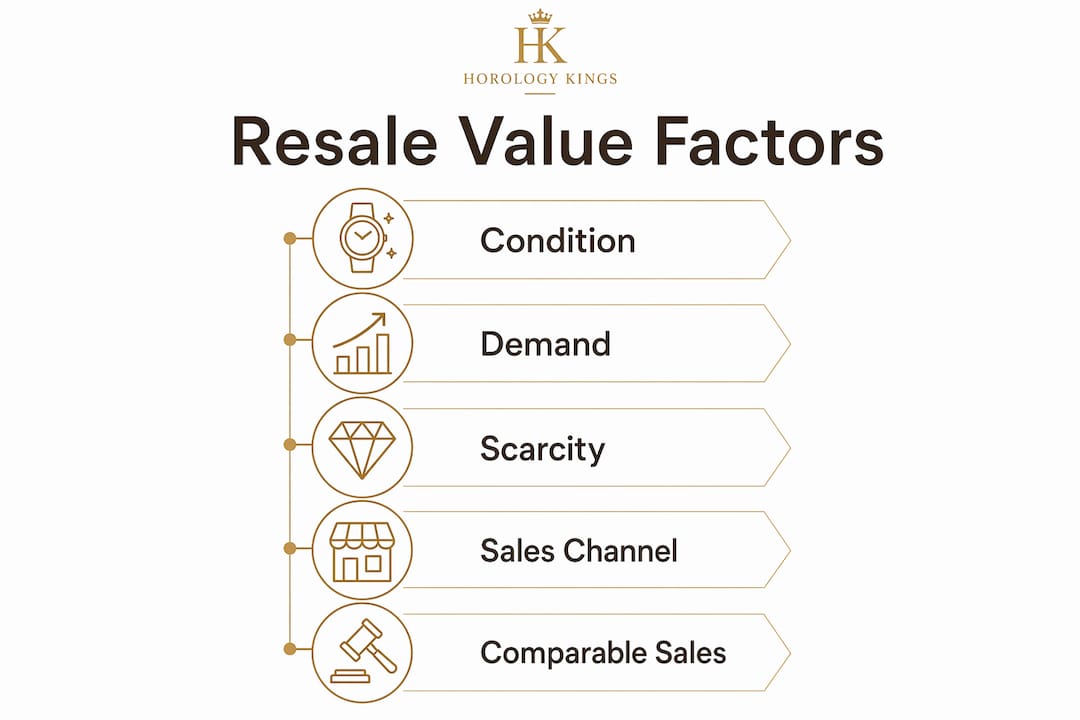
Resale value is the actual price a buyer will pay today, determined by condition, demand, channel, and comparable sold transactions, not by asking prices or original retail figures.
Point | Details |
Definition of resale value | Resale value is the realistic transaction price achievable now, not the asking or retail price. |
Condition drives valuation | Like-new pieces retain roughly 50% of retail; well-worn pieces retain around 10%. |
Use sold data, not listings | Base valuations on median sold prices from the past 30–90 days across multiple channels. |
Channel choice affects net proceeds | Fees, authentication costs, and platform charges reduce what the seller actually receives. |
Resale value differs from residual value | Residual value is a forecasted figure used in finance; resale value is what the market pays today. |
Why I think most sellers leave money on the table
The single biggest mistake I see from sellers is anchoring their expectations to the wrong number. They remember what they paid, or they glance at a dealer’s asking price, and they assume that figure represents the market. It does not. The market is what buyers have actually paid in the last 90 days, and those numbers are accessible to anyone willing to do the research.
The second mistake is ignoring channel selection. Selling a Patek Philippe Calatrava through a general online marketplace when a specialist dealer would pay more and handle everything is a decision that costs real money. The convenience of a familiar platform is not worth a 20% reduction in your net proceeds.
Timing matters more than most sellers acknowledge. The luxury watch market responds to new releases, economic sentiment, and collector trends. A reference that is hot today may cool within six months if a new variant launches or if broader market sentiment shifts. Preparing your watch properly, gathering documentation, and choosing the right moment to sell are all within your control. Most sellers rush the process and pay for it.
For anyone serious about maximising what their watch is worth, the preparation steps before a sale are not optional. Presentation, documentation, and authentication status all move the needle on the final price.
— Lewis
Horology-kings: expert valuations for luxury watch sellers
Horology-kings is a specialist luxury watch dealer based in Hertfordshire, offering buyers and sellers of Rolex, Patek Philippe, Audemars Piguet, Omega, and Cartier a trusted, transparent service.

Whether you want to sell a pre-owned timepiece, source a rare reference, or get an accurate valuation before making a decision, Horology-kings provides expert assessments backed by real market data. Every transaction is handled with full authentication, discreet service, and payment via secure UK bank transfer. Visit Horology-kings to get a valuation or browse the current collection, or use the dedicated watch sourcing service to find a specific reference.
FAQ
What is resale value in simple terms?
Resale value is the realistic price a used item can achieve in the current market, based on actual completed sales rather than asking prices or original retail figures.
How do I determine the resale value of my luxury watch?
Gather median sold prices from 3–5 comparable completed transactions across multiple channels within the past 30–90 days, then adjust for your watch’s condition, provenance, and documentation.
Why does resale value differ from the dealer price?
Dealer prices include markups of 30–100% to cover authentication, servicing, and guarantees. A private seller will typically achieve a lower gross price but avoids those overhead costs.
What is the difference between resale value and residual value?
Resale value is the price achievable right now in the open market. Residual value is a forecasted estimate used in leasing and finance contracts, not a reflection of current buyer demand.
Which luxury watch brands hold their resale value best?
Rolex, Patek Philippe, and Audemars Piguet consistently hold or exceed retail value on the secondary market, particularly for limited-production references with strong collector demand.
Recommended
Comments