.png)

Part exchanging luxury watches: your 2026 guide
- lewisvrichards3
- 3 days ago
- 8 min read
TL;DR:
Part exchange allows luxury watch owners to trade their current watches for new ones using assessed value as credit. Proper preparation, including documentation and independent valuations, can significantly increase the trade-in value. Strategic timing and disciplined negotiation are key to maximizing offers and achieving better transaction outcomes.
Part exchange is the process of trading your existing luxury watch directly towards the purchase of another, applying its assessed value as a deposit against the new piece. The industry term for this is “trade-in,” though “part exchange” is the standard phrase used by UK dealers. This part exchanging luxury watches guide covers every stage of the process, from initial valuation through to completion, with practical advice on maximising what your watch is worth in 2026. Luxury watches from brands such as Rolex, Patek Philippe, Audemars Piguet, Omega, and Cartier can retain between 60% and 200%+ of retail value, making them uniquely powerful assets in a part exchange transaction.
How does the part exchange process work for luxury watches?
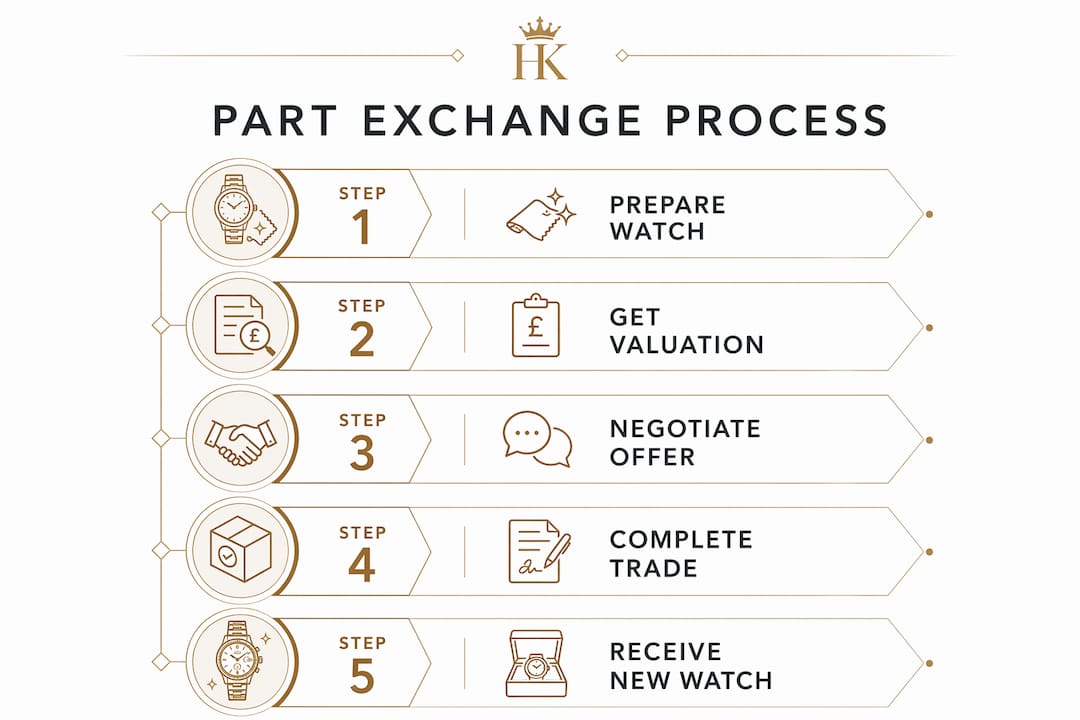
Part exchange combines two transactions into one. You hand over your current watch and receive its agreed value as credit towards a new purchase, rather than selling separately and buying independently.
The process follows a clear sequence:
Contact a specialist dealer and request a valuation. Reputable dealers such as Horology-kings offer in-person and remote assessments. Remote valuations typically require high-resolution photographs and a description of condition, box, and papers.
Submit your watch for authentication. The dealer verifies the reference number, movement, and case against manufacturer records. This step protects both parties and confirms the watch is genuine.
Receive a trade-in offer. The dealer applies their valuation to your watch and presents a credit figure. This credit offsets the price of the watch you wish to acquire.
Negotiate the final price. The trade-in value and the purchase price of the new watch are separate figures. You can negotiate both independently.
Complete the transaction. Once both parties agree, the exchange is documented, payment of any outstanding balance is made, and ownership transfers. Reputable UK dealers use secure bank transfer, which protects both buyer and seller.
In-person exchanges allow you to inspect the new watch directly and often conclude faster. Online exchanges suit buyers sourcing specific models not held locally, though they require careful documentation and trusted couriers.
Pro Tip: Request a written breakdown of the trade-in offer before agreeing to anything. A clear figure in writing prevents misunderstandings during the final negotiation.
Typical timelines range from same-day completion for straightforward in-person deals to one to two weeks for remote transactions involving authentication and shipping.
What documents and preparation do you need for a part exchange?
Preparation is the single biggest factor you control before entering a part exchange. Cleaning, documentation, and provenance directly influence trade-in value and buyer confidence.
Gather the following before approaching any dealer:
Original box and papers. The manufacturer’s box, warranty card, and chronometer certificate confirm authenticity and significantly improve offers. A Rolex Submariner with full set commands a meaningfully higher price than the same reference without.
Service history records. Receipts from authorised service centres show the movement has been maintained correctly. This reduces the dealer’s risk and improves your offer.
Authentication certificates. Third-party certificates from recognised bodies add credibility, particularly for vintage or rare pieces.
Purchase receipt or provenance documentation. This is especially relevant for those following a selling inherited luxury watch guide, where provenance may need to be established through estate paperwork or valuation letters.
Recent sale comparables. Research current market prices for your specific reference using auction records and specialist dealer listings. This gives you a realistic baseline before negotiations begin.
Pro Tip: Clean the bracelet and case with a soft microfibre cloth before any valuation appointment. Presentation at showroom standard can enhance offers significantly, and it costs nothing.
Understanding what drives luxury watch value in the current market also helps you frame your expectations correctly before you walk through the door.
How are luxury watches valued for part exchange?
Luxury watch valuation is the process of determining a watch’s current market worth based on a combination of intrinsic and external factors. Dealers, auction specialists, and independent appraisers each apply similar criteria, though their resulting offers can differ considerably.
Valuation depends on brand, model, condition, rarity, and current market demand. Each factor carries different weight depending on the piece.
Valuation factor | Influence on offer |
Brand and model | Highest influence. Rolex, Patek Philippe, and Audemars Piguet consistently command premiums. |
Condition | Major influence. Unpolished cases and original dials retain more value than restored examples. |
Box and papers | Significant. Full set can add 10%–30% to the offer on high-demand references. |
Rarity and limited editions | High for specific references. Discontinued or limited models often exceed retail. |
Service history | Moderate. Documented servicing reduces perceived risk for the dealer. |
Market timing | Variable. Seasonal demand and brand releases shift prices throughout the year. |
Selling outright to dealers typically returns 65%–85% of market value, with faster liquidity than consignment. In a part exchange, the trade-in credit functions similarly, so understanding this range helps you assess whether an offer is fair.
Pro Tip: Obtain a formal written valuation from an independent appraiser before approaching dealers. It costs a modest fee but gives you a credible reference point that strengthens your negotiating position.
For a thorough breakdown of how appraisers assess timepieces, the 2026 valuation guide for luxury collectors explains the methodology in detail.
What strategies maximise value when part exchanging your luxury watch?
The difference between the highest and lowest offers for the same watch can be 15%–25% of its value. On a £10,000 watch, that gap represents £1,500 to £2,500. The strategies below close that gap in your favour.
Get at least three independent offers. Approach different types of buyers: a specialist dealer, an auction house estimate, and a private marketplace valuation. Each channel prices differently, and the spread reveals the true market range.
Never disclose competing offers. Revealing other bids to dealers causes them to match the lowest figure rather than compete upward. Keep each offer confidential until you are ready to make a final decision.
Time your trade for market peaks. Brand anniversaries, major watch fairs, and the pre-Christmas period typically lift demand. Market conditions fluctuate seasonally, and entering the market at the right moment can meaningfully improve your credit.
Set a walk-away price before you start. Decide the minimum trade-in credit you will accept before any conversation begins. This prevents you from accepting a poor offer under pressure.
Present the watch at its best. A clean bracelet, polished crystal, and complete documentation signal care and authenticity. Dealers factor condition into their risk assessment, and a well-presented watch reduces perceived risk.
Consider consignment for non-urgent trades. Consignment commissions range between 10% and 20% of the final sale price, but the gross return is often higher than a direct dealer offer. If you are not in a hurry, this route can yield a better net credit.
For a structured approach to achieving higher returns, the guide on trading high-end watches outlines seven steps that consistently produce better outcomes.
What are the most common mistakes in luxury watch part exchanges?
Most sellers leave money on the table through avoidable errors. Recognising these mistakes before you start is the most direct way to protect your trade-in value.
Accepting the first offer. A single dealer quote is not a market price. It is one buyer’s assessment of their own margin. Always compare.
Arriving without documentation. Missing box, papers, or service records reduce dealer confidence and justify lower offers. Preparation is non-negotiable.
Revealing competing offers too early. This is the single most common negotiation error. Each dealer should believe they are competing for your business without knowing the other figures.
Ignoring market timing. Selling a sports Rolex during a period of low demand returns less than waiting for a market uptick. Understanding what drives value in 2026 helps you choose the right moment.
Overlooking dealer credibility. Not all dealers operate with the same transparency. Check reviews, ask for references, and confirm the dealer is established and reputable before handing over your watch.
Skipping independent valuation. Walking in without a baseline figure means you cannot assess whether an offer is fair. A professional appraisal, or even guidance from a jewellery valuation resource, gives you a reference point before negotiations begin.
“The sellers who achieve the best part exchange outcomes are those who treat the process like a negotiation, not a favour. They arrive prepared, they hold their position, and they walk away when the offer does not meet their research.”
Key takeaways
Successful part exchanging depends on preparation, independent valuation, and disciplined negotiation rather than luck or dealer goodwill.
Point | Details |
Prepare documentation fully | Original box, papers, and service history directly improve trade-in offers. |
Obtain multiple independent offers | The spread between highest and lowest offers can reach 15%–25% of watch value. |
Never disclose competing bids | Keeping offers confidential encourages dealers to propose their best price. |
Time your exchange strategically | Seasonal demand and brand releases shift values; entering at a peak improves credit. |
Set a walk-away price in advance | Knowing your minimum acceptable offer prevents pressure-driven decisions. |
My honest view on part exchanging luxury watches
Part exchange is genuinely one of the most efficient ways to move through a collection, but only if you treat it as a transaction rather than a convenience. The collectors I see getting the best outcomes are the ones who spend more time preparing than negotiating. They arrive with documentation, a clean watch, and a number in their head. The ones who struggle tend to walk in hoping the dealer will do the work for them.
The 2026 market rewards patience. Certain references are commanding strong premiums right now, and a watch that feels like a liability today may be exactly what a dealer needs next quarter. If your timeline allows, waiting for the right moment is a legitimate strategy, not procrastination.
One thing I would push back on is the assumption that a higher trade-in credit always means a better deal overall. Sometimes a dealer offering a slightly lower trade-in credit is pricing the acquisition watch more fairly. Look at the net cost of the transaction, not just the headline credit figure.
Build relationships with two or three trusted dealers over time. Repeat clients receive better offers, faster authentication, and access to pieces that never reach the open market. That relationship is worth more than squeezing an extra £200 from a one-off deal.
— Lewis
How Horology-kings supports your part exchange
Horology-kings is a Hertfordshire-based specialist in buying, selling, and sourcing luxury watches from brands including Rolex, Patek Philippe, Audemars Piguet, Omega, and Cartier. The team offers expert valuations, authentication, and part exchange services with secure UK bank transfers and full transparency at every stage. Whether you are upgrading your collection or sourcing a specific reference, Horology-kings handles the process with the discretion and expertise that high-value transactions require. Visit Horology-kings to request a valuation or discuss your part exchange options directly with the team.
FAQ
What is part exchange for a luxury watch?
Part exchange is the process of trading your existing watch towards the purchase of another, with its assessed value applied as credit against the new piece. It combines selling and buying into a single transaction.
How much will I get for my watch in a part exchange?
Dealers typically offer 65%–85% of current market value in a direct trade-in. High-demand references from Rolex or Patek Philippe can retain significantly more, depending on condition and documentation.
Does having the original box and papers improve my offer?
Full set documentation, including the original box, warranty card, and service history, can add 10%–30% to the offer on sought-after references. It also speeds up authentication.
Should I get multiple valuations before agreeing to a part exchange?
Getting at least three independent valuations is the most reliable way to establish a fair market baseline. The difference between the highest and lowest offers can reach 15%–25% of the watch’s value.
Can I part exchange an inherited luxury watch?
An inherited watch can be part exchanged, though you may need to provide provenance documentation such as estate paperwork or a probate valuation letter to confirm ownership and authenticity before the dealer can proceed.
Recommended
Comments