.png)

Curated watch collections: build with intention and expertise
- lewisvrichards3
- 6 days ago
- 9 min read
TL;DR:
A curated watch collection is defined by intentional choice, coherence, and purpose rather than quantity alone. It tells a connected story through deliberate pieces serving distinct roles, reflecting the collector’s identity and values. Building such a collection requires discipline, research, and expert support to ensure meaningful growth and long-term satisfaction.
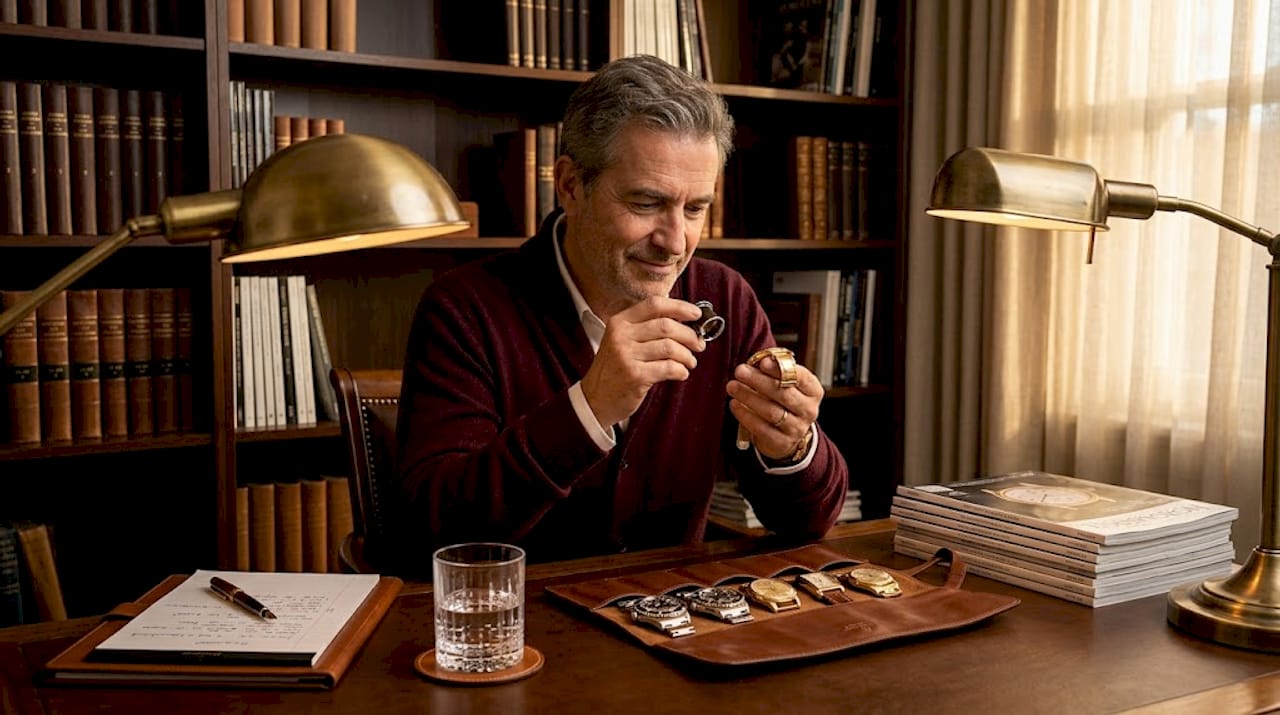
Most collectors assume that more watches automatically means a better collection. It is an easy trap to fall into, especially when the pre-owned market is so rich with temptation. But a curated collection is defined less by the number of watches and more by coherence — each watch chosen with a clear role so the whole tells a connected story rather than being a random assortment. The collectors who derive the most satisfaction, and often the strongest long-term value, are those who build with genuine intention rather than impulse.
Table of Contents
Key Takeaways
Point | Details |
Intention over quantity | A curated watch collection is defined by intentional choices and coherence, not the number of watches. |
Distinct roles matter | Each watch should serve a different purpose, like dress, everyday, and sport—avoiding redundancy. |
UK expert approach | British collectors prioritise research and selectivity when building or expanding their curated collections. |
Curation is ongoing | A curated collection evolves over time, but additions must always earn their place. |
What defines a curated watch collection?
Now that we have redefined the basics, let us break down what truly marks a curated watch collection apart from a mere accumulation of timepieces.
The word “curated” is used loosely in collecting circles, but it carries a precise meaning when applied thoughtfully. A curated collection is not simply a group of expensive or well-regarded watches sitting in a watch box together. It is a deliberately assembled set of pieces where each one earns its place, serves a purpose, and contributes to a larger, coherent narrative about the collector’s taste, values, and lifestyle.
“A curated collection is defined by intention, coherence, and purpose — not by quantity.”
The contrast with a random collection is instructive. Many enthusiasts begin by buying whatever catches their eye, which is perfectly natural at the start. A Rolex Submariner here, a vintage Omega Constellation there, perhaps a Cartier Tank picked up at auction. Each piece may be excellent on its own. But without an underlying logic connecting them, the collection risks becoming a catalogue of impulse decisions rather than a statement of considered taste.
What separates the curated from the random is the story. Every watch in a curated collection should relate to the others in at least one meaningful way, whether through aesthetic language, brand philosophy, complication type, or the occasions on which they are worn. A collector who focuses exclusively on mid-century Swiss dress watches from independent maisons tells a very different story from one who builds around mechanical innovation across the twentieth century. Neither approach is wrong. Both, however, are deliberate.
For collectors exploring what genuine curation looks like in practice, understanding curated watch definitions from a sourcing perspective adds real depth to the decision-making process. The goal is always the same: fewer regrets, stronger meaning, and a collection you would confidently show to anyone who truly understands horology.
Key markers of a genuinely curated collection include:
Intentional selection: every purchase was considered, not impulsive
Non-redundant roles: no two watches serve the same function in the same way
Aesthetic coherence: the pieces share at least one thread, be it era, style, complication, or brand
A clear collector identity: the collection reflects who you are, not just what you could afford at a given moment
Key principles: cohesion, distinct roles, and restraint
Defining “curated” is only the start. The collection’s underlying principles set it apart. Let us look at those in practical terms.
Cohesion
Cohesion does not mean monotony. A cohesive collection can contain a stainless steel sports watch alongside a yellow-gold dress piece and still feel unified. The connective tissue might be an era, a movement type, a brand heritage, or a shared design language. What cohesion demands is that no watch feels like a stranger in the group. When you lay all your watches out together, they should feel as though they belong in the same conversation.
Distinct roles
This is where many collectors struggle. It is tempting to own three versions of broadly the same watch because you love that watch. But a truly curated approach demands that each watch serves a clear, non-redundant role, using a portfolio logic rather than a size-maximising logic. Think of it as assembling the right tools for different jobs. A diver’s watch and a formal dress watch may both be Swiss, mechanical, and superbly crafted, but they serve entirely different moments in a collector’s life.
Collection type | Example role | Representative watch |
Everyday wearability | Robust, versatile, legible | Rolex Explorer or Omega Seamaster |
Formal occasions | Slim, elegant, discreet | Patek Philippe Calatrava or Cartier Tank |
Sporting or adventure | Water-resistant, technical | Rolex Submariner or AP Royal Oak Offshore |
Heritage or investment | Significant provenance | Vintage Omega or early Rolex Datejust |
Restraint
Restraint is arguably the hardest principle to maintain. The luxury watch market is deliberately designed to tempt you at every turn, with new references, limited editions, and auction highlights appearing constantly. Restraint means acknowledging that a new watch must genuinely fill an unmet need before it earns a place. Practising restraint is not about being frugal. It is about respecting the integrity of what you have built.
Pro Tip: Before adding any new piece, ask yourself honestly which existing watch it would replace or complement in your collection and why. If you cannot answer that clearly, wait.
For collectors building a well-rounded set, exploring resources on building a diverse collection can help clarify when an addition genuinely adds depth versus when it simply adds weight.
How UK collectors curate: purpose, research, and growth
Understanding the core principles, let us examine how UK collectors specifically approach building their curated collections, drawing on the particular advantages and challenges of the British market.

The UK pre-owned luxury watch market is one of the most active in Europe, with a strong heritage of respected dealers, well-attended auctions, and an enthusiastic community of collectors. However, that activity also means more temptation, more noise, and more decisions to make carefully.
UK enthusiasts are advised to build with purpose: start with a solid foundation, research thoroughly, and add only intentional watches without overlap. This guidance aligns closely with what experienced collectors in the UK consistently practise, whether they have been collecting for two years or twenty.
A practical approach many serious UK collectors follow runs as follows:
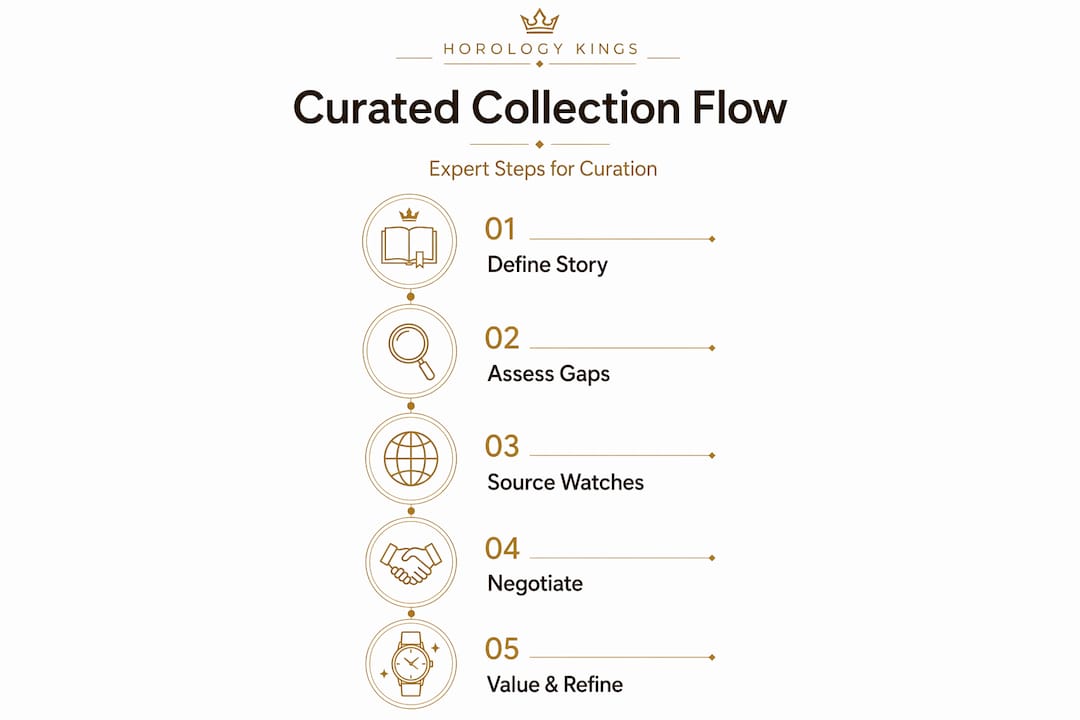
Define your collection’s identity first. Before buying anything, decide what story you want your collection to tell. Are you drawn to vintage Swiss manufacture movements? Post-war British military watches? Contemporary Swiss sports watches from the major maisons? Your answer shapes every decision that follows.
Establish the foundation with three core pieces. The classic “three-watch” framework remains the most sensible starting point: an everyday piece, a dress watch, and a sports or adventure watch. These three cover virtually every occasion and give the collection a functional backbone.
Research each acquisition as though it is your only purchase this year. Study references, production years, movement variations, known service histories, and current market pricing across multiple sources before committing.
Use expert valuations to validate your decision. Emotion can inflate what a watch feels worth. An objective watch valuation checklist grounds your decision in facts and protects against overpaying in a heated market.
Only expand when a genuine gap exists. Once the foundation is solid, additions should close clear gaps in occasion, complication, or aesthetic range — not simply because an opportunity arose.
A well-organised watch collecting workflow can make the difference between reactive buying and truly strategic collection building. The collectors who have the fewest regrets are almost always those with a clear process, not just a clear budget.
It is also worth noting that the UK’s import regulations and VAT rules, particularly for watches sourced internationally, mean that working with UK-based specialists often offers both financial and logistical advantages. Specialist dealers can handle provenance verification, import paperwork, and condition reporting, which removes significant friction from the acquisition process.
The role of sourcing, negotiation, and valuation
With purposeful growth in mind, UK collectors rely on practical skills. Let us break down the main steps involved in sourcing, negotiating, and valuing watches within a curated collection context.
The discipline of building a curated collection includes thoughtful sourcing, ensuring each piece adds clear value without redundancy. Sourcing is not simply about finding a watch. It is about finding the right watch at the right time, in the right condition, and for the right price.
Sourcing channel | Key advantages | Considerations |
Specialist UK dealers | Verified provenance, aftercare support, UK law protection | Prices may reflect premium service |
Auction houses | Access to rare references, competition-driven pricing | Buyer’s premiums add significant cost |
Private sales | Potentially better prices, direct negotiation | Provenance verification is essential |
Online marketplaces | Wide selection, global reach | Risk of misrepresentation; requires due diligence |
Key practices for disciplined sourcing include:
Prioritise reputable dealers who offer documented service histories and clear provenance, particularly for pre-owned pieces from luxury maisons like Patek Philippe and Audemars Piguet
Compare condition grades rigorously — a watch described as “excellent” by a private seller may differ significantly from that same grade at a specialist dealer
Factor in total cost of ownership, including any immediate service requirements, strap or bracelet condition, and any missing original accessories that affect resale value
Negotiate with evidence, not just instinct — knowing current grey market pricing and auction records gives you a factual basis for any offer
On the subject of negotiation, understanding how to negotiate watch purchases is a skill that pays dividends over a collecting lifetime. Many collectors leave significant value on the table simply because they do not know what leverage they hold as informed buyers.
Valuation is the final essential step before any acquisition. An independent expert opinion, or a structured watch valuation guide, removes the emotion from the equation and ensures the piece you are adding genuinely represents fair value. For a collection built around coherence and quality, paying over the odds for a single piece can distort the entire logic of what you have assembled.
What most collectors get wrong about curation
Let us consider the most commonly missed perspective on what curation truly demands from passionate collectors.
The biggest misunderstanding we encounter at Horology Kings is this: collectors often believe that curation is primarily an additive exercise. You find great watches, you learn more, you buy more deliberately, and eventually the collection becomes curated. The reality is more uncomfortable.
Curation requires more discipline and self-reflection than initial collecting. It is about what you exclude as much as what you own. The willingness to sell a watch you genuinely enjoy because it no longer serves the collection’s direction — that is the real test of a curator’s mindset.
We have worked with collectors who own thirty or forty pieces and feel vaguely dissatisfied, unable to identify the source of that feeling. Almost invariably, the issue is not the quality of any individual watch. It is the absence of a governing logic. Once a collector identifies the story they want to tell and begins removing pieces that do not contribute to it, the satisfaction returns almost immediately.
There is also a common myth that curation is only for those with substantial budgets. In reality, a three-watch curated collection built around an Omega Seamaster, a Cartier Tank, and a Rolex Explorer tells a richer story than twenty watches assembled without intent. The coherence creates the value, not the price tags.
For collectors who have reached the point of wanting to refine their existing holdings, the decision to sell watches through a broker rather than through a marketplace is worth serious consideration. A broker who understands your collection’s direction can help position watches appropriately and identify buyers who will value them correctly, rather than treating them as generic pre-owned stock.
The most rewarding collections we see are never the largest ones. They are the most considered ones. And that consideration is available to any collector willing to do the honest work of deciding what their collection is actually for.
Build your curated collection with expert support
Now that you understand the art and discipline of curation, discover how expert services can help you realise your vision without the usual friction or uncertainty.
At Horology Kings, we work exclusively with collectors who take their collections seriously. Whether you are establishing your first three-piece foundation or refining a long-standing collection by removing redundancy and adding precision, our team brings genuine expertise to every stage of the process.

From helping you source a luxury watch that fits your collection’s specific narrative, to providing valuation guidance and negotiation support, we treat every brief with the same discipline we advocate in this article. We also offer specialist watch repair services to ensure that every piece in your collection is performing at its best and retaining its value for the long term. Building with intention is far more achievable when you have a trusted partner who understands what you are building and why.
Frequently asked questions
How many watches should a curated collection include?
There is no fixed number. A curated collection focuses on coherence and distinct purposes, and many exemplary collections comprise as few as three carefully chosen pieces rather than dozens.
What types of watches should form the foundation for a curated collection?
Core foundations typically include a dress watch, a sports or diver’s watch, and an everyday timepiece, as this covers distinct occasions without redundancy and gives the collection immediate functional range.
Can a curated collection evolve over time?
Yes, a curated collection should evolve as your taste develops, but every addition must be intentional. Collectors are advised to add watches that genuinely earn their place and avoid creating unnecessary overlap with existing pieces.
Is it better to have only high-value watches in a curated collection?
Not at all. The collection’s value comes from intention, coherence, and distinct roles rather than price tags, though quality and condition remain important considerations for long-term satisfaction and resale performance.
Recommended
Comments