.png)
Watch collection management tips for luxury collectors
TL;DR:
Proper collection management involves meticulous documentation, appropriate storage, and seasonal environment control to maintain value.
Regular careful handling, scheduled servicing, and avoiding aggressive polishing preserve the watch’s originality and long-term condition.
Owning a Rolex Submariner or a Patek Philippe Nautilus is one thing. Protecting it, maintaining it, and ensuring it holds its value for decades is another matter entirely. Watch collection management tips often get reduced to “wind it regularly and keep it clean,” but that barely scratches the surface for serious collectors. Poor recordkeeping, incorrect storage, and skipped servicing are among the most common reasons high-value pieces lose condition and, consequently, market value. This guide cuts through the noise and gives you a practical, expert-backed framework for managing your collection the way a professional curator would.
Table of Contents
Key Takeaways
Point | Details |
Maintain detailed logs | Recording wear, servicing, and photographic records supports good maintenance and insurance claims. |
Establish routine care | Daily inspections and seasonal adjustments protect your watches’ longevity and appearance. |
Handle winding carefully | Avoid constant winding and follow date-setting best practices to prevent movement damage. |
Secure appropriate insurance | Specialised watch insurance provides better coverage and risk management than homeowners policies. |
Adopt a curator mindset | Rotating, documenting, and protecting your collection ensures value and enjoyment over time. |
Watch collection management tips: understanding and preparing your collection
Building a thorough understanding of your collection sets the foundation for effective maintenance and care.
The first principle of managing a luxury watch collection is knowing precisely what you own. That sounds obvious, but most collectors have gaps in their documentation that only become apparent when they need to make an insurance claim or sell a piece. Collectors should keep detailed logs of wear dates, servicing history, and parts replaced, as these records directly inform both maintenance planning and insurance accuracy.
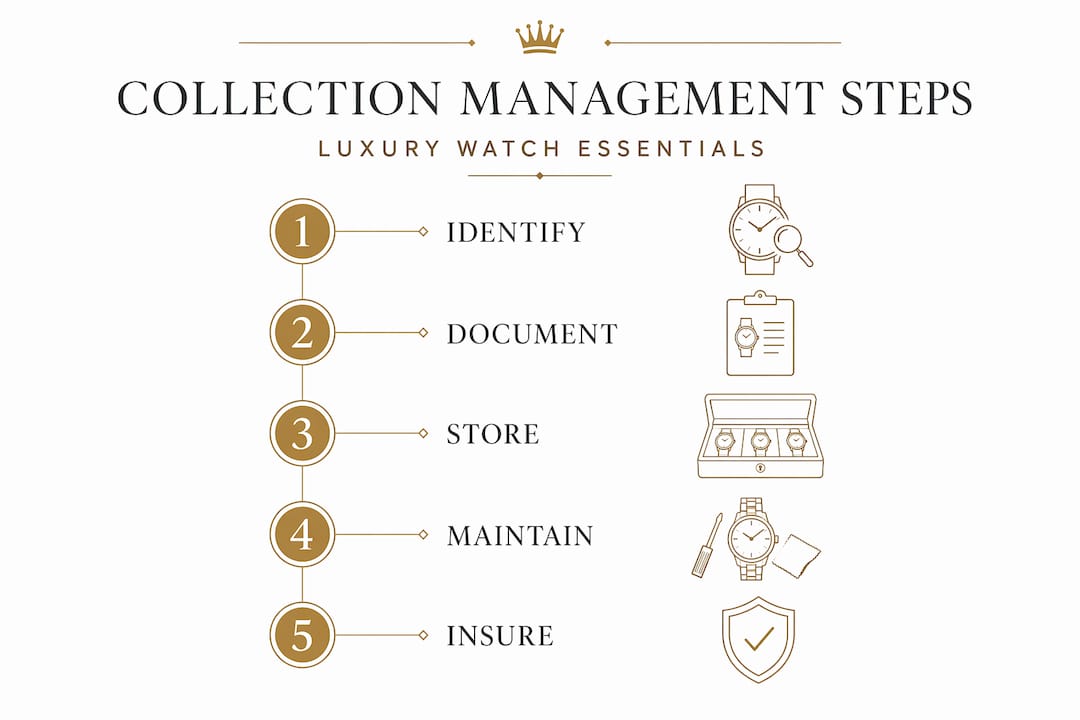
Your documentation system does not need to be elaborate. A spreadsheet or a dedicated app works well. For each piece, record the serial number, reference number, purchase date, purchase price, and a chronological log of every service, repair, and strap change. Photograph the dial, caseback, movement (where visible), and serial engraving at high resolution. These images are critical for provenance and, if the worst happens, for insurance claims. Understanding watch service history value is essential to this process, as thorough records directly affect resale premiums.
Storage is where many collectors cut corners, and it costs them. Here is a practical comparison of common watch storage solutions:
Storage option | Protection level | Humidity control | Dust resistance | Approx. cost |
Soft pouch | Low | None | Minimal | £5–£20 |
Watch box (wood/leather) | Medium | None | Good | £30–£200 |
Watch box with glass lid | Medium | None | Excellent | £50–£300 |
Safe with foam insert | High | None | Excellent | £150–£800+ |
Safe with humidity monitor | Very high | Active monitoring | Excellent | £300–£1,500+ |
Humidity above 70% accelerates crown seal degradation and encourages mould on leather straps. UV light fades dials, particularly on vintage pieces with creamy or tropical patinas that collectors prize. A controlled environment, ideally between 40% and 60% relative humidity, is not a luxury; it is basic preservation. Pairing your safe or watch box with a small silica gel pack and a digital hygrometer costs very little and prevents significant damage. For more on maintaining luxury watches in the right conditions, the details matter enormously.
Quick daily habits reinforce your preparation routine. Spend sixty seconds checking that crowns are fully pushed in, that the crystal is free of deep scratches requiring attention, and that the clasp engages cleanly. These micro-inspections catch problems early, before they become expensive.
Establish daily and seasonal care routines
With your collection well understood and prepared, developing consistent care routines is the natural next step.
Daily care is not about obsession; it is about prevention. Here is a practical routine to build into your wearing habits:
After removing a watch, wipe the case and bracelet with a soft microfibre cloth to remove skin oils and salts.
Check the crown is pushed in fully or screwed down (on water-resistant models) before any storage.
Inspect the crystal under good light for new scratches or chips.
For leather straps, avoid contact with water and apply a leather conditioner sparingly every few months.
For metal bracelets, clean monthly with mild soap, warm water, and a soft brush, paying attention to the folding clasp area where debris accumulates.
Rotate your collection on a three-to-five-piece cycle so no single watch bears disproportionate wear.
Seasonal adjustments are often overlooked in typical watch care advice. British summers, while rarely extreme, bring higher humidity that accelerates oxidation on unprotected steel and can warp wooden storage boxes. Adding silica gel packs to your storage during June through September is a simple counter-measure. Winter central heating drops indoor humidity significantly, which can dry and crack leather straps faster. A small humidifier near your storage space maintains balance.
Simple daily inspections and scheduled servicing every 4 to 7 years prevent catastrophic damage and help maintain watch value over time. Build servicing dates into your calendar the same way you would a MOT for a classic car. Your watch maintenance tips checklist should include environment checks as a seasonal item, not just a one-off setup.

Pro Tip: Rotate watches by lifestyle context, not just wear time. Your sports watch takes more abuse on active days, which means it may need servicing sooner than a dress watch worn twice a month, even if both have similar wrist hours.
Manage winding, time, and date settings carefully
Beyond routine cleaning and wear, careful handling during winding and setting preserves movement integrity.
This is the area where well-intentioned collectors cause the most accidental damage. The mechanics of winding and setting are not complicated, but the consequences of doing them incorrectly are expensive.
Automatic winders: Many collectors assume winders are essential. They are not. If you wear a watch regularly, it will stay wound. Constant winding through a low-quality winder adds unnecessary rotations to the rotor and mainspring. Avoid cheap automatic winders and constant winding to reduce wear; if you do use one, choose a reputable model with brand-compatible rotation settings and a rest period built in.
Manual winding frequency: For manual-wind watches that are not being worn, wind once every one to four weeks. This keeps the lubricating oils distributed across the gear train without the risk of overwinding on older mainsprings.
Date setting danger zone: Most calendar complications use a mechanical finger and cam system that engages near midnight. Changing the date between 8 p.m. and 4 a.m. risks stripping or bending these components. If you are unsure where the hands actually are (for instance, on a watch with no AM/PM indicator), move the hands forward to 6 a.m. before touching the date corrector.
Time setting direction: Always move hands forward, not backward. Reversing the hands works against the designed movement of the dial train and can displace lubricants.
Bracelet cleaning: Jewellers sometimes offer ultrasonic cleaning. This is safe for metal bracelets removed from the watch, but never allow the watch head to go into an ultrasonic bath. The vibrations can dislodge shock-setting jewels and damage delicate escapement components.
Pro Tip: Keep a small index card in your watch box for each manual-wind piece with the last wind date written on it. A two-minute habit that prevents months of anxiety about dried-out movements.
Keep detailed logs and documentation for value and insurance
Accurate records transform good care habits into lasting financial and heritage security.
Detailed logs tying wear, service, and photographic records are essential for accurate maintenance and insurance documentation. Without them, you are relying on memory, and memory is not admissible in an insurance dispute or a resale negotiation.
Here is what your documentation system should include for each piece:
Serial number, reference number, and movement calibre
Purchase invoice and provenance documentation
Original box and papers (stored separately from the watch itself, ideally in a fireproof container)
Full photographic record updated after each service
Dated service reports from watchmakers, including parts replaced
Current market appraisal, reviewed every three to five years
The table below summarises the key document types and their purposes:
Document | Primary purpose | When to update |
Purchase invoice | Provenance and ownership proof | At acquisition |
Service record | Maintenance history and resale value | After every service |
Photographic record | Condition documentation, authentication | Annually or post-service |
Insurance appraisal | Coverage accuracy | Every 3 to 5 years |
Box and papers | Authenticity and resale premium | Preserve from day one |
Maintaining a watch authentication checklist alongside your service records ensures you can demonstrate both the identity and the condition of each piece confidently. For collectors building a legacy collection, original boxes and certificates can add 15 to 30 per cent to resale value on desirable references, particularly Rolex and Audemars Piguet models. A well-organised watch collecting workflow makes maintaining these records far less effort over time.
Choose the right insurance and plan for travel and storage risks
With excellent maintenance and documentation, securing smart insurance and managing travel risks completes thorough collection management.
Insurance is where the financial reality of watch collecting becomes stark. Homeowners insurance typically covers only around £1,500 for jewellery theft, which will not replace a single Rolex Daytona, let alone a collection. Specialised watch insurance policies offer agreed-value coverage (meaning you receive the insured sum, not a depreciated figure), worldwide travel cover, and some policies account for appreciation over time, so your coverage keeps pace with rising market values.
When comparing policies, evaluate these factors:
Coverage limit: Does it reflect current market value per piece, not purchase price?
Agreed-value vs. actual cash value: Agreed-value is significantly better for appreciating references.
Worldwide travel coverage: Essential if you travel with watches.
Claim process: How quickly do they settle, and do they require appraisals upfront?
Exclusions: Some policies exclude mechanical breakdown, which is a significant gap.
A five-year servicing interval is a good baseline, and travel packing methods and insurance coverage should be planned carefully for high-value watches. Insurers may void claims if a watch was checked in as luggage.
For travel, use a padded leather or canvas watch roll and keep it in your carry-on luggage at all times. Never check a luxury watch. Airport handling is rough, and there is no recovery path if a £15,000 watch disappears from checked baggage.
At home, store watches crown-up or dial-up in a secure, dry environment. Use watch service and insurance planning together so your coverage is always current with your collection’s condition and value. A monitored safe with a built-in desiccant tray offers the best combination of physical and environmental protection for serious collections.
Pro Tip: Ask prospective insurers directly whether their policy includes appreciation or inflation adjustment. Many collectors renew policies at purchase price for years and discover at claim time that their coverage falls short by thousands.
Rethinking watch collection management: beyond tradition
The conventional approach to watch care treats maintenance as a chore you schedule when something goes wrong. That reactive mindset is expensive. The collectors whose pieces hold value decade after decade think differently; they think like curators, not owners.
A curator does not wait for a painting to crack before attending to climate control. They maintain the environment consistently, document condition changes proactively, and make restoration decisions based on long-term integrity, not short-term aesthetics. Treating watches as functional artworks needing curator-level care preserves mechanical longevity and investment value better than typical ownership approaches.
Here is where conventional wisdom gets it wrong: many collectors over-polish. A Rolex Submariner with sharp original case edges and an unpolished brushed finish is worth materially more than an identical reference that has been polished smooth. Polishing removes metal and rounds off the crisp lines that define the original design. Once done, it cannot be undone. The same logic applies to refinishing dials or reluming hands. Originality is not just aesthetically preferable; it is financially superior.
Rotation is another undervalued principle. Collectors who rotate through five pieces wear each watch roughly 70 fewer days per year than if they wore one daily. Fewer wrist-hours means slower wear on the movement, the crystal, and the bracelet links. It also means your collection actually functions as a collection rather than a wall display with one workhorse.
Define your own success metrics for managing your collection. Fewer emergency repairs. No devaluation through careless polishing. Watches that are worn, enjoyed, and passed on in better condition than you received them. That is stewardship. Pure investment return is one metric, but it is not the only one that matters.
Discover Horology Kings for expert watch sourcing and servicing
At Horology Kings, we work with collectors who take their watches as seriously as you do. Whether you are looking to add a specific reference to your collection or need professional servicing to bring a piece back to its best, having an expert partner changes the quality of your collection management entirely.

Our sourcing service draws on a deep network across the UK and beyond to find rare and sought-after references that rarely reach the open market. For collectors who want professional support with watch repair and servicing, our team ensures mechanical integrity is maintained to manufacturer standards, with full documentation to support your service records. Visit Horology Kings to explore our current collection and talk to our team about your next acquisition or service need.
Frequently asked questions
How often should I service my mechanical luxury watches?
Mechanical watches require servicing typically every 4 to 7 years, depending on how frequently you wear them and the conditions they are exposed to, including humidity and shock.
Is homeowners insurance enough to cover my luxury watch collection?
Homeowners insurance covers roughly £1,500 for jewellery theft in most policies, which falls well short of most serious collections, making specialised watch insurance essential for adequate protection.
What are the best practices for setting a watch date?
Avoid changing the date between 8 p.m. and 4 a.m. to protect the calendar mechanism; if you are unsure of the hand position, advance the hands to around 6 a.m. before making any date adjustment.
Can I use any automatic watch winder safely?
Avoid cheap or continuous automatic winders as constant winding adds unnecessary wear to the rotor and mainspring; only use high-quality, brand-compatible winders set with appropriate rotation counts and rest intervals.
How should I store my watches when not wearing them?
Store watches crown-up or dial-up in a dry, controlled environment with silica gel packs and a digital hygrometer to maintain relative humidity between 40% and 60%, protecting seals, lubricants, and straps from moisture damage.
Recommended
Comments