.png)
Why diversify watch collections? Reduce risk and enhance value

TL;DR:
Owning many luxury watches does not guarantee collection security or growth without a disciplined diversification strategy. True diversification involves balancing brand exposure, liquidity, provenance, and market segments to make collections resilient and attractive over time. Properly managed watch portfolios reduce risk through proven secondary markets and proportional allocation, but they cannot eliminate all risks during market stress or liquidity shortages.
Owning an impressive array of luxury watches does not automatically mean your collection is well protected or positioned to grow. Many UK collectors make the mistake of equating quantity with security, buying more pieces without a coherent strategy and then wondering why their portfolio stagnates or suffers during market corrections. True diversification in luxury horology is a disciplined practice that balances brand exposure, liquidity, provenance, and price tier to produce a collection that is both resilient and rewarding over the long term.
Table of Contents
Key Takeaways
Point | Details |
Disciplined allocation | Smart diversification means allocating a small, focused portion of your portfolio to quality watches, not spreading funds thinly. |
Risk reduction benefits | A diversified watch mix can lower portfolio volatility and offer an edge through low stock market correlation. |
Liquidity matters | Owning illiquid or hard-to-resell pieces can undermine diversification, so always check secondary market activity and documentation. |
Quality over quantity | Choosing a few resilient, high-value references is often safer than owning many low-provenance watches. |
What diversification really means for luxury watch collections
Diversification is a term borrowed from traditional finance, but applying it wholesale to watches without adjustment leads to poor decisions. In equities, spreading capital across hundreds of assets is practical and cost-effective. With luxury watches, each piece represents a significant, illiquid commitment, so the logic must be adapted carefully.
True watch collection diversification means maintaining exposure across different brands, reference types, complications, and price segments while ensuring that each piece has documented provenance, a functioning secondary market, and genuine collector desirability. It is not about filling a safe with as many brands as possible. Owning ten watches from unfamiliar, low-demand references provides almost no meaningful protection compared to holding three or four pieces from proven houses with deep secondary market liquidity.
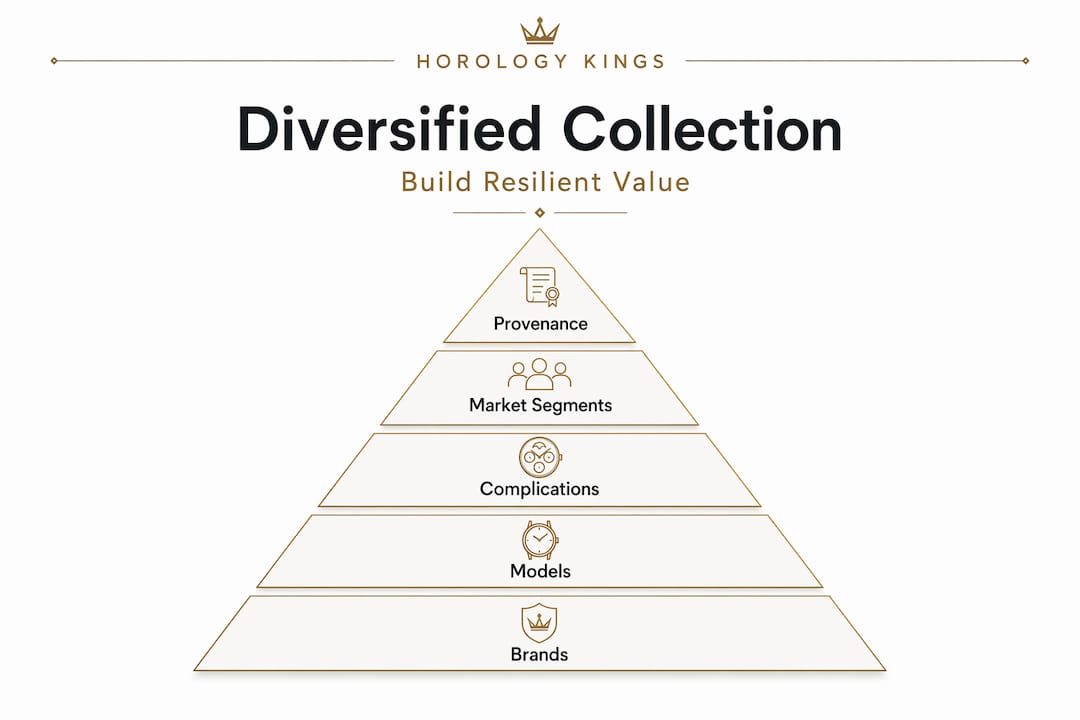
When building a diverse watch collection, UK investors should think of watches as part of a broader alternative asset sleeve rather than a standalone investment vehicle. As noted by analysts examining this space, a disciplined alternative asset allocation for UK collectors is typically framed as 0.5 to 3% of investible assets, not a high-conviction, all-in bet. This framing keeps watches in proportion and prevents over-exposure to an illiquid asset class.
Understanding what makes a watch a genuine collector’s timepiece is equally essential. Reference history, movement calibre, production numbers, and condition all determine whether a piece holds its value or quietly erodes it. Diversifying into watches you do not fully understand is simply a different kind of risk, not a reduction of it.
Spread across brands with proven secondary market depth (Rolex, Patek Philippe, Audemars Piguet, Omega, Cartier)
Balance sports references, dress watches, and complication-driven pieces
Consider age ranges, from modern references to certified vintage pieces
Ensure every piece has verifiable documentation and service history
Pro Tip: Treat your watch allocation like any other alternative asset class. Set an upper limit as a percentage of your wider portfolio and review it annually, just as you would private equity or fine art exposure.
How diversification reduces risk in a watch collection
With a working definition in mind, let’s examine the actual risk and return advantages of a carefully diversified watch portfolio. The case for including watches as a diversifying asset rests partly on their weak correlation with traditional financial assets such as equities and bonds.
Luxury watches, particularly pieces from the top Swiss maisons, tend to move to their own rhythms. Demand is driven by collector sentiment, scarcity, brand stewardship, and cultural relevance, rather than interest rate cycles or earnings seasons. This means a well-chosen watch portfolio does not necessarily collapse when equity markets correct sharply, provided the pieces are genuinely desirable and liquid.

The numbers support this. Research has shown that adding watches to a portfolio can deliver roughly similar average returns while meaningfully reducing overall volatility, with figures showing a reduction from approximately 13.4% to 12.1% in portfolio volatility. That may look modest in isolation, but for serious collectors managing substantial overall wealth, a 1.3 percentage point reduction in volatility represents real, tangible risk management.
Portfolio type | Average annual return | Volatility (standard deviation) |
Traditional assets only | 7.2% | 13.4% |
Traditional assets plus watches | 7.1% | 12.1% |
Watches only | 6.8% | 15.7% |
The table above illustrates that watches work best as a complement rather than a replacement. Holding them in isolation actually increases volatility compared to a blended approach, reinforcing the importance of proportionate allocation.
“A carefully structured watch allocation can contribute meaningfully to portfolio resilience, but its power comes from the combination of low correlation and genuine asset desirability, not simply the presence of more watches.”
For collectors keen to apply these principles in practice, exploring rare watch sourcing strategies is a sensible starting point. Sourcing decisions directly influence the liquidity and desirability profile of your collection, both of which underpin the risk-reduction benefits described above.
The limits: When diversification doesn’t deliver
While the merits are clear, there are crucial limits and missteps to heed when it comes to diversification. Perhaps the most important lesson for UK watch investors is that diversification is not a guarantee. It is a probability game, and several real-world conditions can undermine it.
During periods of genuine market stress, correlations between asset classes tend to rise unexpectedly. What felt uncorrelated during calm conditions can suddenly move in lockstep when liquidity dries up globally. As UBS analysis confirms, correlations between assets are not constant and diversification benefits can be significantly muted when stress conditions spike those correlations. This applies to watches too. During sharp economic downturns, even desirable references can see price softness as discretionary spending tightens and collectors hold off buying.
Liquidity is the second major constraint. A watch that is difficult to sell quickly and at fair value provides weak protection when you actually need cash. As Morningstar’s analysis of illiquid asset risk highlights, illiquidity within a portfolio sleeve can undermine downside protection precisely when you most need to exit a position. Not all watches trade equally. A rare Patek Philippe reference with global auction demand is structurally different from a niche independent watchmaker’s piece that appeals to a tiny audience.
Watch type | Typical resale timeline | Price discovery | Liquidity tier |
Rolex sports reference (Daytona, Submariner) | Days to 2 weeks | Strong, global | High |
Patek Philippe Nautilus or Aquanaut | 1 to 4 weeks | Strong, auction-backed | High |
Audemars Piguet Royal Oak | 1 to 4 weeks | Strong, established | High |
Independent brand, limited edition | 3 to 12 months | Weak, niche | Low |
Vintage dress watch, no papers | 1 to 6 months | Moderate, specialist | Medium |
Understanding the secondary market dynamics of each piece you hold is non-negotiable. Without that knowledge, diversification becomes a theoretical exercise rather than a practical safeguard.
Key risks to keep front of mind:
Emotional buying driven by trend rather than fundamentals
Diversifying into segments with no verifiable resale data
Ignoring service costs, which erode returns over time
Assuming that brand prestige alone guarantees liquidity
Understanding the real value drivers behind specific references equips you to make decisions rooted in evidence rather than enthusiasm. And if you ever need to exit positions efficiently, having a clear discreet selling strategy in place is part of responsible collection management.
Pro Tip: Before adding any watch to your collection for investment purposes, research its average sale price at major auction houses over the past three to five years. If there is no verifiable price history, treat it as purely a passion purchase, not a portfolio asset.
Beyond the numbers: How to build a resilient and valuable collection
With the risks and limits laid out, let’s explore exactly how you can apply diversification to your own collection for lasting value. The goal is a portfolio of watches that holds up in soft markets, appreciates in strong ones, and can be liquidated fairly quickly if circumstances demand it.
A tiered approach is the most effective structural framework. Think of your collection in three distinct layers.
Core tier (50 to 60% of collection value): These are your anchor pieces. Rolex sports references, Patek Philippe calatrava or Nautilus models, and Audemars Piguet Royal Oak variants with full documentation. These pieces have deep global demand, consistent auction records, and strong price support even in softer markets. They form the backbone of your collection’s value and liquidity.
Growth tier (25 to 35% of collection value): Watches with strong appreciation potential but slightly less immediate liquidity. Think pre-owned Omega Speedmaster Moonwatch references with historical significance, Grand Seiko limited editions with growing Western collector interest, or select Cartier complications. These pieces offer the prospect of meaningful value gains while still having credible resale channels.
Speculative or passion tier (10 to 15% of collection value): Independent watchmakers, limited collaborative references, or vintage pieces requiring restoration. These carry higher risk and lower liquidity, but they bring character and the possibility of outsized returns. The key is keeping this tier capped so it cannot destabilise the whole collection.
As the key principles of watch investing make clear, diversification within watch investing must reflect liquidity tiers and price-discovery characteristics. Illiquidity and slower resale can undermine the practical risk reduction that diversification theoretically offers.
Provenance and documentation deserve special emphasis. A watch with full box, papers, and a verified service history commands a premium at resale that can be 20 to 40% above an identical piece without documentation. Part of building a resilient collection is maintaining meticulous records for every piece, not as a bureaucratic chore, but as a genuine value-preservation exercise.
Explore auction strategies for collectors to understand how major sale venues price and position different references. Auction results are the most transparent form of price discovery in the watch market, and fluency with them will sharpen every buying and selling decision you make.
Pro Tip: Never ignore the recurring costs of owning watches at a portfolio level. Servicing a mechanical watch every four to seven years can cost between £500 and £3,000 depending on the brand and movement complexity. Factor these costs into your real return calculations, just as a property investor would account for maintenance and management fees.
Why most collectors get diversification wrong
There is a persistent myth in watch collecting circles that spreading capital across more pieces automatically means greater safety. In practice, the opposite is often true. Collectors who expand too broadly end up with a fragmented group of watches, many of which have weak resale markets, inconsistent documentation, and limited collector appeal outside niche circles.
Real stability in a watch portfolio tends to come from consolidating into higher, more resilient price brackets rather than spreading thinly across lower-value references. As research into watch investment considerations notes, some analyses argue that stability comes from consolidating into higher and more resilient price brackets first, then diversifying across proven high-end references rather than diluting across many mid-market pieces.
Behavioural traps compound this problem. Collectors often buy emotionally, attracted by aesthetics, trend momentum, or the thrill of acquiring something rare-seeming, without rigorously checking secondary market depth. Once owned, there is a natural reluctance to sell underperforming pieces at a loss, a cognitive bias known as the disposition effect that financial researchers have documented extensively across asset classes. The result is a collection bloated with watches that looked exciting at purchase but now sit uneasily in the portfolio without contributing genuine value or liquidity.
The collectors we see succeed consistently are those who treat every acquisition as a deliberate decision grounded in the real drivers of watch value. They are willing to consolidate, willing to sell pieces that no longer serve the collection’s objectives, and disciplined enough to resist the urge to fill every market segment at once. Sometimes owning five exceptional pieces is a far stronger position than owning fifteen average ones.
Take the next step with expert guidance
If you are ready to apply smarter diversification principles to your collection, working with specialists who understand both the collector and investment dimensions of luxury watches makes a significant difference. At Horology Kings, we help UK collectors identify, source, and manage high-quality timepieces that genuinely strengthen a portfolio rather than simply adding numbers to it.

Whether you want to source a specific watch with the right provenance and price-discovery history, or need expert watch repair and servicing to protect and maintain the condition of your existing pieces, our team in Hertfordshire is here to help. We offer discreet, transparent services backed by genuine market expertise, so your collection decisions are always informed by substance, not speculation.
Frequently asked questions
How many watches should I own to be ‘diversified’?
For UK investors, holding 3 to 5 well-chosen pieces across leading brands and market segments often provides sufficient diversification. As analysts confirm, a small, disciplined allocation to watches as an illiquid alternative asset works better than spreading too broadly.
Does diversification guarantee my collection won’t lose value?
Diversification reduces risk but does not eliminate it. Research from UBS confirms that correlations between assets rise during stress conditions, which can significantly mute the protective benefits of diversification precisely when you need it most.
Should I diversify by brand, model, or price tier?
Effective diversification considers brand, reference, and liquidity rather than labels or price alone. Focus on pieces with proven value, and remember that illiquidity and slower resale can undermine the practical risk reduction that diversification is meant to provide.
What is an ideal percentage of my portfolio for watches?
Most conservative UK collectors keep watches at 0.5 to 3% of their investible assets. This framing, supported by analysis of alternative asset allocation approaches, keeps watch exposure proportionate and avoids over-commitment to an illiquid class.
Recommended
Comments