.png)
Horological investment: a guide for UK collectors

TL;DR:
Luxury watches have outperformed many traditional assets, boasting an average ROI of 34%, far exceeding other collectibles. Successful horological investment depends on understanding market dynamics, selecting reputable brands, and managing risks like overpaying, illiquidity, and authenticity issues. UK tax rules favor watch investors through exemptions, but careful planning and disciplined holding are essential for maximizing returns.
Luxury watches have quietly outpaced many traditional alternative assets. An estimated average gross ROI of 34% places them above wine, art, and classic cars in the alternative investment hierarchy. Yet for all that performance, horological investment remains poorly understood, even among serious collectors who have been buying watches for years. This guide clarifies what it actually involves, what drives returns, where the risks sit, and how UK tax rules affect your position so you can approach the market with the clarity it demands.
Table of Contents
Key Takeaways
Point | Details |
Horological investment definition | It means buying luxury watches to sell later at a profit on the secondary market, influenced by market pricing dynamics. |
Top investment factors | Brand reputation, scarcity, watch condition, and market timing are critical to achieving good returns. |
Risks and costs | Hidden costs, illiquidity, and overpaying for certified pre-owned watches can reduce investment gains. |
UK tax benefits | Watches often qualify as wasting assets and may benefit from exemptions or lower Capital Gains Tax liabilities. |
Balanced investment approach | Marrying passion with research and patience offers the best route to successful horological investing. |
Understanding what horological investment means
At its core, horological investment means buying sought-after watches with the intention of selling them later at a higher secondary-market price. Your return is simply the difference between what you paid and what a buyer later pays you. That sounds straightforward. In practice, it requires a precise understanding of secondary-market dynamics, because the retail price and the resale price are rarely the same thing, and sometimes not even close.
The watch secondary market operates on supply and demand signals that shift constantly. A reference that commands a 30% premium above retail one year can correct sharply the next if production increases or consumer sentiment moves. Tracking model performance is therefore not optional. Tools such as Chrono24’s market data, WatchCharts, and auction house results from Christie’s and Phillips give you a working picture of where a given reference trades over time.
Key principles to anchor your thinking:
Purchase price is everything. Overpaying at the point of entry is the single most common reason watch investments underperform.
Secondary-market pricing differs from retail. Some watches trade below retail on the grey market; others command multiples. Know which category you are buying into.
Returns are not guaranteed. Market conditions, changing tastes, and macroeconomic pressures all affect resale values.
Patience is structural. Watch investment is not a liquid asset class. It rewards those who can wait for the right conditions and the right buyer.
“The return on a horological investment depends entirely on the price paid at entry and what the next buyer is willing to pay at exit.” This is the market reality that separates informed collectors from optimistic ones.
Why luxury watches have become a sought-after investment asset
Watches outperform most collectibles not by accident but by design. Scarcity is engineered into the production of leading Swiss houses. Emotional resonance is baked into the heritage of every reference. Combined, these factors create persistent demand that holds value across economic cycles in ways that few tangible assets can replicate.
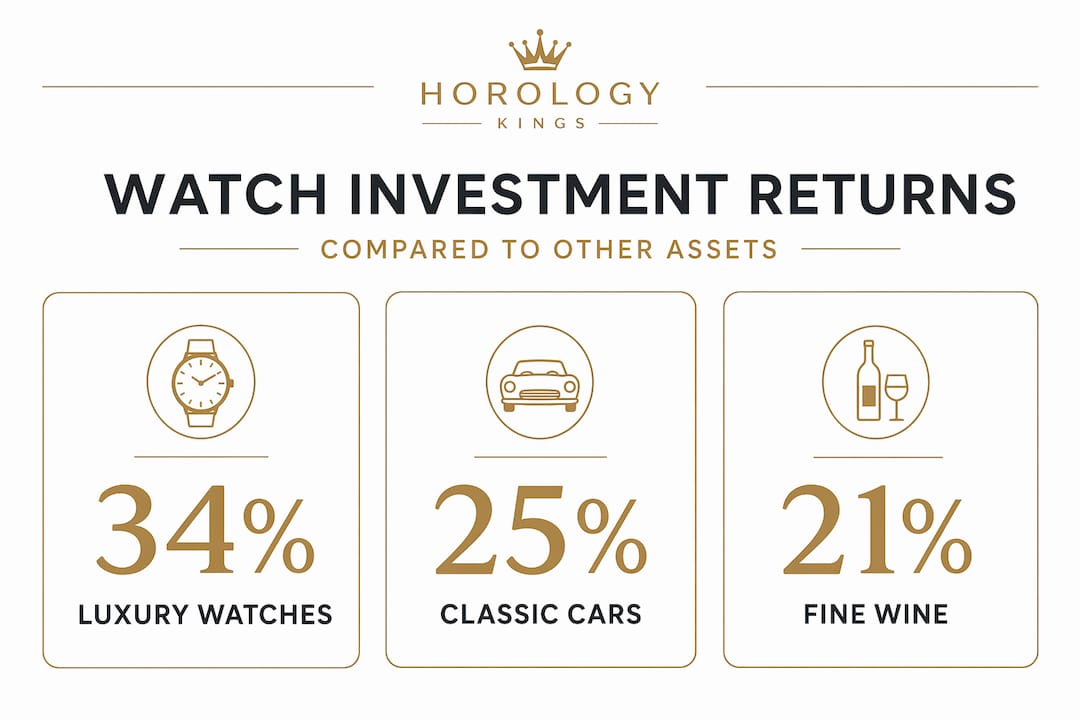
According to Knight Frank’s Wealth Report, watches deliver an average gross ROI of 34%, comfortably ahead of other luxury collectibles at 16%. For context, consider how other asset classes compare:
Asset class | Average gross ROI (approx.) |
Luxury watches | 34% |
Classic cars | 25% |
Wine | 21% |
Collectibles (general) | 16% |
Art | 11% |
The drivers of luxury watch value extend well beyond raw investment logic. Cultural cachet, the mechanical craftsmanship argument, and the fact that a great watch is also an object of daily pleasure all contribute to sustained collector demand. Unlike art as an asset, where value is deeply subjective and audiences narrow, luxury watches have a globally liquid secondary market and recognisable reference points that transcend geography.
Brands that consistently produce strong investment results in the UK market include:
Rolex — References such as the Daytona and Submariner have demonstrated exceptional long-term value retention and secondary-market premiums.
Patek Philippe — The Nautilus and Aquanaut remain benchmarks for horological investment performance globally.
Audemars Piguet — The Royal Oak, particularly in steel, commands premiums that reflect its enduring cultural status.
Portfolio diversification is another underappreciated benefit. Watches do not correlate with equities or bonds in any direct way. During periods of equity market volatility, well-chosen horological assets have historically held or grown their value, making them a genuine diversification tool for high net worth investors rather than simply a lifestyle indulgence.
Key factors that influence horological investment success

Success in this asset class is not a matter of buying any expensive watch. It is about making deliberate, informed choices across several critical dimensions. Investment outcomes depend heavily on brand reputation, scarcity, condition, and market timing. Get one of these wrong and you hold a liability, not an asset.
Here are the factors that matter most, in order of practical importance:
Brand reputation. The role of brand reputation in watch value cannot be overstated. The top three houses command premiums that smaller, equally skilled manufacturers simply cannot match.
Scarcity. Limited production runs, particularly those under 1,000 pieces, tend to appreciate more reliably. Special editions tied to anniversaries or cultural moments add further upward pressure.
Condition. A watch in unworn or lightly worn condition with its original bracelet, box, and papers will always outperform a polished example with missing documentation at the point of resale.
Provenance. Documented ownership history, particularly for vintage references, can add significant value. A watch with a notable former owner or competition history is worth materially more than an identical reference without that story.
Market timing. Entering a market at peak hype and exiting before correction is the ideal but rarely achieved scenario. Most successful horological investors operate with a three to ten year horizon rather than chasing short-term arbitrage.
Do not overlook carry costs. Servicing a mechanical watch every five to eight years at an authorised service centre can cost £500 to £3,000 depending on the reference. Insurance for a watch valued at £30,000 or more adds meaningful annual cost. Secure storage, if not at home, adds further expense. These costs reduce your net gain and should form part of any honest investment calculation before you commit to a purchase.
Pro Tip: Before buying any watch for investment, calculate your realistic break-even price after factoring in purchase premium, expected servicing costs, insurance, and platform or dealer fees at exit. Many watches that look profitable on paper become marginal once you account for the full cost of ownership.
Explore investable timepieces for 2026 to understand which specific references currently merit serious consideration.
Navigating risks and common pitfalls in horological investment
Every asset class carries risk. Watches carry a specific set that rewards those who understand them in advance.
The most dangerous pitfall is overpaying at entry. Certified pre-owned watches from authorised dealers carry premiums that reflect the dealer’s guarantee and certification process, not the watch’s underlying market value. That premium is often unrecoverable at resale. Buying privately or through specialist intermediaries with transparent pricing models tends to give better entry points.
Key risks to manage:
Illiquidity. A watch is not a stock. You cannot exit your position in seconds. Finding the right buyer at the right price can take weeks or months, particularly for rarer references.
Condition risk. A single instance of poor storage, an unrecorded service by a non-authorised watchmaker, or a missing original bracelet can reduce resale value by 20% or more.
Market correction risk. The period from 2021 to 2022 saw extraordinary secondary-market premiums on certain Rolex and Patek Philippe references. Many of those premiums corrected sharply by 2023. Buying at the top of a hype cycle without a long holding horizon is genuinely hazardous.
Authenticity risk. Sophisticated counterfeits and franken-watches (genuine cases with replaced movements or dials) circulate in the market. The watch authentication checklist is essential reading before any significant purchase.
“Not all expensive watches are investment-grade watches. The difference between the two often comes down to provenance, condition, and the specific reference, not the brand name alone.”
Pro Tip: When evaluating a pre-owned watch for investment, always request the full service history, original purchase receipt if available, and documentation confirming any replacement parts. Missing any of these is not necessarily a deal-breaker, but it must be reflected in the price you pay.
Understanding the UK tax implications of horological investment
Tax treatment is one of the most practically important and least discussed aspects of horological investing basics for UK collectors. Getting it wrong can turn a profitable sale into a costly liability.
The key rules in the UK are:
Wasting asset exemption. Most watches qualify as wasting assets under HMRC guidance because they have a predictable useful life of under 50 years. Wasting assets are generally exempt from Capital Gains Tax (CGT), which is a significant structural advantage over most other investment classes.
Chattel exemption. Watches sold for under £6,000 are exempt from CGT under the chattel exemption rules, regardless of wasting asset status. This creates a practical tax-free band for lower-value sales.
Annual CGT allowance. The current annual CGT allowance in the UK stands at £3,000. Gains above this threshold on assets that do not qualify for exemption are taxable.
Trading classification. If HMRC determines that your buying and selling constitutes a trading activity rather than personal sales, the gains may be treated as income rather than capital gains, attracting a higher tax rate.
Business use deductions. If a watch is demonstrably used for business purposes, certain costs may be deductible, though this is a narrow and closely scrutinised exemption.
Practical tax planning steps worth considering:
Keep meticulous records of every purchase and sale, including provenance documentation and any associated costs.
Take advice from a tax professional familiar with luxury asset disposals before selling any watch for a significant gain.
Understand the wasting asset rules fully before assuming all watch sales are automatically tax-free.
If you buy and sell frequently, obtain clarity on whether HMRC would classify your activity as trading.
A fresh perspective on hodling horological investments
The conventional wisdom in watch investment tends to obsess over which references to buy. Far less attention goes to when to sell, and that is where most returns are actually made or lost.
Timing and market understanding matter enormously because the price a future buyer will pay is shaped by forces largely outside your control: currency movements, cultural moments, brand decisions on production volumes, and the broader mood of the collector market. This is not a market you can time with precision. What you can control is your entry price and your willingness to hold.
The investors we see achieve the most consistent outcomes at Horology Kings are not the ones chasing the hottest reference of the moment. They are the ones who buy watches they genuinely love, at prices that make sense even in a flat market, and hold them long enough for the right buyer to appear. That philosophy sounds obvious. In practice, it requires discipline that many collectors find difficult when the market is running hot and the temptation to flip quickly is real.
Passion matters too, and not just sentimentally. A watch you love is a watch you will care for properly, store correctly, and resist selling in a panic during a market downturn. Forced sales under pressure almost always destroy value. The collector who genuinely wants to wear and enjoy a Patek Philippe Nautilus is, paradoxically, often better positioned as an investor than one who buys it purely as a spreadsheet entry.
The definition of a collector’s timepiece involves more than investment grade status. It involves a relationship between owner and object that, when approached thoughtfully, tends to produce better outcomes on both counts.
Explore Horology Kings’ services to support your investment journey
Putting the principles in this guide into practice is considerably easier with expert support behind you.
At Horology Kings, we work with serious UK collectors and high net worth investors who want to buy, sell, and hold watches with confidence. Whether you are looking to enter the market for the first time or refine an existing collection with investment potential in mind, our team provides transparent valuations, discreet transactions, and access to carefully authenticated timepieces from Rolex, Patek Philippe, Audemars Piguet, and beyond. If you are looking for a specific reference that is difficult to source independently, our watch sourcing service draws on an established expert network to locate it on your behalf. We also offer professional watch repair and servicing to protect the condition and therefore the value of your existing pieces. Every interaction is backed by secure UK bank transfers and the discretion that collectors at this level expect.
Frequently asked questions
What exactly is horological investment?
Horological investment involves buying luxury or rare watches with the expectation they will appreciate in value for resale on the secondary market, with returns determined by the difference between purchase and sale price.
Do I have to pay Capital Gains Tax on watch sales in the UK?
You may owe Capital Gains Tax on watch sale profits exceeding the annual allowance, but watches classified as wasting assets or sold under £6,000 may qualify for exemptions, making professional tax advice essential before any significant disposal.
Which watch brands are best for investment?
Rolex, Patek Philippe, and Audemars Piguet consistently command secondary-market premiums driven by brand reputation, engineered scarcity, and sustained global collector demand.
What are common pitfalls in watch investment?
Overpaying at entry, illiquidity during resale, high maintenance and insurance costs, and buying watches without verified authenticity or complete documentation are the most frequently encountered risks.
How can I mitigate risks when investing in watches?
Research secondary-market data thoroughly before buying, purchase only from reputable sources with transparent pricing, maintain all original documentation, and focus on watches you genuinely want to own so that a longer holding period never feels like a burden.
Recommended
Comments