.png)
How to choose a Swiss watch: Expert guide for UK buyers

TL;DR:
Choosing the right purpose and budget is crucial for selecting an ideal Swiss watch.
Verify authenticity and purchase from reputable sources to protect your investment.
Regular maintenance and complete service history are essential for long-term value retention.
Choosing a Swiss watch in the UK is genuinely exciting, but it can also feel overwhelming. The market spans dozens of iconic brands, hundreds of reference numbers, and a worrying number of convincing fakes. Whether you’re considering your first luxury purchase or adding a carefully selected piece to a growing collection, the stakes are real. Get it right and you’ll own something that brings daily pleasure and potentially grows in value. Get it wrong and you may spend years regretting a rushed decision. This guide walks you through every key consideration, from setting your budget and understanding movements to verifying authenticity and protecting long-term value.
Table of Contents
Key Takeaways
Point | Details |
Define your goals | Clarifying if you’re buying to wear, collect, or invest determines your best Swiss watch options. |
Prioritise authenticity | Only purchase from reputable authorised retailers and demand full documentation and authentication. |
Service history matters | A well-documented service record is essential for value retention and future sales of your watch. |
Favour enduring brands | Buying from respected brands like Rolex or Patek Philippe increases long-term value and collector appeal. |
Clarify your purpose and budget
Before you even look at a single reference number, ask yourself one honest question: what is this watch actually for? The answer shapes every decision that follows.
There are broadly four reasons people buy Swiss watches:
Daily wear. You want something robust, comfortable, and versatile enough for the office, gym, and weekend.
Occasional use. A dress watch for formal events, worn a few times a year but cherished every time.
Collection building. You’re drawn to horology as a hobby, accumulating pieces for the joy of variety and craft.
Investment and resale. You see the watch market as an asset class and want pieces likely to appreciate.
Each goal demands a different approach to brand and model selection. A daily wearer needs scratch resistance and a robust movement. An investor needs to focus on Swiss watches that gain value and avoid niche references with thin secondary markets.
Budget is the other anchor. Here’s a rough guide to what different spending levels realistically unlock in 2026:
£3,000 to £6,000: Entry-level Omega, TAG Heuer, and pre-owned Rolex Oyster Perpetual references. Solid craftsmanship, strong brand recognition.
£6,000 to £15,000: Mid-range Rolex, Cartier, and Breitling. The Rolex Submariner sits firmly here. High liquidity on the secondary market.
£15,000 and above: Patek Philippe entry models, Audemars Piguet Royal Oak, and top investable watches from Richard Mille. The prestige tier.
For investment buyers, the ‘Big Four’ brands are Rolex, Patek Philippe, Audemars Piguet, and Richard Mille — the most stable long-term performers. These are the names that dominate auction results and hold their value even during market corrections.
Pro Tip: Never ignore ongoing service costs when setting your budget. A mechanical Rolex typically requires a full service every five to eight years, which can cost £500 to £1,000 at an authorised centre. Factor this into your total cost of ownership from day one, especially if you’re buying at the top of your budget. TH March’s buying guidance recommends buyers account for these costs before committing.
With your intent for the purchase clearer, it’s time to understand the types of Swiss watches available and which characteristics align to your needs.
Understand types and features of Swiss watches
The Swiss watch world has produced an enormous variety of styles over the past century. Understanding the main categories helps you filter options quickly and make a decision with confidence.
The four principal types are:
Dress watches. Slim, elegant, and designed for formal settings. Typically plain dials, leather straps, and no complications beyond date display.
Sports and diver watches. Built for durability. Water-resistant to 100m or more, luminous hands, unidirectional bezels. Rolex Submariner and Omega Seamaster are the definitive examples.
Pilot watches. Large, legible dials inspired by aviation instruments. IWC Big Pilot and Breitling Navitimer are the benchmark references.
Chronographs. Watches with integrated stopwatch functions. Popular for their visual complexity and historic motorsport associations.
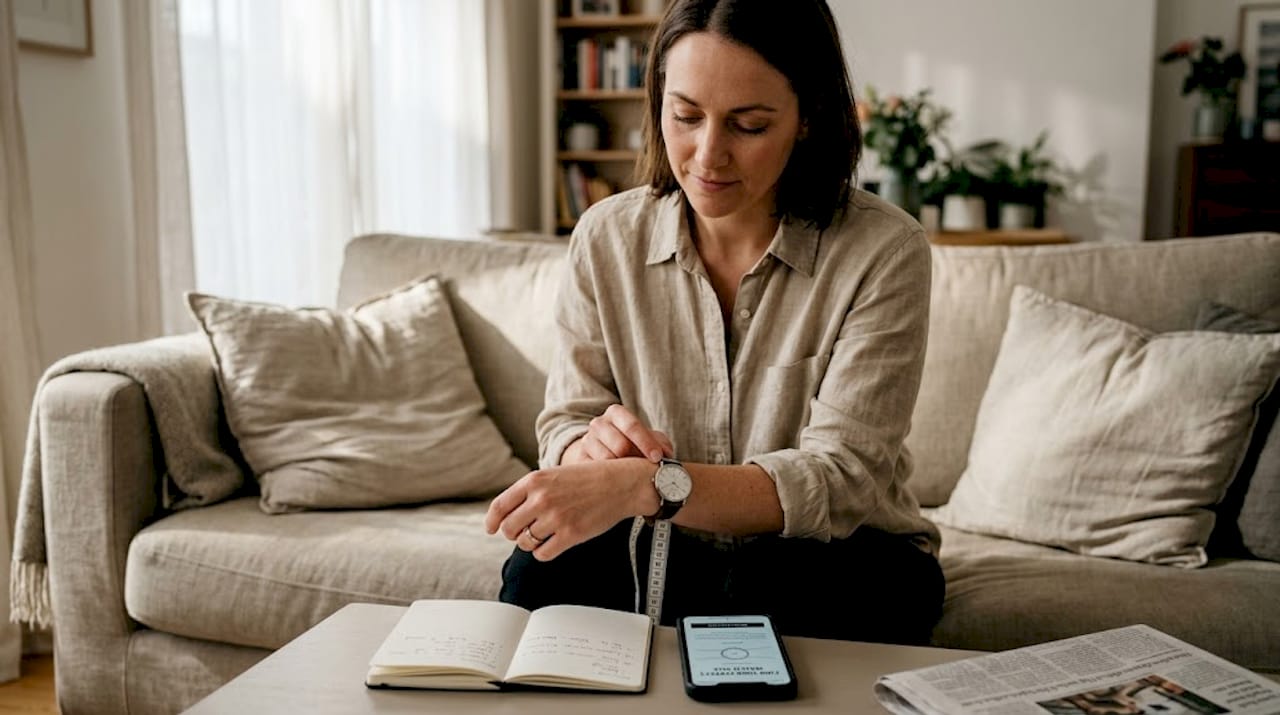
Size matters more than people expect. According to watch sizing guidance, 38 to 42mm suits most UK wrists comfortably, offering good dial presence without looking oversized.
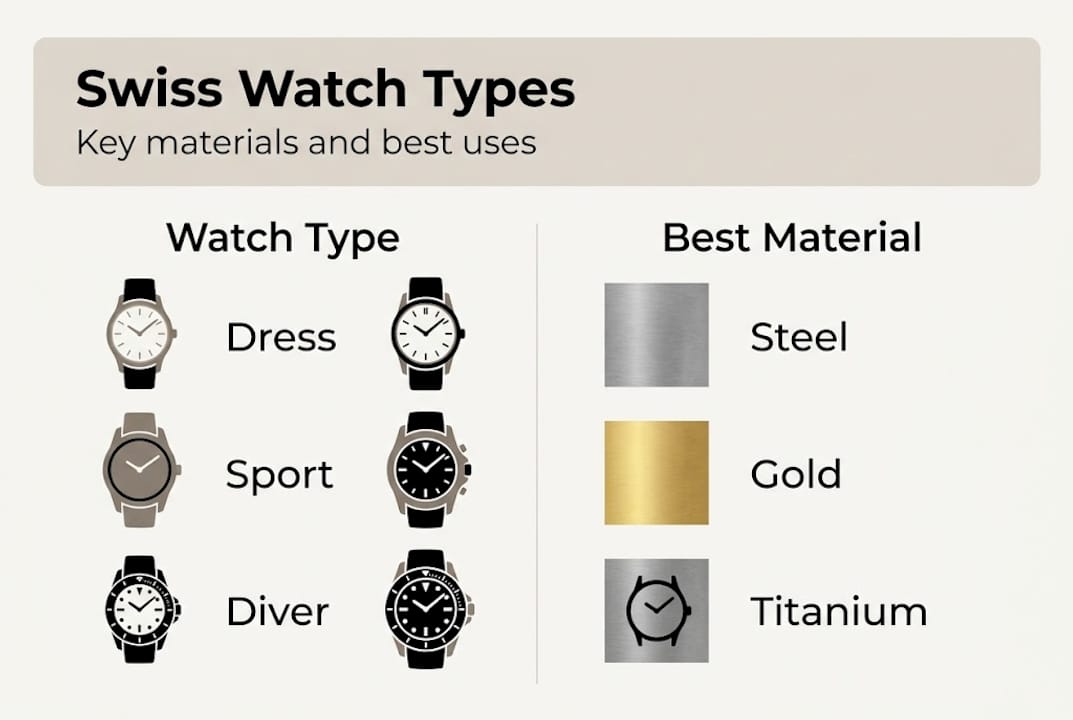
Watch type | Best materials | Typical size | Best suited for |
Dress | Gold, platinum, leather | 36–40mm | Formal occasions, collection |
Sports/diver | Stainless steel, sapphire | 40–44mm | Daily wear, investment |
Pilot | Steel, titanium, leather | 41–46mm | Casual and smart-casual wear |
Chronograph | Steel or gold, rubber/leather | 40–44mm | Collectors, enthusiasts |
For materials, stainless steel remains the most practical and the most liquid on the secondary market. Gold increases prestige and value but narrows the buyer pool. Titanium offers excellent comfort for larger cases.
Movement is perhaps the most important technical choice. Mechanical movements, either manual-wind or automatic, are universally preferred for investment pieces because they demonstrate fine craftsmanship and improve with careful watch maintenance. Quartz movements are accurate but lack the artisanal appeal that drives collector demand.
Pro Tip: Prioritise sapphire crystal over mineral glass if daily wear is your goal. It is significantly harder and resists scratching in almost all everyday scenarios, protecting dial legibility and resale condition for years.
Once you know the broad options, matching technical specs and styles to your lifestyle ensures your Swiss watch is genuinely worn and enjoyed.
Select reputable retailers and verify authenticity
The counterfeiting industry has grown alarmingly sophisticated. Some fakes are immediately obvious; others require expert inspection to identify. Protecting yourself starts with choosing the right seller.
Here is how the three main purchasing routes compare:
Buying route | Advantages | Risks |
Authorised dealer | Genuine stock, warranty, service network | Limited selection, full retail price |
Specialist pre-owned dealer | Wider range, better prices, expert knowledge | Verify credentials carefully |
Private/online marketplace | Potentially lowest prices | High counterfeit risk, no recourse |
UK buyers often prefer the in-store experience for a first purchase, because try-on and verification at an authorised dealer removes almost all risk. However, specialist pre-owned dealers like Horology Kings provide access to rare references and discontinued models that authorised dealers simply cannot stock.
When buying any Swiss watch, follow this process:
Research the dealer. Check reviews, industry memberships, and how long they’ve been trading. Understanding how to choose UK watch dealers is a skill worth developing early.
Inspect the paperwork. Every legitimate watch comes with original box, papers, and ideally a receipt or certificate of origin. Authentic Swiss watch dealers never struggle to provide these.
Check serial and model numbers. Verify these against the manufacturer’s records or a trusted database. Numbers should match the case, the papers, and the service booklet.
Request independent authentication. For investment-grade pieces above £10,000, professional luxury watch authentication from a third party is money well spent.
Use secure payment methods. Bank transfer direct to a verified business account is safer than cash or unprotected payment apps. Read up on safe watch buying practices before any transaction.
‘Always insist on paperwork and independent authentication for investment-grade watches.’ Missing documentation is one of the single biggest factors in reduced resale value.
Finally, once you’ve found a legitimate seller, there’s one investment factor you simply can’t overlook: service history and ongoing maintenance for long-term value.
Check service history and plan for long-term value
A luxury Swiss watch is a mechanical instrument. It needs regular care to perform accurately and to hold its worth. When buying pre-owned, the service history is just as revealing as the physical condition of the watch.
What constitutes a complete service record?
Original purchase receipt or invoice
Manufacturer’s service booklet with dated stamps
Records of any parts replaced during servicing
Documentation of who performed each service (authorised centre preferred)
Before-and-after photographs if the case or bracelet was polished
Service history is critical for both investment longevity and proving authenticity to future buyers. A gap in records doesn’t automatically mean a watch is problematic, but it does warrant deeper investigation and typically justifies a lower purchase price.
Typical service intervals vary by brand:
Rolex: Every five to ten years
Patek Philippe: Every three to five years
Omega: Every five to eight years
AP (Audemars Piguet): Every five years
For long-term collection value, keep all documentation from the moment you purchase. Store it safely, separate from the watch itself, and photograph every document as a digital backup.
Pro Tip: Always use authorised service centres for any maintenance work. Third-party repairs using non-genuine parts can reduce the watch’s desirability significantly and, in some cases, void any remaining manufacturer warranty. The value impact of improper servicing far outweighs the short-term cost saving.
If you want to see how proactive maintenance protects your investment, reviewing watch service documentation standards will give you a clear framework to follow.
Now that you have an expert’s checklist, here’s one essential mindset shift that separates savvy buyers from the crowd.
A collector’s perspective: Beyond the basics of choosing a Swiss watch
Here’s something the glossy buying guides rarely say: the best collections are rarely assembled quickly, and the best purchases are rarely the most logical ones.
We’ve seen clients buy technically perfect watches that they never wore because the connection wasn’t there. We’ve also seen clients make slightly impulsive purchases on a reference they fell in love with, only to hold it for a decade and sell for three times what they paid. Passion and patience are genuine edges in this market.
The watch world rewards those who invest time in real relationships. Developing trust with a specialist dealer means early access to desirable references, honest pricing, and guidance that goes beyond a transaction. The same applies to fellow collectors. Enthusiast communities, both online and in person, carry knowledge you simply won’t find in any buyer’s guide.
Market hypes around specific references come and go. Certain rare watch case studies show clearly that patience and selectivity consistently outperform chasing whatever is trending. Classic references from the Big Four tend to outperform novelty pieces over five-year or ten-year horizons. Buy what you genuinely love, verify everything, and let time do the rest.
Find your perfect Swiss watch with Horology Kings
At Horology Kings, we work with buyers at every stage, whether you’re still deciding between your first Rolex and Omega, or you’re searching for a specific Patek Philippe reference to complete a collection.
Our Hertfordshire-based team offers expert valuations, full authentication, and a sourcing service that reaches across our trusted network to find the exact piece you want. Every watch we handle comes with verified documentation and transparent pricing. If you’re ready to take the next step, source a Swiss watch through our dedicated service, or explore our expert watch servicing to keep your current collection performing at its best.
Frequently asked questions
What is the best Swiss watch brand to buy for investment in 2026?
Rolex and Patek Philippe lead in long-term retention and appreciation, with Rolex, Patek Philippe, AP, and Richard Mille collectively recognised as the top investment brands by collectors and market analysts alike.
Is it safe to buy Swiss watches online in the UK?
It can be safe if you use reputable, authorised dealers and always insist on proper authentication and complete paperwork. UK buyers benefit from verifying credentials and documentation before any online purchase is completed.
How important is service history when buying a Swiss watch?
Service history is vital for both authenticity and preserving future resale value; a watch without complete records is significantly less desirable to serious buyers and collectors.
Which features should I prioritise for a daily wear Swiss watch?
Opt for stainless steel or titanium cases, sapphire crystal and 38–42mm sizing, and a mechanical movement, which together deliver the best combination of durability, wearability, and long-term value retention.
Recommended
Comments