.png)
Limited edition watches explained: value, rarity and buying insights
TL;DR:
A true limited edition is produced in a fixed, publicly stated quantity with individual numbering.
Scarcity and genuine production limits drive higher value and collector demand.
Verifying authenticity requires official documentation, provenance, and manufacturer confirmation.
A single Patek Philippe limited edition sold at auction for over £5 million, yet the buyer ahead of them in the bidding queue had no idea how many examples existed. That disconnect is more common than you might think. The term ‘limited edition’ is one of the most misused phrases in the luxury watch market, and it costs collectors real money when misunderstood. Whether you are building a serious collection or considering your first significant purchase, knowing exactly what limited edition means, how it affects value, and how to buy wisely is not optional. It is essential.
Table of Contents
Key Takeaways
Point | Details |
True definition | A limited edition watch is a timepiece produced in a strictly finite quantity, distinguished from standard and special editions. |
Impact on value | Genuine limited editions can create significant demand and value appreciation due to scarcity and collector interest. |
Watch out for fakes | Always verify authenticity and production numbers as not all ‘limited editions’ are genuinely rare or valuable. |
Smart buying | Follow a thorough research and documentation checklist before purchasing any limited edition timepiece. |
What defines a limited edition watch?
With collectors often chasing the latest ‘exclusive’ releases, it is vital to grasp what actually qualifies as a limited edition and why these distinctions matter.
At its core, a limited edition watch is a timepiece produced in a strictly capped quantity. The manufacturer commits to a fixed production run, typically engraving or printing the edition number directly on the case back or dial, for example 001/250. Once that run is complete, no further examples are made. This is not a marketing promise. It is a production commitment, and it carries legal and reputational weight for the brands involved.
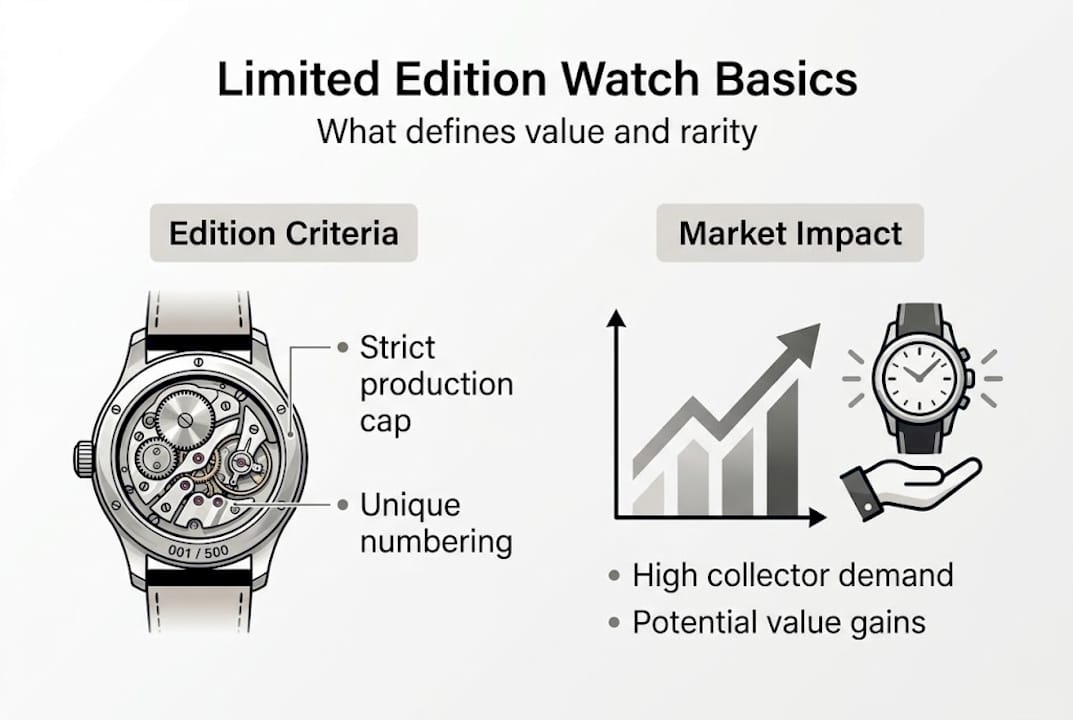
However, the term is applied loosely across the industry, and that is where confusion begins. A collector’s timepiece definition hinges on more than a label. Understanding the differences between edition types is fundamental:
Edition type | Production cap | Typical numbering | Rarity level |
Limited edition | Strictly fixed | Yes (e.g. 001/500) | High |
Special edition | Often uncapped | Rarely | Variable |
Standard production | Open-ended | No | Low |
Special editions are frequently mistaken for limited editions. A special edition may feature a unique dial colour or commemorative engraving, but the brand may produce thousands of examples with no cap in place. Standard production models, by contrast, are simply the core catalogue offering.
According to Hodinkee’s analysis of limited editions, a significant proportion of buyers cannot accurately state the production size of the watch they purchased, which speaks to how effectively marketing language clouds genuine understanding. This matters because production size directly influences secondary market behaviour.
Famous recent examples that illustrate genuine limited edition practice include the Audemars Piguet Royal Oak Concept series, produced in runs as small as 50 pieces globally, and the Rolex Daytona ‘John Player Special’ references, which command premiums far beyond their retail price due to documented scarcity.
Key characteristics that define a true limited edition:
A publicly stated, fixed production number
Individual numbering on each piece
Official documentation confirming edition status
No re-issue or continuation of the same reference
When authenticating luxury watches, verifying edition status is one of the first steps any serious buyer should take. The difference between limited and special is not semantic. It is financial.
Why limited editions matter to collectors and the market
Defining what makes a model ‘limited edition’ sets the foundation for understanding why collectors and investors gravitate towards these timepieces.
Scarcity drives desire. That is not a new concept, but in the luxury watch world it plays out with remarkable intensity. When a brand caps production at 200 pieces for a global market of millions of enthusiasts, the mathematics of supply and demand work strongly in favour of the buyer who secures one at retail.
Rare Swiss watches have demonstrated 50% value gains within a single year in documented cases, particularly for pieces from Patek Philippe and Audemars Piguet. These are not outliers. They reflect a pattern that the secondary market has reinforced repeatedly.
Watch reference | Production run | Retail price (approx.) | Secondary market premium |
AP Royal Oak Concept | 50 pieces | £120,000 | 80 to 150% above retail |
Patek Philippe Nautilus 5711 | Discontinued | £30,000 | 200 to 300% above retail |
Rolex Daytona ‘Panda’ | Open production | £14,000 | 60 to 100% above retail |
The psychological drivers behind collector demand are equally important. Exclusivity signals status. Owning a piece that fewer than 500 people in the world possess is a powerful motivator, and brands understand this deeply. It is why Forbes identifies limited edition watches as valuable not just as objects but as social and financial assets.
At auction, limited editions consistently outperform expectations. Christie’s and Phillips regularly see bidding wars erupt over pieces with production runs below 100. The combination of documented scarcity and collector passion creates a market dynamic unlike almost any other luxury category.
That said, the market does overhype certain releases. Not every watch labelled ‘limited’ appreciates. Some depreciate sharply once the initial excitement fades. Using a proper watch valuation guide before committing to a purchase is essential to separating genuine opportunity from marketing noise.
Factors that support strong value retention in limited editions:
Brand heritage and auction track record
Very small production numbers (under 500 pieces)
Unique complications or materials not found in standard lines
Strong collector community and documented demand
Recognising true limited editions: factors and pitfalls
Knowing why limited editions matter, it is just as crucial for collectors to correctly identify genuine exclusivity and avoid common traps.
The numbering on a watch case back is your first reference point. A marking of 047/200 tells you two things: this is the 47th example produced, and the total run is 200 pieces. But numbering alone is not sufficient proof. Skilled counterfeiters replicate engravings, and some sellers apply misleading edition claims to standard production watches.
Spotting fake watches requires more than a visual inspection. Verifying provenance through official paperwork is non-negotiable. Here is what to look for when assessing a limited edition claim:
Official certificate of authenticity issued by the manufacturer
Original box and papers matching the edition number on the watch
Retailer purchase receipt or auction house documentation
Brand registration records where applicable
Consistent serial number matching manufacturer databases
Red flags that should prompt serious caution:
Vague edition language such as ‘boutique exclusive’ or ‘regional limited’ without a stated production number
Missing or photocopied documentation
A seller unable or unwilling to confirm the total edition size
Prices significantly below secondary market value for a supposedly rare piece
No provenance trail beyond the current seller
The concept of provenance in collecting is particularly important here. A watch with a clear ownership history, original receipts, and manufacturer correspondence is worth considerably more than an identical example with no paper trail.
Pro Tip: Always request the full documentation pack before agreeing a price. Serial numbers are useful, but the complete paperwork, including the original purchase invoice and manufacturer certificate, is what protects your investment and supports resale value.
GQ’s limited edition insights highlight how ‘boutique exclusives’ are a particularly common source of confusion. A brand may produce a dial variant exclusively for one retailer, presenting it as rare, while actually making several hundred examples across multiple boutique locations globally. Always ask for the global production figure, not just the allocation to a single retailer.
When you authenticate a luxury watch before purchase, the edition verification process should be built into your standard due diligence, not treated as an afterthought.

Buying a limited edition watch: strategy and checklist
Once you know how to separate true limited editions from marketing hype, you will want to follow proven strategies to buy confidently and securely.
The signs of watch value go beyond condition and brand name. For limited editions specifically, the buying process demands a structured approach. Here is a step-by-step checklist:
Research the production run before approaching a seller. Know the total edition size and any regional allocation details.
Verify the edition number on the case back matches the documentation.
Request all original paperwork, including box, certificate, and purchase receipt.
Cross-reference the serial number with the manufacturer’s records or an authorised dealer.
Check auction records for comparable sales to establish fair market value.
Inspect the watch in person or via a trusted third party before completing payment.
Confirm the seller’s reputation through reviews, industry references, or established dealer status.
Choosing where you buy matters enormously. Established dealers who specialise in pre-owned luxury watches offer accountability that private sellers cannot match. Ask any seller directly: Can you provide the full provenance? What is your returns policy if authentication fails? How do you handle disputes?
Audemars Piguet limited editions represent one of the strongest legacies in this space. The brand’s Royal Oak Offshore and Concept series have produced some of the most sought-after limited runs of the past two decades, with resale premiums that consistently reward patient, well-informed buyers.
Pro Tip: Retain every document associated with your purchase, including correspondence with the seller. Complete paperwork can add 15 to 25% to the resale value of a limited edition piece, particularly at auction.
Modern buying channels have expanded significantly. Online launches, brand pre-order programmes, and specialist auction platforms now sit alongside traditional boutique retail. Esquire’s buying advice recommends treating pre-orders with particular caution, as delivery timelines and final specifications can shift between announcement and release.
A collector’s perspective: why true rarity is more than a number
After covering practical and technical insights, it is worth exploring the meaning of rarity from a more philosophical, collector-minded perspective.
Here is something the market rarely says plainly: not all limited editions are equally collectible, and a low production number does not automatically make a watch worth owning. We have seen pieces produced in runs of 25 sit unsold for years, while a standard production reference with a compelling story trades hands for multiples of its retail price.
The watches that genuinely endure in collections tend to share something beyond scarcity. They have a story. A movement breakthrough, a celebrated collaboration, a historical moment captured in the design. That narrative is what separates a truly collectible piece from a watch that merely carries a number on its case back.
Sentimental value and celebrated provenance sometimes outweigh production figures entirely. A true collector’s value is built on meaning as much as mathematics. Our advice, drawn from years of working with serious collectors, is this: buy what moves you, then verify that the fundamentals support it. Passion and rigour are not opposites in this hobby. The best collections are built on both.
Source your next limited edition with Horology Kings
If this guide has inspired your search for a unique timepiece, expert help is available for every step of your buying journey.
At Horology Kings, we specialise in sourcing, authenticating, and valuing limited edition watches for collectors across the UK and beyond. Our team understands the nuances that separate genuine rarity from clever marketing, and we apply that knowledge to every piece we handle. Whether you are looking to browse our curated luxury watch selection or need help tracking down a specific reference, we are here to help.
For collectors seeking something truly rare, our dedicated watch sourcing service leverages an expert network built over years in the industry. We handle the due diligence so you can focus on the joy of collecting, with full transparency and secure UK bank transfers at every stage.
Frequently asked questions
How do I verify a watch is truly a limited edition?
Always check for official documentation, edition number marking, and request provenance papers to confirm authenticity. Authenticating a luxury watch should include verifying the stated production run directly with the manufacturer or an authorised dealer.
Do limited edition watches always increase in value?
Not always. While rare Swiss watches have shown 50% gains in documented cases, many limited editions hold steady or depreciate; brand reputation, production size, and collector demand all play decisive roles.
What makes limited editions different from special editions?
Limited editions have a strictly capped and publicly stated production run, while special editions may feature unique design elements without any cap on the number produced.
Which luxury brands are famous for sought-after limited editions?
Brands such as Audemars Piguet, Patek Philippe, and Rolex are consistently regarded as the benchmark for desirable limited runs, often featuring exclusive complications and materials unavailable in their standard collections.
Recommended
Comments