.png)

Notable luxury watch engravings: a collector's guide
- lewisvrichards3
- May 20
- 9 min read
TL;DR:
Notable watch engravings significantly enhance a timepiece’s provenance, artistry, and collectability when executed with skilled techniques and supported by clear provenance. Limited editions and heritage models with documented historical significance rank highest, while personal engravings mostly have sentimental value but can reduce market worth. Recognising the craftsmanship behind engravings, such as bulino and friction techniques, allows collectors to identify genuine, irreplaceable pieces that will appreciate over time.
A watch without an engraving tells the time. A watch with one tells a story. For serious collectors, notable luxury watch engravings represent one of the most underappreciated dimensions of haute horlogerie, where artistry, provenance, and personal meaning converge on a surface smaller than a thumbnail. Yet identifying which engravings are genuinely significant, and which are decorative afterthoughts, is a skill most enthusiasts develop slowly, often at the cost of missed opportunities. This guide cuts through that uncertainty with a curated framework and specific examples worth knowing.
Table of Contents
Key takeaways
Point | Details |
Engraving adds provenance | A historically significant engraving can substantially increase a watch’s collectability and auction value. |
Technique determines quality | Hand engraving methods like bulino set a far higher standard than machine-cut text. |
Limited editions carry weight | Anniversary engravings on restricted runs signal authenticity and often appreciate faster. |
Personalisation has practical limits | Keep personal engravings under 200 characters to maintain legibility on any case surface. |
Display matters for engraved pieces | Warm wood showcases complement engraved heritage watches and help present them at their best. |
1. Criteria for evaluating notable luxury watch engravings
Not all engravings are created equal. Before you can properly appreciate the notable luxury watch engravings on any given timepiece, you need a clear set of criteria to measure them against. Here is how experts at Horology-kings approach evaluation.
Artistic technique. The method used to cut the engraving matters enormously. Hand engraving using a burin or the Italian bulino technique achieves surgical precision and genuine figurative storytelling on metal surfaces. Machine-engraved text, by contrast, is uniform and lacks the organic depth of hand work. For artisan engraving techniques to qualify as notable, the hand of the engraver must be visible in the result.
Historical provenance. Engravings connected to specific people or events carry weight beyond their appearance. A caseback inscription confirming a gift from a head of state, or an anniversary edition engraving commemorating a brand milestone, elevates a watch from collectible to significant.
Rarity and limited edition status. Limited edition engravings on restricted production runs signal authenticity in a way a standard retail engraving cannot. The fewer pieces produced, the more the engraving reinforces the watch’s scarcity.
Placement and material. Where an engraving sits changes how you experience it. Casebacks reward the owner on every removal. Rotors are glimpsed through exhibition casebacks. Bezels are worn publicly. Each placement carries different expressive weight, and the metal or surface treated (gold, platinum, enamel, silver) affects the visual result significantly.
Impact on value. A well-documented, historically relevant engraving can meaningfully increase realised prices at auction. Conversely, a poorly executed personal engraving by a previous owner can suppress value. Understanding this distinction is one of the more practical skills a collector can develop.
Ask for provenance documentation that explains the origin of any significant engraving.
Examine the engraving under magnification before purchase whenever possible.
Cross-reference auction records to see whether comparable engravings have added or reduced value.
Pro Tip: If a seller cannot explain why an engraving is significant, treat that as a gap in the provenance chain, not a minor detail.
2. The Patek Philippe Nautilus 50th anniversary engraving
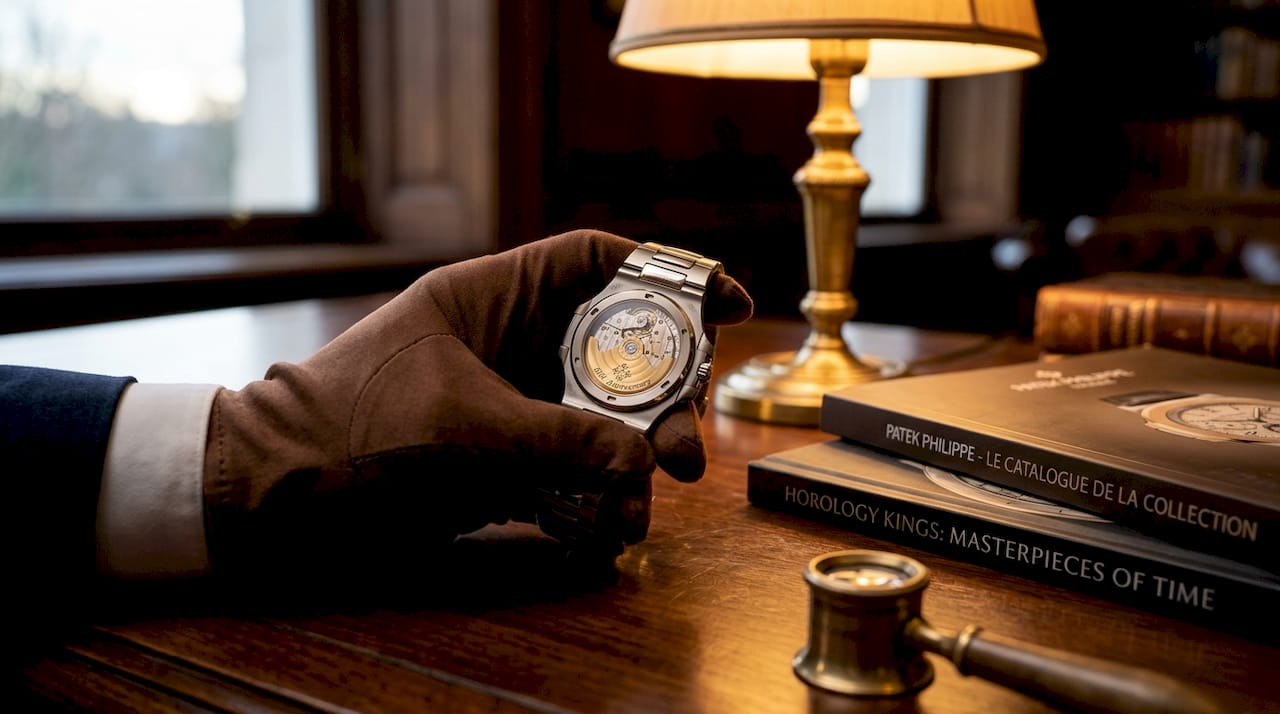
Patek Philippe marked five decades of the Nautilus in 2026 with one of the most talked-about luxury watch engraving ideas of the year. The house produced a limited run of 2,000 pieces, each carrying a 22-carat gold micro-rotor engraved with the inscription “50 1976–2026.” At 90,000 CHF per piece, the engraving is not merely decorative. It is a certification of the watch’s place in horological history, visible through the sapphire caseback with every glance.
What makes this engraving notable is the combination of factors it satisfies simultaneously: precious metal, skilled execution, strict scarcity, and an anniversary narrative that any knowledgeable collector can immediately contextualise. Historically inspired limited editions use engravings precisely this way, to confer authenticity and commemorate milestones while boosting collectability.
3. The Moritz Grossmann Tefnut silver-plating by friction engraving
To mark its 200th anniversary, Moritz Grossmann released the Tefnut in a version using an almost extinct technique: silver-plating by friction. The balance cock of each piece carries the engraved year “1826”, the year of the brand’s founding, executed with a precision that reflects the watchmaker’s Germanic perfectionism. With only 12 pieces per version, priced between €52,500 and €54,300, this is an engraving that functions as a historical document as much as an aesthetic choice.
The technique itself is worth noting. Silver-plating by friction involves manually applying silver to the component surface through controlled abrasion, a method that creates a depth and warmth machine processes cannot replicate. For collectors who care about how an engraving was made, not just what it says, the Tefnut is a masterclass.
4. Luca Cavolini’s bulino technique on watch dials
Master engraver Luca Cavolini treats watch surfaces as figurative storytelling canvases, using the bulino technique to achieve results that look closer to fine art print-making than traditional watchmaking decoration. The bulino involves using a very fine burin to build up tonal images through thousands of tiny individual marks, each placed by hand. There is no undo. Every mark is permanent.
Cavolini’s work appears on custom commissions where the watch face or caseback becomes a miniature narrative scene, whether a landscape, a portrait, or an abstract composition. What distinguishes his engravings from standard decorative work is that the figurative storytelling has compositional intent. You read the image rather than simply admire a pattern. For collectors who value unique watch designs, a Cavolini-engraved piece represents something genuinely irreplaceable.
5. Patek Philippe Rare Handcrafts 2026 collection
The 2026 Rare Handcrafts collection from Patek Philippe brought multiple intricate hand-engraved casebacks to Geneva, each depicting nature scenes, musical allegories, and architectural motifs worked in extraordinary detail. This is not anniversary engraving for commemorative purposes. This is engraving as the primary artistic statement of the watch, subordinating the movement and dial to the craftsmanship on the reverse.
Patek Philippe’s Rare Handcrafts pieces consistently achieve significant auction premiums because the engraving work is documented, attributable, and irreproducible at scale. They represent the clearest example in contemporary watchmaking of what luxury watch personalisation can look like when a house commits fully to the craft. Collectors who understand the value of a collector’s timepiece consistently rank these pieces among the most significant acquisitions available.
6. Bovet Fleurier’s engraving as brand identity
At Bovet Fleurier, hand-engraving is a core part of the brand’s identity rather than an occasional flourish applied to special editions. The house employs in-house engravers whose work appears across the movement, case, and dial on a significant proportion of its production. Engraving is not decoration here. It is structure.
This philosophy separates Bovet from brands that treat engraving as a finishing option. The result is that even a standard Bovet carries a depth of surface detail that many limited-edition watches from larger houses cannot match. For collectors building a collection around engraving quality rather than brand recognition, Bovet is a name that consistently rewards closer attention.
7. Personal handwriting engravings on luxury watches
Handwriting engraving offers a layer of personalisation that no factory option can replicate. Several specialist engravers now offer the ability to reproduce actual handwriting on a caseback or inner case surface, working from a high-quality scan or photograph and providing a digital proof before any cutting begins. The result is something genuinely unique: a watch carrying the literal hand of a person who mattered.
The constraint is practical. Legibility requires keeping the text under 200 characters, and the quality of the source image directly affects the fidelity of the reproduction. When done well, a handwriting engraving transforms a fine watch into a genuinely irreplaceable object, which is worth thinking about when you consider that most other forms of luxury watch personalisation stop well short of that level of intimacy.
8. Comparison of selected notable engravings
Watch model | Engraving type | Limited edition | Artistic technique | Historical significance | Price indication |
Patek Philippe Nautilus 50th | Anniversary text, micro-rotor | Yes, 2,000 pieces | Precision hand-engraved gold | 50 years of the Nautilus | 90,000 CHF |
Moritz Grossmann Tefnut | Founding year, balance cock | Yes, 12 per version | Silver-plating by friction | Brand 200th anniversary | €52,500–€54,300 |
Patek Philippe Rare Handcrafts 2026 | Figurative caseback scenes | Yes, very limited | Hand engraving, multiple techniques | High artistic prestige | Price on application |
Bovet Fleurier (standard production) | Movement and case decoration | No | In-house hand engraving | Brand identity piece | Varies by model |
Cavolini commission | Bespoke figurative dial/caseback | One of a kind | Bulino | Unique provenance | Commission-dependent |
Personal handwriting piece | Text or signature | One of a kind | Specialist reproduction | Personal significance | Varies by engraver |
The table illustrates a clear hierarchy. Watches combining limited production, attributable technique, and documented historical significance occupy the top tier for collectability. Personal engravings, while emotionally significant, rarely enhance market value.
9. Choosing the right engraving for your collection
The right notable engraving depends entirely on what you are trying to achieve as a collector. Here is a straightforward breakdown by collector profile.
The historical collector should prioritise anniversary and commemorative engravings on verified limited editions, where the documentation is solid and the narrative is well-established. The Patek Philippe Nautilus 50th is the obvious current example. Authentication matters above everything else. Always verify that the engraving matches production records.
The art-focused collector should look at houses like Bovet and bespoke commissions using techniques such as bulino. Understanding how rarity drives value in this context means recognising that one genuinely hand-engraved piece outweighs ten with machine-applied decoration, regardless of brand recognition.
The personalisation collector is making an emotional rather than financial argument for their acquisition. That is entirely legitimate. The practical rules to follow:
Keep inscriptions under 200 characters for legibility.
Use a specialist engraver who provides digital proofs before cutting.
Understand that personal engravings by previous owners typically reduce secondary market value, even when well-executed.
Choose placement thoughtfully: a caseback inscription is private, a bezel inscription is public.
For display, heritage watch engravings are best presented in showcases using warm materials such as walnut or ebony, which complement the tonal depth of hand-engraved surfaces without competing visually.
Pro Tip: When buying an engraved watch for investment, treat the engraving as part of the provenance chain. Request any documentation that explains who commissioned it, when, and why.
My honest perspective on engraved watches
I have spent years studying engraved timepieces, and the consistent surprise is how often serious collectors undervalue them. People who would spend weeks researching a movement complication give a hand-engraved caseback a cursory glance and move on. That is a significant blind spot.
The emotional weight of a hand-engraved watch is not sentimental fluff. It is evidence of irreproducibility. When Luca Cavolini places ten thousand individual marks on a watch surface to build a single image, that work cannot be faked, copied, or printed. It is also finished. Unlike a movement that might be serviced and adjusted repeatedly over decades, the engraving is fixed in time at the moment of creation.
What I have found is that the collectors who genuinely understand engraving technique, who know the difference between bulino and engine-turning, who can read a caseback for its artistry rather than just its text, consistently acquire watches that others undervalue. That gap between what the market assigns and what the piece is actually worth is where the most interesting opportunities sit.
My view is that engraving will become increasingly significant as haute horlogerie faces pressure to justify the premium it commands. When movements are mechanically mature and design languages are established, hand engraving is one of the few remaining frontiers where genuine, irreproducible human skill can be demonstrated directly on the object. That is not going away.
— Lewis
Source and acquire engraved watches through Horology-kings

Finding watches with genuinely notable engravings requires more than browsing a standard retail catalogue. At Horology-kings, we specialise in sourcing, buying, and selling authenticated luxury timepieces across Patek Philippe, Audemars Piguet, Rolex, and beyond, including limited editions and engraved pieces that rarely appear through conventional channels. Our team provides expert valuations and discreet purchasing assistance, so whether you are acquiring or selling a significant engraved watch, you can do so with full confidence. If you have a specific piece in mind, our watch sourcing service connects you directly to our specialist network.
FAQ
What makes an engraving add value to a luxury watch?
An engraving adds value when it carries documented historical provenance, was applied using a skilled hand technique, and appears on a verified limited edition. Personal engravings by previous owners typically reduce market value rather than increase it.
What is the bulino technique in watch engraving?
Bulino is a fine engraving method using a small hand-held burin to build tonal images through thousands of individual marks. It achieves figurative precision on metal surfaces and is considered one of the most demanding skills in decorative watchmaking.
How long should a personal watch engraving be?
Keep personal engravings under 200 characters to maintain legibility on a watch case surface. A shorter, well-chosen inscription will always read more clearly than a lengthy text compressed onto a small caseback.
Which brands are most associated with hand-engraved watches?
Patek Philippe, Bovet Fleurier, and Moritz Grossmann are among the most consistently recognised names for notable hand-engraved luxury watches. Bovet in particular treats engraving as a core element of its identity rather than a special-edition option.
How should engraved watches be displayed?
Heritage watch engravings are best displayed in showcases using warm materials such as walnut or ebony, which complement the tonal quality of hand-engraved surfaces and protect the piece from dust and light exposure.
Recommended
Comments