.png)
CHF 500 won't prove ownership: Patek Extracts explained for UK buyers
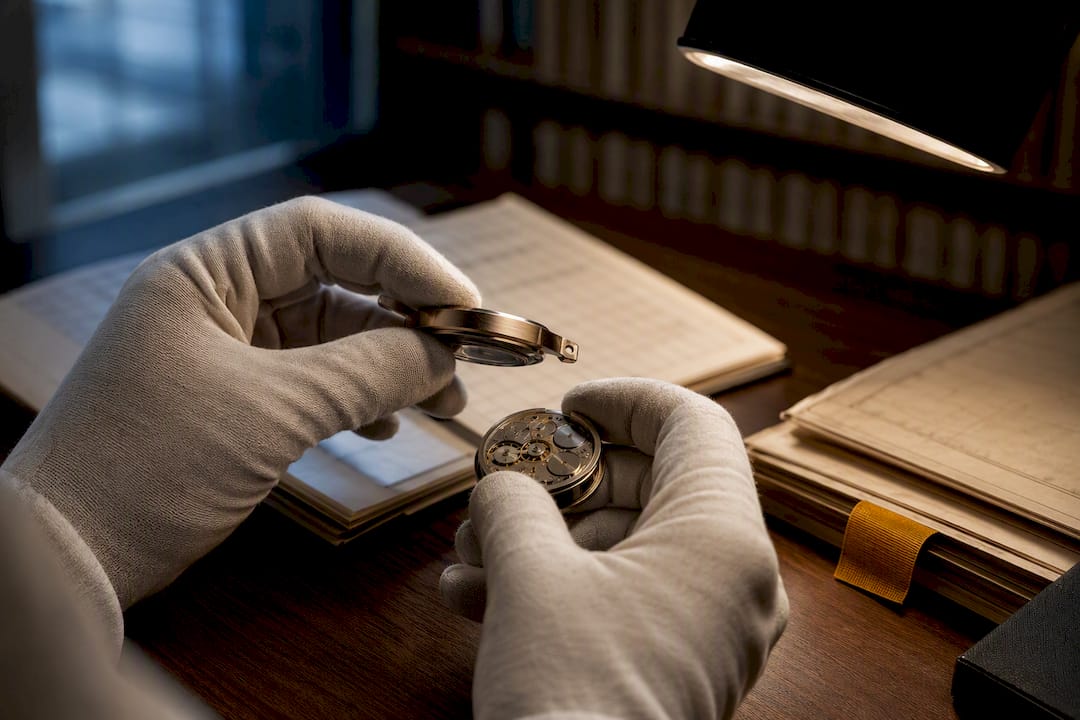
A Patek Extract from the Archives is Patek Philippe’s official transcript of its historical sales register, confirming details such as manufacture date, case and movement numbers, and original specification. Owners can request one once their watch is at least ten years past its first sale, for a service fee of CHF 500. It is a valuable research document, but it is not proof of ownership and it will not authenticate a watch on its own.
TL;DR:
An Extract from the Archives records only the factory details of a watch, such as case and movement numbers, manufacture, and sale dates, but does not prove ownership or authenticity.
Requests are limited to vintage models first sold at least ten years earlier, with a maximum of one request per year per watch, focusing mainly on watches produced until 1989.
Accurate submission of high-quality photographs, serial numbers, and supporting documents is crucial, as incorrect or incomplete files often cause delays or rejection.
The service fee is CHF 500, with an estimated processing time of about ten weeks, and the fee is refundable if the watch is found ineligible.
The Extract is best used to confirm facts for provenance research and should be paired with physical inspection and authentication checks for reliable valuation.
Table of Contents
How to order an Extract from the Archives
Every request starts on Patek Philippe’s own website, not through a dealer or third party. The official ordering page hosts the order form and a downloadable set of photo instructions that specify exactly what images the archive department needs to identify a watch correctly.
Getting the submission right the first time matters, because incomplete files are one of the most common causes of delay. Before you begin, gather:
Clear photographs of the dial, case, caseback and movement.
The case number and movement number, legible and unobscured.
Any existing service papers or previous Patek documentation, if available.
A valid email address for confirmation and delivery updates.
Once submitted, Patek’s system generates a confirmation receipt. Keep this. It is your reference point if you need to query progress or clarify a document later, and it is the only proof you have that the request entered the queue.
Eligibility rules and the vintage focus
Not every Patek Philippe watch qualifies, and the rules are stricter than many first-time applicants expect. Two conditions apply to every request:
The watch must have been first sold at least ten years before the date of the request.
Only one request per timepiece is permitted roughly once per year.
In 2021, Patek Philippe refocused the service specifically toward antique and vintage watches, broadly meaning models produced or sold until 1989. The Extract was never designed to replace the Certificate of Origin issued with contemporary watches, and Patek has made that distinction explicit. If you own a recent model, the Certificate of Origin from the point of sale remains your primary document, not an Extract.
One detail collectors often overlook: an Extract is issued for the watch, not the person requesting it. It carries no owner’s name and confers no legal claim.
What the Extract records and what it leaves out
An Extract draws on registers Patek Philippe has kept since 1839, and typically lists the watch type, case number, movement number, caliber, style, dial type, bracelet type, and the dates of manufacture and sale. For a vintage piece, that combination of facts can settle years of speculation about whether a dial or bracelet is original to the watch.
What it will not do is certify authenticity or confirm current ownership. Because the document is a transcript of factory records at the point of sale, it can just as easily expose a problem as confirm a pedigree, flagging a redial, a swapped movement, or other departures from the original specification. That is a feature, not a flaw, but it means sellers should be prepared for what an Extract might reveal before they order one.
Preparing your request: photos, serials and invoices
The quality of your submission decides how smoothly the request moves through Patek’s archive department. Follow this sequence:
Photograph the dial, full case, caseback and movement in good, even light, with no glare over engraved numbers.
Confirm the case and movement numbers match what you photograph. Mismatches are a common trigger for rejection.
If the watch has been serviced by Patek Philippe recently, check whether that service invoice falls within the guarantee period — if so, it can substitute for serial-number photographs.
Name your files clearly (front, back, movement, case number) and submit high-resolution scans or photographs rather than screenshots.
Keep a copy of every document you submit, in case Patek’s team requests clarification.
Pro Tip: If your watch’s serials are worn or partially obscured from polishing, a recent Patek service invoice is often a cleaner substitute than a poor photograph, and it avoids the delay of a rejected image.
Heavy modification, missing or altered numbers, and paperwork that contradicts the physical watch are the most frequent reasons a request stalls or is refused outright.
Cost, processing time and refunds
Set your expectations before you pay. The service costs CHF 500 per request, payable in Swiss francs, and international customers should check their bank’s foreign transaction handling before submitting payment.
Patek’s stated processing window runs to roughly ten weeks from order confirmation, so this is not a same-month document for anyone planning an imminent sale or auction consignment.
Key terms to note before ordering:
Fee: CHF 500 per request.
Frequency: one request per timepiece roughly once per year.
Delivery: approximately several weeks.
Refund: the fee is returned in full if the timepiece is found ineligible.
Build the ten-week window into any sale timeline well in advance.
How collectors and dealers actually use Extracts
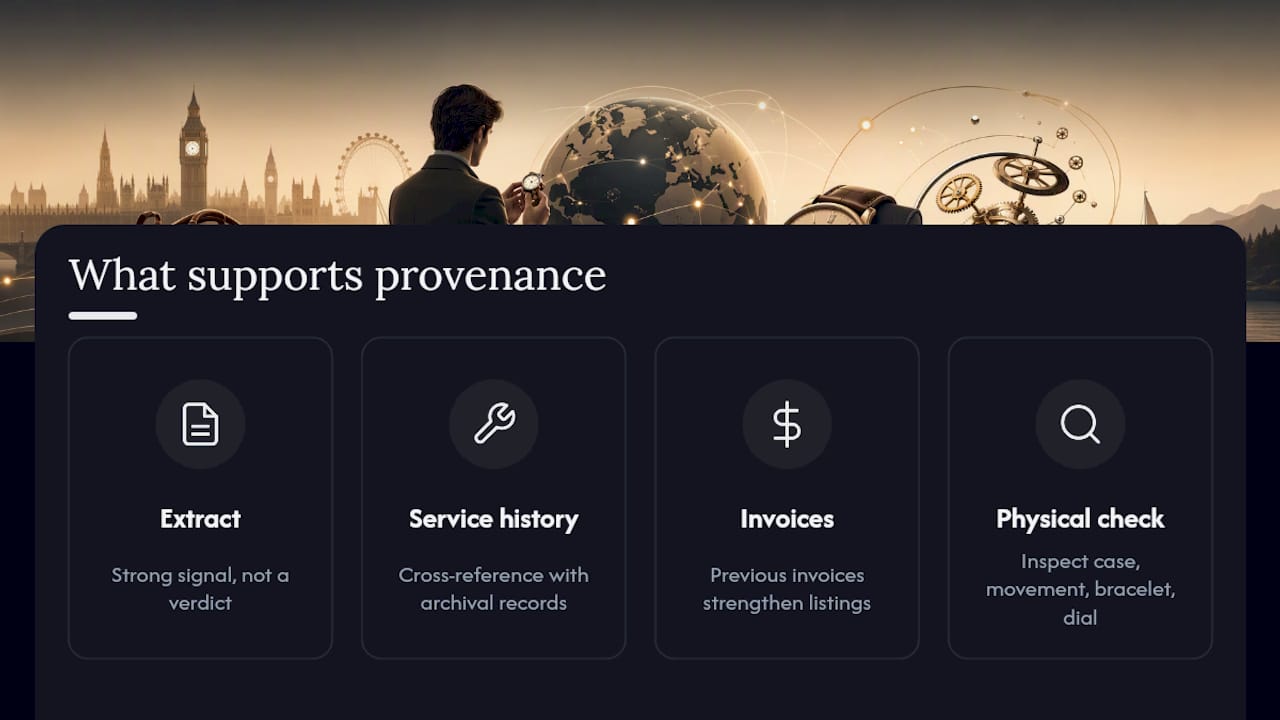
Provenance research rarely rests on one document, and an Extract is most useful alongside the paperwork a watch already carries. Dealers and serious collectors treat it as one piece of a larger puzzle: confirming the case and movement numbers align, checking the manufacture and sale dates against a family history, and using the record to settle a dispute over an “original” bracelet or dial before a sale proceeds.
Vintage Patek Philippe watches are typically approached by cross-referencing archival documentation with service history, previous invoices, and physical inspection, because a single Extract will not catch every discrepancy on its own. It is a strong signal, not a verdict. Where a client is preparing a private sale or considering selling a Patek Philippe, we walk through which supporting documents actually strengthen a listing and which are cosmetic.
Why the Extract gets misunderstood
The biggest misconception around this document is that it functions like a passport, something that proves the watch is genuine and that you legitimately own it. It does neither. It confirms what Patek Philippe’s own register says about a specific case and movement combination at the point of first sale, nothing more.
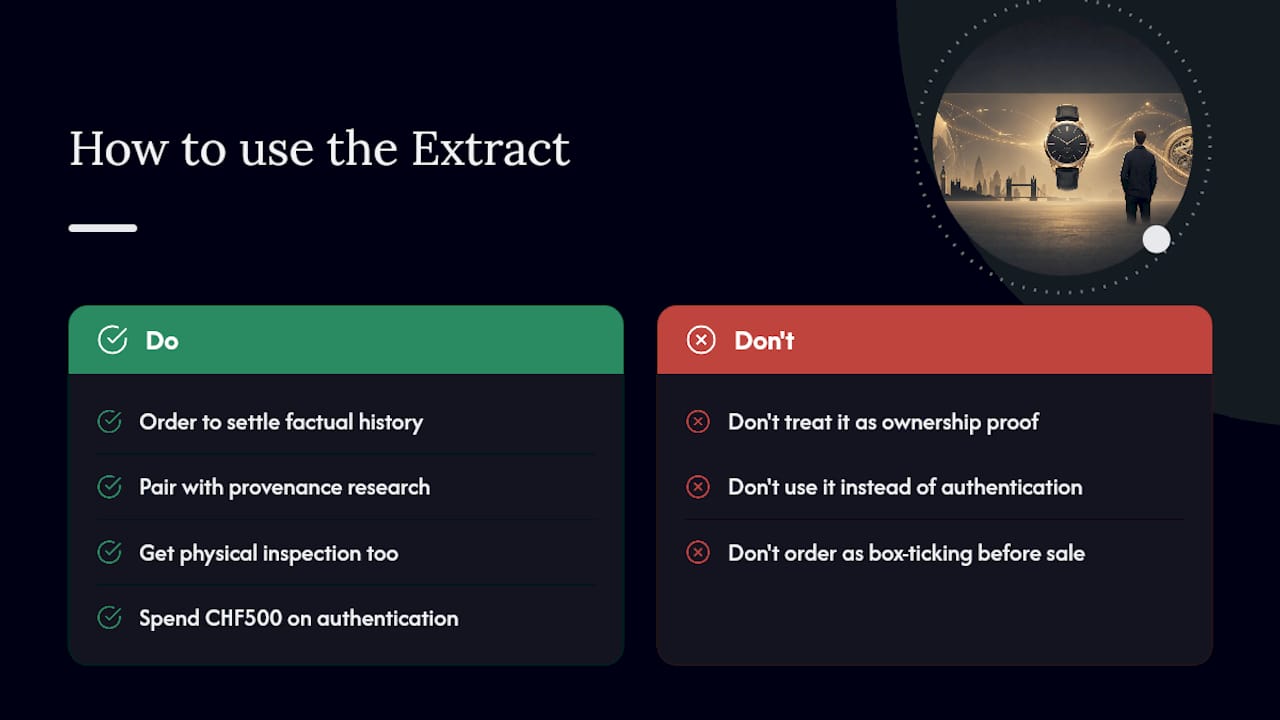
That distinction gets lost because the fee, the formality of the request, and the ten-week wait all suggest something more binding than a records transcript. Collectors chasing certainty would do better spending that CHF 500 alongside a proper authentication check rather than in place of one. The 2021 refocus toward antique and vintage watches was, if anything, an admission from Patek that the service had been asked to do a job it was never built for.
My advice to anyone weighing this up: order the Extract when you genuinely need to settle a factual question about an older watch’s history, not as a box-ticking exercise before a sale. Pair it with proper provenance research and physical inspection, and it earns its keep. Used alone, it tells you less than the price tag implies.
— Lewis
Let Horology-kings handle the paperwork and the sale
Gathering serials, chasing service invoices, and photographing a decades-old caseback properly is fiddly work, and one blurred image can cost you another twelve months’ wait under the request-frequency rule. Horology-kings is the practical alternative to doing this alone: our specialists know how to prepare documentation correctly the first time, and we handle the sale that follows.
We do not issue official Extracts ourselves, but we help clients prepare accurate photographs and paperwork before they submit a request, and we build that documentation into a proper watch valuation once it arrives. If you are weighing up a sale, our team can also source a specific watch on your behalf, complete with the provenance checks a serious buyer expects. Get in touch through Horology-kings to start your valuation, or browse our current pre-owned watches while your paperwork is in progress.
Sources
For the current rules, fees and timelines, go directly to Patek Philippe’s Extract from the Archives FAQ and the official ordering page, which includes the photo instructions referenced throughout this guide. Hodinkee’s report on Patek’s 2021 policy change remains the clearest independent account of why the service shifted toward vintage watches.
FAQ
What does “extract from the archives” mean?
It means a certified transcript of Patek Philippe’s own sales register for a specific watch, covering details recorded at the point of manufacture and sale. It is not a certificate of authenticity or an ownership document.
Can a normal person buy a Patek Philippe?
Yes. Patek Philippe sells through authorised retailers for new models, and pre-owned examples are widely available through specialist dealers such as Horology-kings, where every watch is authenticated before sale. Vintage and rare references simply require more patience and, often, sourcing help to find the right piece.
Is Patek dropping prices?
Prices across the pre-owned market fluctuate by model and reference rather than moving as one trend, and speculation about broad price drops rarely reflects what happens at the top end of rare or vintage pieces. A current valuation from a specialist dealer is the most reliable way to know where a specific watch stands today.
Is Patek more luxurious than Rolex?
Both are regarded among the finest Swiss watchmakers, but they sit in different tiers of exclusivity and craftsmanship, and comparing them comes down to personal taste and collecting priorities rather than one being objectively superior. Patek Philippe is generally positioned higher for haute horlogerie complications and historical prestige, while Rolex leads on volume and brand recognition.
How much does a Patek Extract from the Archives cost?
The service costs CHF 500 per request, refunded in full if the watch turns out to be ineligible. Processing typically takes around ten weeks from order confirmation.
Recommended
Comments