.png)

Selling an unserviced luxury watch: your 2026 guide
- lewisvrichards3
- Jun 27
- 8 min read
TL;DR:
Selling an unserviced luxury watch involves understanding its true value based on originality and condition. Proper documentation and careful channel selection can maximize returns, while avoiding unnecessary servicing saves money. Preparation and patience lead to better results in the competitive pre-owned watch market.
Selling an unserviced luxury watch is the process of transferring ownership of a timepiece that has not undergone professional mechanical servicing, typically defined as a full movement overhaul by a watchmaker. Sellers who understand this distinction gain a real advantage. The pre-owned luxury watch market rewards honesty about condition, and knowing how to value, prepare, and position an unserviced piece can mean the difference between a strong sale and a disappointing one. This guide covers valuation principles, channel selection, and the practical steps that lead to the best net return in 2026.
How is an unserviced luxury watch valued?
Valuation of an unserviced watch depends on originality, condition, and documentation, not on whether the movement has been recently overhauled. Collectors and specialist dealers increasingly favour watches that retain their original finish, unpolished cases, and factory-correct components. A watch that has never been touched by a third-party watchmaker can actually command a premium over one that has been over-serviced with non-original parts.
The key exception is a non-running watch. A non-running watch can suffer a value drop of 20%–40% compared to a working example. That gap is large enough to justify a basic repair in some cases, but only to restore function, not to polish or refinish the case.
Servicing before sale rarely pays off financially. Retail servicing costs typically run £400–£1,200, and professional dealers prefer to handle servicing themselves to control quality and margin. They factor that cost into their offer regardless of whether you have already paid for it. Spending money on a service you will not recover is one of the most common and costly mistakes sellers make.
Documentation has an outsized effect on valuation. Original box and papers, known in the trade as “full set,” can add meaningful value to any pre-owned watch. Even without papers, provenance matters. Purchase receipts, insurance records, and photographs of the watch being worn all help establish authenticity and ownership history.
Original box and papers increase buyer confidence and support a higher asking price.
Service records from authorised dealers demonstrate responsible ownership.
Purchase receipts or insurance documents provide provenance when papers are absent.
Photographs showing the watch in use over time add a personal ownership history.
Pro Tip: Do not confuse “unserviced” with “neglected.” A watch stored correctly in a dry environment, wound periodically, and never polished is in a far stronger selling position than one that has been casually worn and cosmetically altered.
What are the main selling channels for unserviced luxury watches?
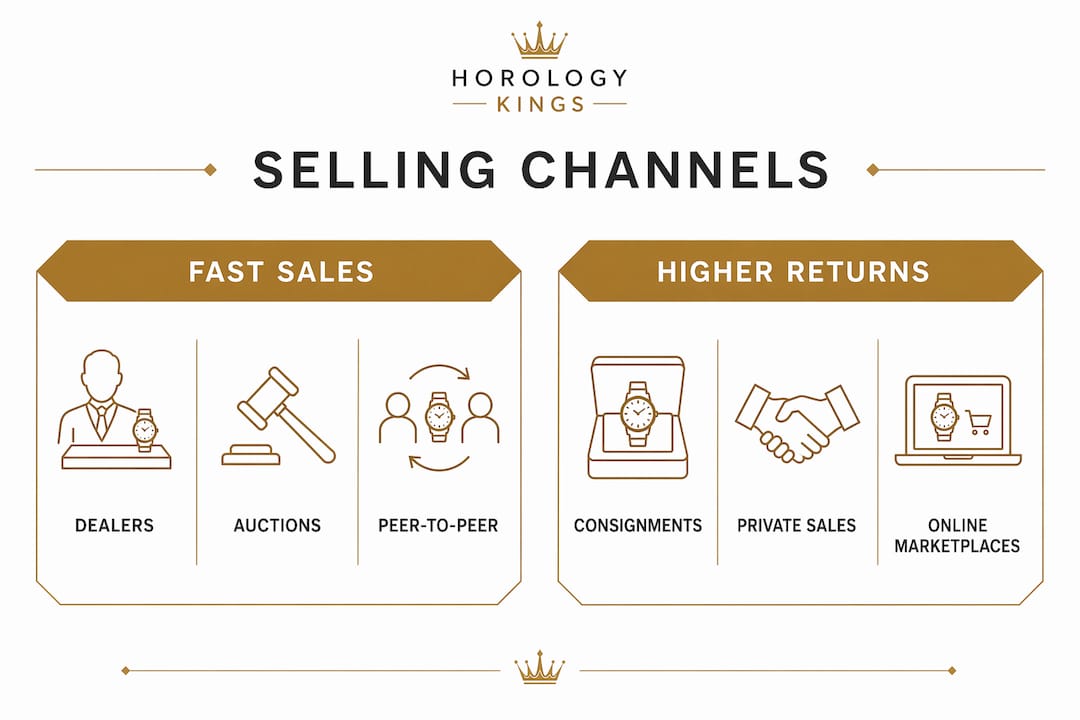
The channel you choose affects both the price you achieve and how quickly you receive payment. No single route suits every seller. The right choice depends on whether you prioritise speed, maximum return, or security.
Dealer sale
Selling directly to a specialist dealer is the fastest route. Dealer sales typically return 60%–80% of market value, with payment processed within 24–72 hours. The trade-off is a lower net price, but the transaction is clean, secure, and requires minimal effort from the seller. For sellers who value certainty over maximum proceeds, this is the most practical option.
Consignment and private sale
Consignment through a reputable dealer or a private sale via a specialist marketplace can return 85%–100% of market value. The process takes longer, typically 2–8 weeks, and involves more effort from the seller. Fees and commissions reduce the headline figure, so calculate net proceeds carefully before committing.
Auction
Auction houses suit rare or historically significant pieces where competitive bidding can push prices above standard market rates. Buyer’s premiums and seller’s commissions can be substantial, and the outcome is never guaranteed. Auction works best for watches with strong provenance or collector appeal.
Peer-to-peer marketplace
Selling directly to another collector via an online marketplace offers the highest potential return but carries the greatest risk. Peer-to-peer selling exposes sellers to fake payment confirmations, shipping scams, and post-sale disputes. Always use an escrow service and insured, signed-for shipping when selling privately.
Channel | Typical return | Payment speed | Risk level |
Specialist dealer | 60%–80% of value | 24–72 hours | Low |
Consignment/private sale | 85%–100% of value | 2–8 weeks | Medium |
Auction | Variable | 4–8 weeks post-sale | Medium |
Peer-to-peer marketplace | Up to 100% of value | Variable | High |
Pro Tip: Treat channel selection like a financial decision. Calculate your net return after fees, commissions, and time cost before choosing. A dealer offer at 70% of value paid tomorrow may outperform a private sale at 90% that takes two months and requires ongoing effort.
How to prepare your unserviced watch and gather accurate valuations
Preparation is the stage where most sellers either protect or lose value. The goal is to present the watch honestly, gather multiple credible offers, and make an informed decision based on real market data.
Gather all documentation. Collect the original box, papers, purchase receipt, and any service records. Even partial documentation strengthens your position. A watch with its original warranty card and box commands more interest than an identical piece sold loose.
Verify the serial number. Contact the manufacturer or an authorised dealer to obtain any official service history linked to the serial number. Serial number verification can yield official records that partially substitute for lost paperwork and reassure buyers about authenticity.
Photograph the watch thoroughly. Shoot the dial, case, caseback, bracelet, and any visible wear under good natural light. Honest photographs build trust and reduce the chance of disputes later.
Do not polish or clean aggressively. A light wipe with a soft cloth is fine. Anything more risks removing original finish and reducing collector appeal.
Obtain at least three independent quotes. Offers can vary by 15%–25% on a £10,000 watch, which equates to a £1,500–£2,500 difference in net proceeds. Approach a specialist dealer, a reputable auction house, and at least one other credible source before deciding.
Monitor actual sold prices, not asking prices. Sellers who track completed sales on specialist platforms get a realistic picture of what buyers are actually paying. This prevents overpricing and helps you time the sale when market sentiment is favourable.
Check that the watch runs and keeps reasonable time before any sale.
Note any scratches, dents, or missing components honestly in your condition description.
Keep all packaging and accessories together, as separating them reduces value.
Pro Tip: Approach the process like a watch valuation exercise, not a sale. The more information you gather before committing to a channel, the stronger your negotiating position.
Common mistakes sellers of unserviced luxury watches make
The most expensive mistakes in luxury watch resale are avoidable. Each one either destroys value, exposes the seller to fraud, or prolongs the sale unnecessarily.
Over-polishing the case. Collectors value unpolished, original watches significantly more than cosmetically altered ones. Sharp case edges and factory finish are signs of authenticity. Polishing removes them permanently.
Accepting the first offer. A single quote gives you no context. Without comparison, you cannot know whether an offer is fair, low, or exceptional.
Failing to verify buyer credibility. On peer marketplaces, check feedback history, request proof of identity, and never release a watch before cleared funds are confirmed.
Misrepresenting condition. Describing a watch as “excellent” when it has visible wear creates disputes and damages your reputation as a seller.
Misunderstanding servicing return on investment. Professional dealers rarely increase their offer because a seller has paid for a service. The cost is almost never recovered in the sale price.
“The collector market rewards honesty. A watch described accurately, presented with its original finish, and supported by documentation will always attract more serious buyers than one that has been cleaned up and oversold.”
Pro Tip: Read the best practice guidance on selling second-hand luxury watches before listing anywhere. Understanding the risks specific to high-value private transactions protects both your watch and your money.
Key takeaways
Selling an unserviced luxury watch successfully requires honest condition assessment, multiple independent valuations, and a channel choice that matches your priorities for speed and net return.
Point | Details |
Avoid pre-sale servicing | Servicing costs £400–£1,200 and dealers rarely increase offers to cover it. |
Document everything | Original box, papers, and serial verification protect value and reassure buyers. |
Get three quotes minimum | Offers vary by 15%–25%, so comparison is the single most effective way to improve net proceeds. |
Match channel to priority | Dealer sales pay faster at lower rates; consignment and private sales yield more but take longer. |
Never polish the case | Original finish and sharp edges are collector assets. Polishing destroys them permanently. |
My honest view on the unserviced watch market in 2026
The market for unserviced luxury watches has matured considerably. Collectors who once worried about buying a watch without a recent service have largely shifted their thinking. Originality now carries real weight, and I see this play out regularly in how buyers respond to well-documented, untouched pieces.
What surprises first-time sellers most is how little a service adds to the sale price. I have seen sellers spend over a thousand pounds on a full movement overhaul, only to receive the same offer they would have got without it. Dealers build servicing into their business model. They are not going to pay you for work they intended to do themselves.
The sellers who achieve the best outcomes are the ones who treat the process like a luxury watch resale decision rather than a clearance. They gather documentation, get multiple quotes, and monitor actual sold prices before committing to a channel. Patience at the preparation stage consistently produces better results than rushing to list.
My advice for first-time sellers is straightforward. Do not touch the watch cosmetically. Gather everything you have in terms of paperwork. Get at least three quotes from credible sources. Then choose the channel that fits your timeline, not the one that promises the highest number without context.
— Lewis
Sell your unserviced watch with Horology-kings
Horology-kings is a specialist luxury watch dealer based in Hertfordshire, offering expert valuations and secure purchases for unserviced timepieces from brands including Rolex, Patek Philippe, Audemars Piguet, Omega, and Cartier.
If you are ready to sell, Horology-kings provides free valuations, transparent offers, and payment via secure UK bank transfer. There are no hidden fees and no obligation to accept. The team handles unserviced watches regularly and understands how to price them fairly based on condition, provenance, and current market demand. Visit Horology-kings to request your valuation and take the next step with confidence.
FAQ
Does an unserviced watch sell for less than a serviced one?
Not necessarily. Collectors often pay more for unserviced watches with original finish and documentation intact. A non-running watch is the main exception, where value can drop by 20%–40%.
Should I service my luxury watch before selling it?
No, in most cases. Servicing costs are rarely recovered in the sale price because dealers prefer to handle servicing themselves and factor the cost into their offer.
How many quotes should I get before selling?
Get at least three independent quotes. Offers on a £10,000 watch can vary by £1,500–£2,500, so comparison directly improves your net proceeds.
What documents should I gather before selling?
Collect the original box, papers, purchase receipt, and any service records. If papers are missing, serial number verification with the manufacturer can provide official service history as a partial substitute.
Is peer-to-peer selling safe for luxury watches?
It carries the highest risk of the main selling channels. Use an escrow service, insured shipping, and verify buyer credibility thoroughly before releasing the watch.
Recommended
Comments