.png)

How timepiece rarity drives value for luxury watch collectors
- lewisvrichards3
- May 10
- 10 min read
TL;DR:
Rarity in watches depends on limited availability from production, discontinuation, or unique variants, influencing value. Market demand, condition, and timing determine whether scarcity leads to investment growth or stagnation. Successful collectors focus on activated demand and provenance rather than just rarity headlines for sustainable gains.
Rarity in the watch world is frequently treated as a guarantee, a shorthand for “this will be worth more tomorrow.” Seasoned collectors know the reality is far more nuanced. Brand rationing and constrained distribution create powerful secondary-market price dislocations, but that mechanism only fires when several other conditions align. This guide unpacks exactly how scarcity, sustained demand, condition, and market timing work together to determine whether a rare timepiece becomes a sound investment or a costly mistake.
Table of Contents
Key Takeaways
Point | Details |
Scarcity must be activated | True value only emerges when rarity coincides with strong collector demand and quality. |
Secondary market sets benchmarks | Limited supply can push prices higher on the resale market, bypassing retail ceilings. |
Condition trumps rarity alone | Only well-preserved rare pieces command lasting premiums over time. |
Market cycles influence prices | Auction results and broader cycles reveal shifting opportunities and risks for collectors. |
Smart collecting is strategic | Applying nuanced knowledge of rarity and demand is key to successful investments. |
What does rarity actually mean in horology?
To understand how rarity influences value, we must first be clear about what “rarity” truly means in the world of watches. The word gets applied loosely, often to pieces that are simply old, oddly coloured, or produced in a numbered edition. Real rarity is more structured than that, and understanding its categories will sharpen your acquisition decisions immediately.
At its core, rarity in horology refers to the limited availability of a specific reference relative to collector demand. That limitation can arise from several distinct sources:
Production quantity: A reference with fewer than a few hundred examples ever made (such as certain Patek Philippe perpetual calendars in precious metal) is rare by pure mathematics.
Discontinued status: When a manufacturer retires a reference, the existing supply becomes permanently fixed. The Rolex Explorer II ref. 1655 “Steve McQueen” and the original Audemars Piguet Royal Oak ref. 5402 both gained mystique partly through discontinuation.
Unique or one-off pieces: Bespoke commissions, prototype references, and charity auction specials sit at the extreme end of scarcity, with single-digit or even single-unit production.
Dial and case variants: A standard reference can carry a rare sub-variant, such as a “tropical” dial that has naturally oxidised to a warm brown, making that specific example far scarcer than its siblings.
Regional or era-specific releases: Watches distributed exclusively in a single country or during a narrow production window often surface in smaller numbers on the global market decades later.
Heritage, scarcity, and condition are the three pillars that TycoonStory and Hodinkee consistently highlight when framing long-term collector value, and condition’s effect on vintage reference pricing can be dramatic.
“Not every rare watch is a valuable watch. Rarity provides the raw material; the market decides whether that material is worth anything.”
Exploring limited edition watches reveals how even artificially numbered pieces can sit unsold if the underlying demand is weak. The category matters enormously.
How does scarcity drive market value?
Now that we have defined rarity, it is time to see how this rarity actually translates into market behaviour and value shifts. The mechanism is elegant but not automatic.
When a manufacturer deliberately constrains supply below demand, a secondary market emerges as what analysts rightly describe as an alternative pricing system. Retailers cannot sell above the authorised retail price, so unfulfilled demand spills onto dealer and auction platforms where prices float freely. This is precisely how certain Rolex sports references have traded at two to three times retail for extended periods.
Primary market vs secondary market realities
Factor | Primary market (authorised dealer) | Secondary market (dealers and auctions) |
Pricing | Fixed retail price | Demand-driven, can exceed retail significantly |
Availability | Waiting list or allocation | Immediate but at a premium |
Authentication | Manufacturer guarantee | Requires independent verification |
Selection | Current production only | Full range including discontinued references |
Negotiation | Very limited | More flexibility depending on seller |
The waiting list dynamic deserves particular attention. Long queues for key models, as documented by Hodinkee, do not just reflect current demand. They also signal to the secondary market that supply will remain tight, which in turn sustains elevated resale prices. Buyers who cannot or will not wait then pay the secondary premium, reinforcing the cycle.
Understanding the true luxury watch value at play requires recognising that the primary market price is often the floor, not the ceiling, for certain references. A Patek Philippe Nautilus ref. 5711 in stainless steel, for example, carried a retail price of roughly £26,000 before its discontinuation, yet traded consistently above £100,000 on the secondary market at peak demand.
How secondary market value is formed reveals another layer: liquidity. A truly rare piece with a thin buyer pool can be simultaneously scarce and illiquid, meaning you cannot easily exit the position at the quoted price. Highly activated references with deep collector bases, by contrast, trade with genuine market depth.
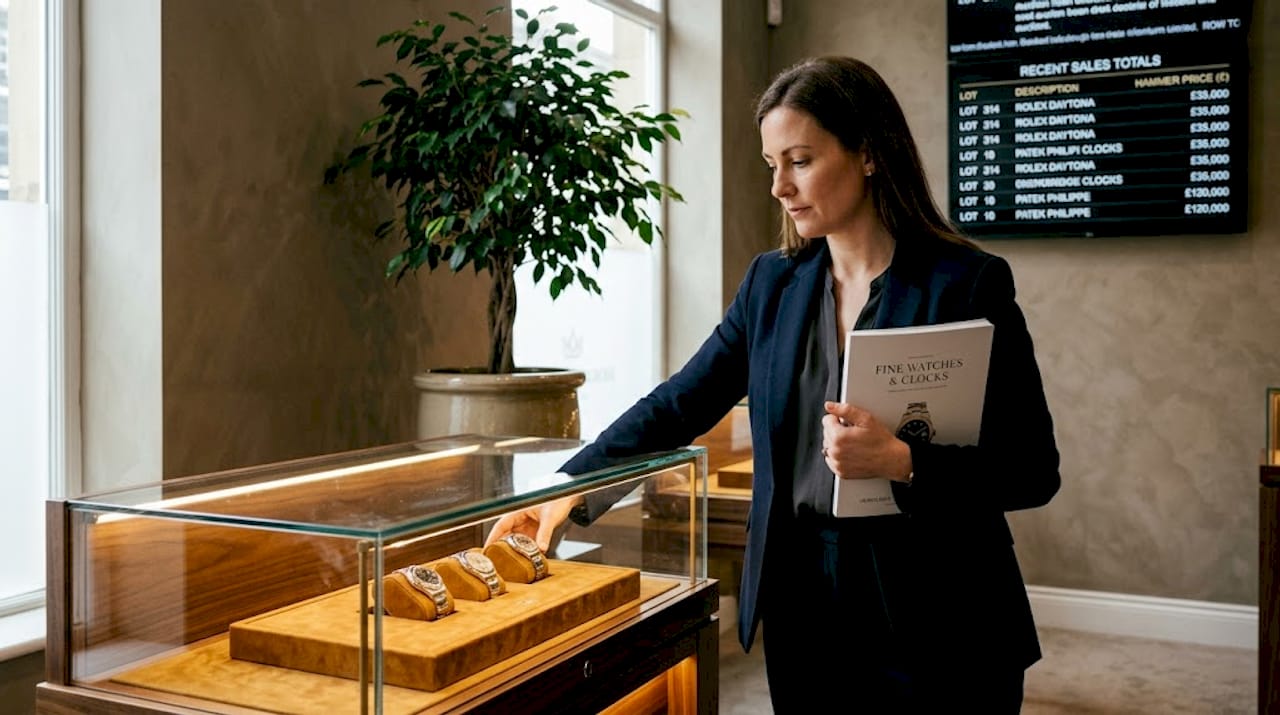
Pro Tip: When assessing a secondary market premium, check the spread between asking and transaction prices over a 12-month window. A consistently narrow spread signals real, stable demand rather than speculative froth.
Why scarcity alone is not enough: demand and condition
While scarcity creates the opportunity for higher value, several key factors determine if, and how much, that value materialises. The watch market has repeatedly demonstrated that the rarest piece in the room can go unsold if the market is not ready to activate that scarcity.
Rarity’s investment role is moderated by condition, originality, and broader demand cycles, meaning that a watch with a production run of 50 pieces but no living collector community may never reach its theoretical ceiling. Compare two hypothetical scenarios:
How key variables combine to affect investment performance
Variable | Scenario A (strong performance) | Scenario B (weak performance) |
Production quantity | Fewer than 200 examples | Fewer than 150 examples |
Collector demand | Deep, active community | Niche or faded interest |
Condition | Unpolished, full set, papers | Relumed dial, no box |
Provenance | Documented original owner | Unknown history |
Brand heritage | Tier-one Swiss maison | Lesser-known independent |
Outcome | Significant appreciation | Flat or declining value |
The lesson is clear: rarity is the stage, not the performance. Demand is what fills the theatre.
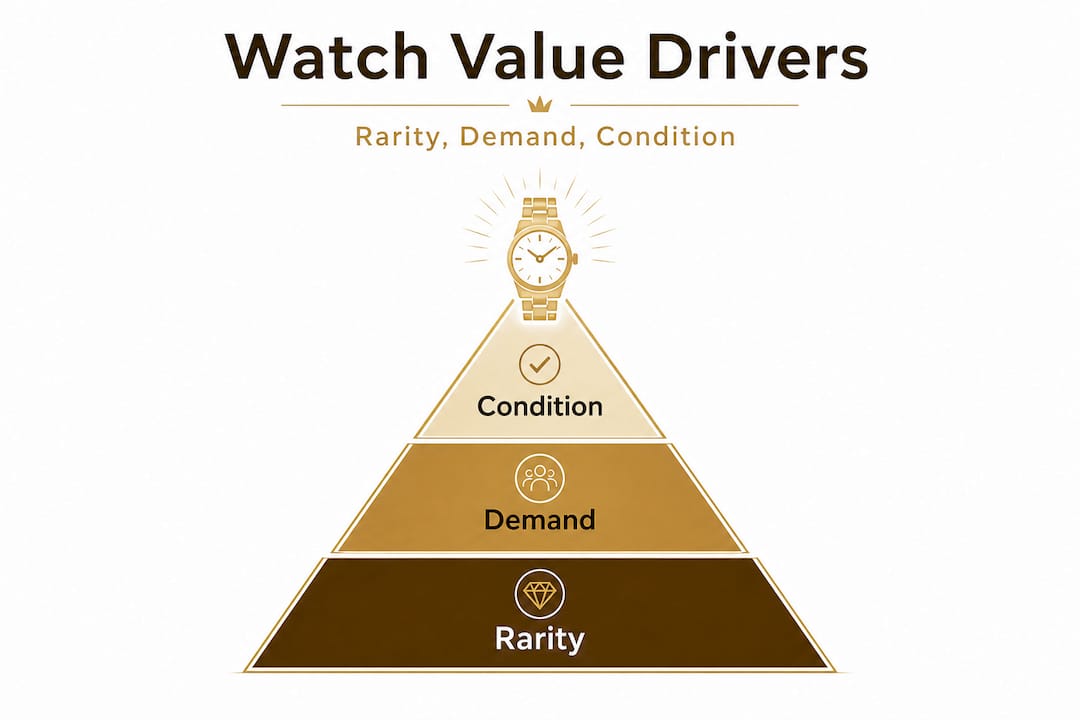
Condition deserves its own focus. In the vintage segment, an unpolished case retaining its original sharp lugs can multiply the value of an already scarce reference by a substantial factor. A polished case on the same reference can cut value by 30 to 50 per cent in the eyes of serious collectors. Reviewing watch condition and authenticity indicators before any acquisition is non-negotiable.
Provenance adds a further layer. A Rolex once owned by a notable figure, or a Patek with its original numbered archive extract, carries a story that sustains demand beyond the watch itself. These paper trails are not merely sentimental. They are financial assets.
Key factors to scrutinise before attributing investment potential to a rare reference:
Originality of dial and hands: Any replacement components reduce desirability and value significantly.
Case condition: Signs of polishing, drilling, or repair work affect both aesthetics and integrity.
Full set documentation: Original box, papers, hangtags, and warranty card are increasingly non-negotiable for top-tier buyers.
Service history: A documented service by a recognised watchmaker supports mechanical trust and asking price.
Market liquidity: Research recent actual sale prices rather than relying solely on asking prices.
Commissioning a proper valuation guide process before committing to a significant purchase is one of the most underused tools available to collectors.
Pro Tip: Always cross-reference a watch’s asking price against actual hammer prices at major auction houses over the past 24 months, not listed estimates. Estimates can be set aspirationally.
Market cycles, auctions, and structural shifts
Understanding the mechanics of rarity and market value is only half the battle. Investors must also pay close attention to overall market cycles and auction performance, because timing is frequently the difference between an exceptional return and a disappointing one.
The post-pandemic watch market offered a stark lesson. Between 2020 and 2022, speculative demand inflated secondary prices across a wide range of references, including many that lacked genuine rarity or deep collector foundations. When that speculative capital retreated, prices for superficially “rare” pieces corrected sharply, while genuinely scarce pieces with authentic demand proved remarkably resilient.
A recent headline underlines the point about structural demand: the Phillips Bacs & Russo Geneva auction achieved a record $83 million, demonstrating that the highest tier of the market, where true rarity meets deep collector demand, continues to perform exceptionally even as mid-tier liquidity fluctuates.
Practical lessons for timing your investment entry and exit:
Study pre-sale estimates against hammer prices. Consistent over-performance at auction signals that scarcity is actively supported by demand. Under-performance or passed lots signal softening.
Track price indices quarterly. Published secondary market indices covering major Swiss references provide a macro view that individual listings cannot.
Observe which categories auction houses are promoting. Marketing investment by major auction houses in specific categories often precedes increased buyer activity in those areas.
Monitor cultural catalysts. Film appearances, celebrity associations, and anniversary editions can rapidly activate demand for previously undervalued references.
Note the shift in buyer demographics. Younger collectors entering the market in 2026 are prioritising different references and complications than the previous generation, creating opportunity in both emerging and overlooked categories.
“The auction room is not just a place to buy and sell. It is the watch market’s most transparent pricing signal. Reading it carefully is a competitive advantage.”
Staying current with auctions and rare watches activity, and understanding which rare watches are generating genuine value gains, provides the market intelligence needed to make better-timed decisions.
How collectors can capitalise on rarity-driven opportunities
With a solid grasp of how rarity, demand, and condition interact in value creation, let us review how you can turn this knowledge into practical investment and collecting success.
Long-term value depends on heritage, scarcity, and condition, and market activation relies on demand cycles. Knowing this, a structured pre-purchase checklist becomes your most practical tool.
Pre-purchase evaluation checklist for rare timepieces:
Confirm the production history and total quantity made for the specific reference and variant.
Verify originality of all components: dial, hands, case, crown, and clasp.
Request an independent expert assessment, not just the seller’s declaration.
Review at least 10 recent actual sale prices for the same or closely related reference.
Examine the brand’s catalogue trajectory: is the reference gaining or losing cultural relevance?
Assess the depth of the collector community around this specific reference.
Confirm all paperwork, service records, and provenance documents are present and credible.
Consider your own holding period honestly: rarity-driven gains often require patience measured in years, not months.
Navigating sourcing rare watches in the UK market requires working with partners who have access to private collections and off-market inventory, because the most genuinely rare pieces rarely appear on public listings. Building trusted relationships within the collector community is therefore a practical investment strategy in itself.
Authentication and due diligence cannot be rushed. A reference that checks every box on paper but lacks credible authentication is a risk regardless of how compelling the asking price appears. Use experts with proven track records and request detailed condition reports that document each component individually.
Why smart collectors rethink rarity and chase activated value
Here is a perspective informed by years of market observation: the collectors who consistently achieve the strongest returns are not the ones hunting the rarest piece. They are the ones hunting pieces where rarity and demand have already locked in together, what we call “activated value.”
Purely rare watches without an active collector base require you to predict a future that the market has not yet priced. That is a speculative bet, not an investment. It can pay off spectacularly, but the failure rate is high and the liquidity risk is real. Genuine expertise lies in identifying watches where scarcity is already recognised, demand is demonstrably sustained, and the price has not yet fully reflected the combination.
Condition and provenance are consistently underpriced relative to their actual effect on value at the highest levels. Many collectors focus on the reference number and overlook that two examples of the same reference can have a 40 per cent price gap based entirely on originality and documentation. That gap represents both risk and opportunity depending on which side of it you are standing.
In 2026’s market, the most successful collectors are those who understand deeper drivers of watch value well enough to act with conviction when genuine activated value appears, rather than chasing scarcity headlines that the broader market has already repriced. The market rewards knowledge, patience, and a clear-eyed view of what rarity actually means in context.
Ready to source or sell a rare timepiece?
If you are looking to capitalise on what you have just learned, the next step is working with a specialist who can match your objectives with genuine market access.
At Horology Kings, we specialise in sourcing, buying, and selling the world’s most sought-after references with full transparency and secure transactions. Whether you want to source a specific watch that rarely surfaces publicly, or sell a piece from your collection at the right price, our expert team in Hertfordshire provides discreet, professional support at every stage. As a trusted platform for rare watches, we combine deep market knowledge with an established collector network to help you act with confidence, whether you are a first-time investor or a seasoned collector with decades of experience.
Frequently asked questions
Can a rare watch lose value even if it’s scarce?
Yes. Low production combined with low demand leads to weak secondary markets, meaning scarcity alone cannot prevent value deterioration when collector interest is absent.
What makes some rare watches appreciate faster than others?
Sustained collector demand, outstanding originality, and strong brand heritage all accelerate appreciation, as long-term value depends on the intersection of all three rather than any single factor.
How do auction results influence the value of rare timepieces?
Major results establish new market benchmarks and signal active demand, as illustrated by the record $83 million total achieved by Phillips Bacs & Russo in Geneva, which validated the resilience of top-tier rare watches.
Is it better to buy rare watches new or on the secondary market?
The secondary market often provides access to genuinely rare references that retail channels cannot supply, but when scarcity is strongly activated, the secondary market functions as an alternative pricing system where premiums above retail are the norm.
How do I confirm the authenticity and condition of a rare timepiece?
Engage a qualified independent expert, request original provenance documents and service records, and insist on a detailed condition report covering every component before completing any purchase or sale.
Recommended
Comments