.png)
Understanding watch complications: A guide for collectors
TL;DR:
Many collectors mistakenly believe simplicity equates to refinement, but complications showcase extraordinary engineering feats beyond basic time-telling. These features, such as moonphases and tourbillons, are highly prestigious, involving complex mechanisms that elevate a watch’s craftsmanship and value. Understanding complications enables collectors to appreciate mechanical artistry and make more informed investment decisions in horology.
There is a persistent misconception in casual watch circles that simplicity equals refinement. Strip away everything beyond the hour and minute hands, so the thinking goes, and you have the purest expression of watchmaking. Seasoned collectors know better. A watch complication is any feature that goes beyond basic time-telling, and these additional mechanisms represent some of the most extraordinary feats of mechanical engineering ever conceived. Understanding complications does not just make you a more informed buyer; it transforms the way you see every timepiece on your wrist or in your collection.
Table of Contents
Key Takeaways
Point | Details |
Comprehensive definition | A complication is any function of a watch beyond basic time-telling, ranging from date displays to tourbillons. |
Diverse categories | Complications are grouped by practical purpose, mechanical ingenuity, and artistic value. |
Collector’s edge | Understanding complications helps you appreciate true horological artistry and informs wise acquisitions. |
Maintenance matters | Proper care and regular servicing are essential for keeping complicated timepieces functional and valuable. |
Significance for investment | Iconic complications often drive desirability and investment value in luxury watches. |
What is a watch complication?
The word “complication” has an unfortunate sound to it. It implies difficulty, inconvenience, perhaps even unnecessary fuss. In horology, however, it carries enormous prestige. An introduction to horology reveals that the discipline is as much philosophy as it is engineering, and complications sit at its very heart.
To be precise, a complication is any feature on a watch beyond the display of hours, minutes, and typically seconds. That is the technical boundary. On one side of that boundary sits the simple three-hand display. On the other side sits everything else: calendar mechanisms, elapsed-time measurement, astronomical displays, striking mechanisms, and precision-enhancing devices.
“In luxury mechanical watch culture, complications are discussed as mechanical features beyond time-telling — each one requiring additional components, engineering decisions, and often years of development.”
Common complications you will encounter include:
Date display — a calendar aperture or subdial showing the current date
Chronograph — a stopwatch function integrated into the movement
Moonphase — a rotating disc that tracks the lunar cycle
Perpetual calendar — a mechanism that automatically accounts for months of varying lengths
Tourbillon — a rotating cage that counters the effects of gravity on the escapement
Minute repeater — a chiming mechanism that audibly strikes the time on demand
Power reserve indicator — a display showing remaining mainspring tension
Each of these involves additional wheels, levers, cams, and springs, all integrated seamlessly into the movement. That engineering challenge is precisely what makes complications so deeply respected among connoisseurs.
Types and categories: A collector’s framework
With a definition in hand, the next step is to understand the rich diversity of complications that exist and how collectors group them. Complications range from practical functions to highly complex mechanisms and can be categorised into six principal families: Display, Practical, Chronograph, Precision, Astronomical, and Striking.
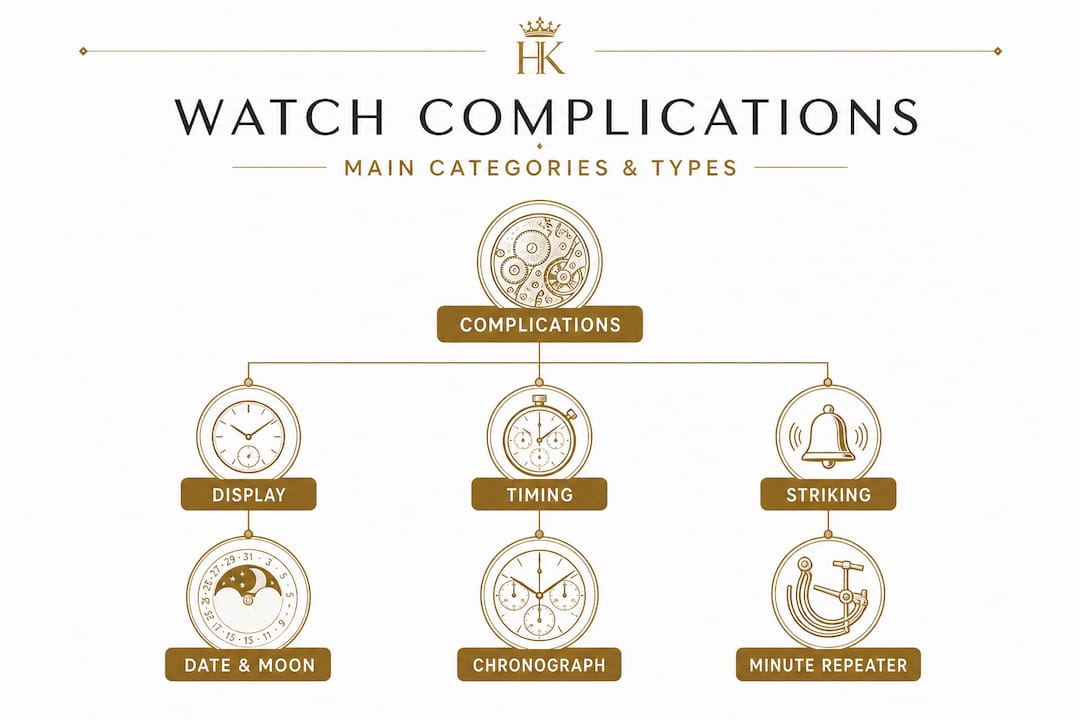
Having a framework matters enormously when you are evaluating a piece for purchase, because it allows you to immediately place any complication in context. The craftsmanship and prestige behind a given complication depends partly on which category it occupies and how technically demanding that category is to execute.
Here is a summary of the main complication categories alongside representative examples:
Category | Function | Typical examples |
Display | Shows additional time-related information | Date, day, dual time zone |
Practical | Offers functional utility beyond reading the time | Power reserve, alarm |
Chronograph | Measures elapsed time | Standard chronograph, flyback, rattrapante |
Precision | Improves accuracy of timekeeping | Tourbillon, remontoire |
Astronomical | Tracks celestial or calendrical cycles | Moonphase, perpetual calendar, equation of time |
Striking | Audibly indicates the time | Minute repeater, quarter chime, sonnerie |
These categories are not mutually exclusive. A grand complication watch, such as a Patek Philippe Calibre 89 or a Vacheron Constantin Reference 57260, can combine elements from every single category simultaneously. That kind of integration is where mechanical watchmaking reaches its absolute summit.
The main complication categories at a glance:
Display complications — the most accessible and widely produced
Chronograph complications — highly practical and enormously popular among collectors
Astronomical complications — poetic and technically demanding
Precision complications — rarely visible but often the most technically impressive
Striking complications — the rarest and most labour-intensive to produce
Iconic complications: What should every collector know?
Understanding the various types leads naturally to asking which complications actually define collector and connoisseur discussions, and why. Collectability in timepieces is shaped by rarity, mechanical achievement, brand heritage, and the story a complication tells. These four iconic complications sit at the pinnacle of that conversation.
The chronograph — invented in the early 19th century, refined by firms such as Breitling, Heuer, and Omega, the chronograph measures elapsed time using an independent start, stop, and reset mechanism. Its historical significance at Omega is particularly well documented, given the brand’s role in timing the Olympic Games and the Apollo missions.
The perpetual calendar — this mechanism automatically adjusts for months of 28, 29, 30, and 31 days, including leap years in most implementations. It will only require correction once every century, around the year 2100 on most current models.
The tourbillon — invented by Abraham-Louis Breguet in 1801, a tourbillon is a rotating cage mechanism designed to increase accuracy by neutralising the effects of gravity on the escapement as the watch changes position. Its collector cachet is unmatched; a tourbillon signals genuine horological ambition.
The minute repeater — arguably the most labour-intensive complication to produce, a minute repeater chimes the hours, quarters, and minutes on demand. Fine tuning the hammers and gongs to produce a pleasing, harmonious tone can take a master watchmaker weeks of adjustment.
“Some complications are deceptively simple visually but still require a dedicated mechanism, additional parts, and precise engineering to function reliably.”
A date window is a perfect example of this principle in practice.
Pro Tip: Never dismiss a date complication as trivial. Even the seemingly basic date display found on a Rolex Datejust involves an instantaneous jumping mechanism driven by a specially shaped cam. That instant flick of the date at midnight is the product of considerable mechanical ingenuity, and it is precisely this kind of hidden engineering that distinguishes a well-made date complication from a mediocre one.
Statistically, perpetual calendars and chronographs are the complications most frequently recorded in major auction results. Analysis of sales at Phillips, Sotheby’s, and Christie’s consistently shows that complicated Patek Philippe and Audemars Piguet pieces dominate the upper price brackets, with tourbillon and minute repeater examples routinely achieving multiples of their pre-sale estimates.
The art and challenge of complication design
Once you appreciate iconic complications, it is important to grasp the technical sophistication and care that go into their creation, and upkeep. The most useful framework here is to understand complications as subsystems that provide information, measure intervals, improve accuracy, or add unique performance features, each with its own mechanical and regulatory challenges.
Consider what it takes to bring a new complication to production in a serious manufacture:
Concept and specification — engineers define what the complication must achieve, its accuracy requirements, and how it will interact with the host movement’s existing gear train and energy supply.
Prototype development — individual components are designed, often at tolerances measured in microns, then hand-assembled and tested independently before being integrated.
Integration and regulation — the complication module must be married to the base movement without compromising the movement’s rate or power reserve. This stage often requires significant redesign.
Finishing — every visible component must be hand-finished to the brand’s standards: anglage on plate edges, perlage on hidden surfaces, and polished bevels on levers. Finishing can account for a significant portion of total production time.
Quality testing and certification — the completed movement undergoes positional testing, power reserve verification, and often third-party chronometric certification such as COSC (Contrôle Officiel Suisse des Chronomètres).
Long-term field validation — leading manufacturers test complications under real-world wearing conditions for extended periods before releasing a calibre to the public.
Pro Tip: When purchasing a complicated watch, always ask about the manufacturer’s recommended service interval and the typical cost of a full service. A tourbillon or minute repeater service can run to thousands of pounds and require specialist skills that only a handful of watchmakers worldwide possess. Factor that into your total cost of ownership and budget accordingly. Detailed maintenance for complicated watches covers what to expect and how to prepare. For owners already looking ahead, exploring watch servicing essentials will give you a clearer picture of what proper care involves.
The finishing on a complicated movement also matters enormously to value. A movement where every component receives hand-applied decoration is categorically different from one that has been machined and left largely unfinished. Collectors learn to distinguish between the two, and auction results reflect that distinction clearly.
How to choose and appreciate complicated watches
With insight into complication design, prospective buyers can make more informed choices and better appreciate the craft behind every function. Complications require careful integration and correction mechanisms, which directly impacts both maintenance requirements and long-term collectability. That practical reality should shape your selection process.
Key factors to weigh when selecting a complicated watch:
Movement origin and complexity — is the complication built in-house or sourced from a specialist movement maker? In-house manufacture generally commands greater respect and, over time, stronger resale figures.
Service history and provenance — a watch with a documented service record from an authorised centre is far preferable to one with an unknown history, particularly for high-complication pieces where improper servicing can cause irreparable damage.
Resale and secondary market performance — not all complications are equally valued by the secondary market. Perpetual calendars from top-tier manufacturers retain value exceptionally well; lesser-known brands with similar complications often do not. Preserving value with maintenance is as important as the initial purchase decision.
Legibility and wearability — a watch with seven complications crammed into a 38mm dial may be an engineering triumph but practically unreadable. Consider whether the complications you are choosing genuinely serve your lifestyle and aesthetic preferences.
Brand support and parts availability — for vintage complicated pieces in particular, confirm that the manufacturer or specialist restorers still hold or can fabricate the necessary spare parts. Some older calibres are now effectively irreparable.
Your own horological literacy — the more you understand, the better equipped you are to evaluate. A Swiss watch selection guide provides an excellent foundation for this process.
Spotting a well-executed complication versus a superficial one takes practice, but the telltale signs are there if you know where to look. A poorly regulated perpetual calendar will lose track of dates. A chronograph with a poorly adjusted column wheel will feel sticky or uncertain on actuation. A tourbillon that wobbles inconsistently or has a bridge that shows machining marks rather than hand-finishing signals corner-cutting. These details matter enormously to both enjoyment and future value.
A collector’s perspective: Why complications are more than fancy features
There is a temptation, even among experienced collectors, to reduce complications to a checklist. Tourbillon: ticked. Perpetual calendar: ticked. Minute repeater: ticked. Grand complication acquired. But this transactional mindset misses what complications actually represent when you live with them.
Complications are stories told in steel, gold, and ruby. When you understand wristwatch provenance and the history of a specific calibre, wearing a minute repeater becomes a conversation with every watchmaker who shaped that tradition. The first time you slide a repeater pusher and hear the watch chime the time in a dark room, no checklist mentality survives that experience intact.
We would also push back gently on the investment-first framing that dominates many collector conversations today. Complications do tend to hold and grow their value, yes. But if you buy a perpetual calendar purely because you expect it to appreciate, you are likely to be disappointed by the process of ownership. These are demanding pieces. They require care, understanding, and genuine engagement. The collectors who love complicated watches most are not those who bought them for a return; they are the ones who spent time learning to read the moonphase, who appreciate the sensation of a smooth chronograph pusher, who are genuinely curious about what happens inside the case.
The mechanical novelty of a true complication is not gadgetry. It is not a feature list. It is the result of human ingenuity applied over centuries to one of the most constrained design problems imaginable: add meaningful function to a wearable mechanism with no electronic assistance, powered by nothing more than a coiled spring. That is what complications celebrate. And that is why they endure.
Discover and source your next complicated timepiece
If this exploration of complications has deepened your interest in acquiring a piece that genuinely challenges and rewards, we are here to help you take the next step with confidence.

At Horology Kings, based in Hertfordshire, we specialise in sourcing, valuing, and selling pre-owned luxury watches from the most respected Swiss manufacturers. Whether you are searching for a specific reference with a particular complication or simply want expert guidance on what suits your collection, our team has the network and knowledge to assist. You can source a watch through our dedicated sourcing service, or explore our curated collection to see what is currently available. Every transaction is handled with full transparency, expert valuation, and secure UK bank transfer, so your next acquisition is as rewarding as the watch itself.
Frequently asked questions
Is a chronograph considered a complication?
Yes, a chronograph measures elapsed time independently of the regular time display, making it a complication by the standard definition used in professional horology.
Which watches feature the most complications?
Grand complications, such as certain references from Patek Philippe and Vacheron Constantin, combine perpetual calendars, tourbillons, chronographs, and repeaters into a single movement, sometimes incorporating dozens of additional functions simultaneously.
Are all complication mechanisms mechanical?
In serious collector watchmaking, yes. Complications are mechanical features driven by gears, springs, and levers rather than electronic or quartz-based systems, which is a core part of what makes them so respected.
Do complications affect a watch’s value?
Significantly so. Rare and technically refined complications consistently add value and prestige to a timepiece, with examples from leading manufacturers regularly achieving premium results at major auction houses.
Recommended
Comments