.png)

Watch box and papers: what collectors must know
- lewisvrichards3
- Jun 1
- 9 min read
TL;DR:
Original box and papers provide crucial provenance for luxury watches, with papers offering stronger authenticity proof.
While the box enhances ownership experience, verified papers confirm serial number, dealer, and purchase details essential for value and authenticity.
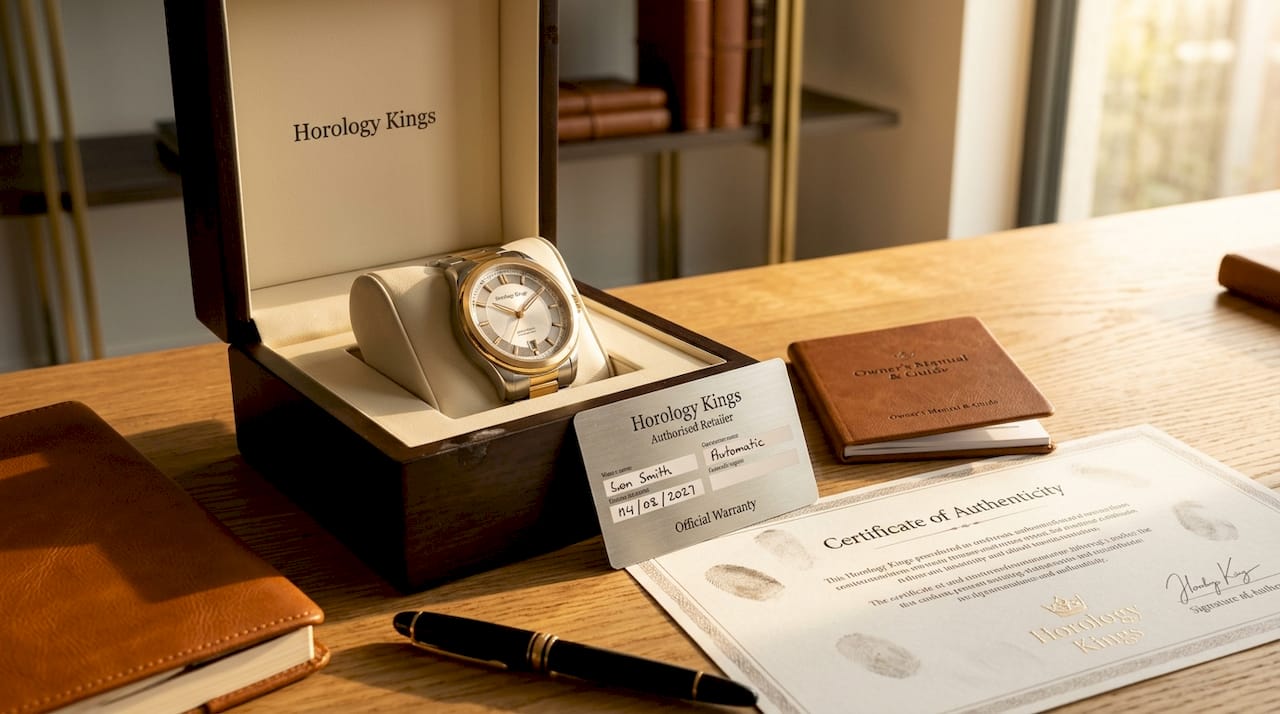
“Watch box and papers” is the industry shorthand for the original presentation box and official documentation that accompany a luxury watch from an authorised retailer at the point of sale. Together, these items form the provenance record for a timepiece, confirming its identity, purchase history, and legitimacy. For collectors buying or selling Rolex, Patek Philippe, Audemars Piguet, Omega, or Cartier watches, understanding what is watch box and papers means understanding the single most consequential factor in a watch’s resale value and buyer confidence. A watch without its original box and papers is a watch without a paper trail.
What is watch box and papers: the full set explained
The term “full set” describes a watch accompanied by every item it left the retailer with. That typically includes more components than most buyers realise.
The core items in a complete set are:
Warranty card or certificate of origin. This is the most critical document. The warranty card records the watch’s serial number, the name of the authorised dealer, and the purchase date. It functions as the primary proof of sale and provenance anchor. Without it, establishing a watch’s history becomes significantly harder.
Outer shipping box. The plain brown or branded outer carton that protects the presentation box during transit.
Inner presentation box. The branded display case, often lacquered wood, leather, or high-grade plastic, specific to each manufacturer. Rolex uses its distinctive green and gold livery; Patek Philippe presents watches in a navy blue box with a white interior.
Instruction manual. A printed booklet covering operation, setting, and care of the specific reference.
Chronometer certificate. Issued by the COSC (Contrôle Officiel Suisse des Chronomètres) for movements that have passed official rate testing. Not all watches include this, but certified models do.
Hang tags and swing tags. Small card or plastic labels attached to the watch at retail, often bearing the reference number and retail price.
Purchase receipt. The original sales invoice from the authorised dealer.
Collectors use specific shorthand to describe what is present. “Full set” or “complete set” means all original items are present. “Double boxed” refers to a watch that retains both the inner presentation box and the outer shipping carton, which is rarer and slightly more desirable. “NBNP” stands for no box no papers, the least desirable condition for resale purposes.
Brand-specific differences matter considerably. Rolex has changed its warranty card format multiple times, moving from paper certificates to green plastic cards and, more recently, to a credit-card-style format with an NFC chip. Modern warranty formats from brands including Rolex, Breitling, and Audemars Piguet now incorporate digital verification features, which makes matching the card format to the production year of the watch an important authentication step in itself. Patek Philippe issues a “Certificate of Origin” rather than a standard warranty card, which carries the reference and serial number and is considered among the most authoritative provenance documents in horology.
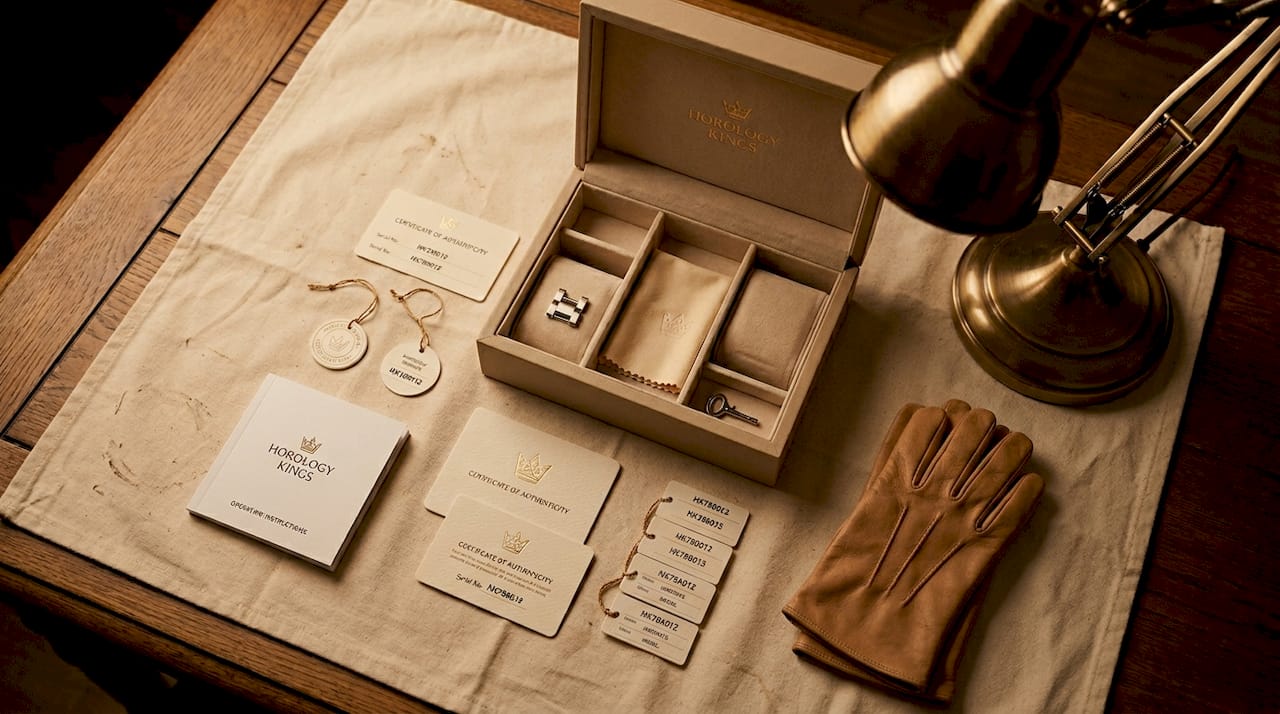
Pro Tip: Store hang tags and swing tags inside the presentation box rather than attached to the watch. They are easily lost but contribute to the completeness of the set and, therefore, to its perceived value.
Do papers prove authenticity more than the box does?
The short answer is yes, and the distinction matters enormously when you are buying or selling a pre-owned watch.
The watch box is primarily a presentation and storage item. It protects the watch, displays it attractively, and signals the brand’s prestige. What it does not do is link the watch to a specific transaction, a specific dealer, or a specific date. A box from a Rolex Submariner could theoretically accompany any Submariner of a similar era. On its own, it tells you almost nothing about the watch inside it.
Papers are a different matter entirely. The warranty card or certificate of origin ties a specific serial number to a specific authorised dealer and a specific purchase date. That chain of information is what watch provenance actually means. When a buyer can match the serial number on the watch to the serial number on the warranty card, and verify that the issuing dealer is a legitimate authorised retailer, they have a meaningful evidential basis for authenticity.
The three most important things papers confirm are:
Serial number match. The number engraved on the case must correspond exactly to the number printed on the warranty card. Any discrepancy is an immediate red flag.
Authorised dealer identity. The dealer named on the card should be verifiable as an official stockist for that brand at the time of sale.
Purchase date alignment. The date on the card should be consistent with the watch’s production year, which can be cross-referenced using published serial number databases for brands like Rolex and Omega.
“The ultimate proof is a verified watch and authentic papers. Many collectors value boxes and papers for provenance and aesthetic reasons, but neither substitutes for professional authentication.”
That said, counterfeit paperwork is a genuine and growing risk. Sophisticated fakes can replicate the appearance of warranty cards, certificates, and even presentation boxes convincingly enough to deceive an untrained eye. Papers alone are not a guarantee of authenticity. They are strong supporting evidence that must be assessed alongside the watch itself by a qualified watchmaker or authorised dealer.
Pro Tip: When buying a pre-owned watch, use the watch authentication checklist approach: verify the serial number independently, check the card format against known examples for that production year, and have the movement inspected by a specialist before completing any transaction.
How much do box and papers affect resale value?
The financial impact of having original box and papers is well documented and substantial. Watches sold with their complete original set trade at a premium of 10% to 30% on the secondary market, with some transactions showing a 31% uplift in value compared to equivalent watches without documentation. That figure represents a meaningful sum on a watch priced at £10,000 or more.
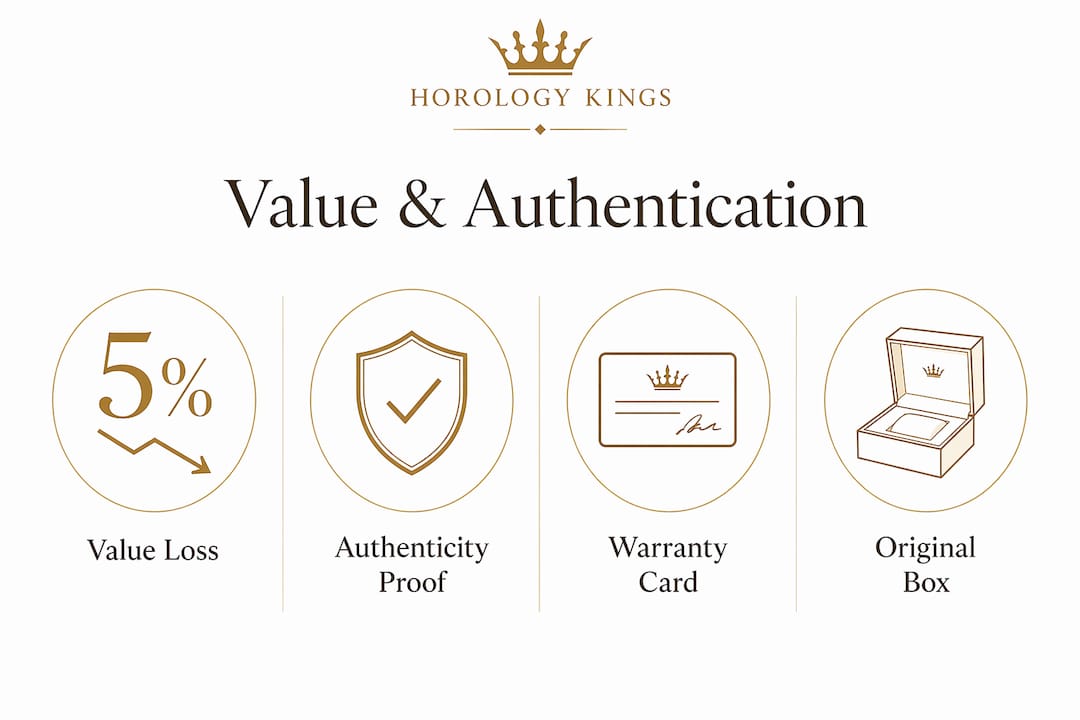
The split between box and papers is not equal. Collectors who lose only the box but retain their papers are in a considerably stronger position than those who have the box but no documents. Watches without boxes can lose as little as 3% to 5% of their full value when papers are present and verified. Losing the papers, by contrast, triggers a far steeper discount because buyer confidence drops sharply without documented provenance.
Condition | Approximate value impact | Primary reason |
Full set (box and papers) | Full market value or premium | Complete provenance, maximum buyer confidence |
Papers only, no box | 3% to 5% below full set | Papers confirm identity; box is cosmetic |
Box only, no papers | 15% to 25% below full set | No documented provenance or serial confirmation |
No box, no papers (NBNP) | 20% to 30% below full set | Lowest confidence, hardest to authenticate |
Beyond resale, original packaging and paperwork are directly relevant to insurance. Valuers use these items to confirm the watch’s details and establish the correct replacement value. Without them, insurers and appraisers must rely on market comparables, which can undervalue the insured amount and leave the owner exposed in the event of a claim. For collectors holding watches worth tens of thousands of pounds, that gap is not trivial.
The role of certificates in determining market price is particularly pronounced for highly collectable references. A Rolex Daytona or Patek Philippe Nautilus with matching papers commands a meaningfully higher price than the same reference without, and in some cases the papers themselves become a talking point in the transaction.
What to do when box or papers are missing or suspect
Missing documentation does not automatically mean a watch is inauthentic or a poor purchase. There are entirely legitimate reasons why a watch might lack its original set.
Common reasons for absent box or papers include:
The watch was purchased many years ago when buyers did not routinely retain packaging.
The original owner lost or discarded the box during a house move.
The watch was a gift and the recipient never received the full set.
The watch was purchased in a country where documentation practices differed.
Vintage watches, particularly those produced before the 1980s, were rarely sold with the comprehensive documentation that modern buyers expect.
Vintage watches without full sets can still be highly valuable and entirely authentic, provided they are verified through other means. Servicing records from authorised workshops, engraved dedications that can be historically traced, and expert appraisal by a certified watchmaker all contribute to establishing provenance in the absence of original papers.
When papers are present but their authenticity is in question, the steps to take are straightforward:
Compare the card format, font, and print quality against known genuine examples for that brand and production year. Reference communities such as specialist forums and brand-specific collector groups maintain extensive photographic archives.
Check the serial number on the card against the number on the case and, where possible, against the movement.
Contact the issuing authorised dealer directly. Many dealers retain sales records and can confirm whether a specific serial number was sold through their business.
Commission an independent appraisal from a qualified horologist or submit the watch to a brand’s own authentication service.
For watch authentication in 2026, digital tools are increasingly available. Some brands now allow serial number verification through their own websites or NFC-enabled cards, which removes a layer of uncertainty for recent purchases.
Pro Tip: Store your box and papers in a cool, dry location away from direct sunlight. Keep the warranty card in an acid-free sleeve inside the presentation box. Deterioration of the card reduces its legibility and, in turn, its evidential value. Premium watch care extends beyond the watch itself.
Key takeaways
Original box and papers are the primary provenance record for any luxury watch, with papers carrying significantly more evidential weight than the box alone.
Point | Details |
Papers outweigh the box | Missing the box costs 3% to 5% in value; missing papers costs 15% to 30% or more. |
Serial number match is critical | The warranty card must match the case number exactly to serve as valid provenance. |
Counterfeits exist | Fake papers and boxes require professional verification, not just visual inspection. |
Insurance depends on documentation | Original packaging and papers allow valuers to confirm correct replacement value. |
Vintage watches are different | Older pieces often lack full sets but can be authenticated through servicing records and expert appraisal. |
Why I think collectors get this slightly wrong
Most collectors understand that box and papers matter. Fewer understand why they matter in the specific way they do, and that gap leads to poor decisions in both directions.
I have seen buyers walk away from genuinely exceptional watches because the box was missing, treating its absence as a red flag equivalent to missing papers. That is a mistake. The box is packaging. It is beautiful, brand-specific packaging, and it adds to the experience of ownership, but it does not tell you anything meaningful about the watch’s history. Papers do.
The more interesting shift I am watching is the move towards digital provenance. Breitling’s Passport, Audemars Piguet’s digital warranty, and the broader discussion around blockchain-based ownership records suggest that the physical warranty card will eventually become a secondary document rather than the primary one. That transition is still years away from being universal, but collectors buying watches today should be aware that the format of “papers” is already changing. An NFC-enabled card from a 2023 Rolex is a fundamentally different object from a paper certificate from a 1995 Rolex, and both need to be assessed on their own terms.
My practical advice is this: prioritise papers over box, always. But never treat papers as a substitute for having the watch itself properly examined. The importance of authenticity in this market cannot be reduced to a single document. Box and papers are the starting point for trust, not the conclusion of it.
— Lewis
Find authentic watches with full provenance at Horology Kings

Horology Kings specialises in buying, selling, and sourcing luxury watches with verified provenance from Hertfordshire, England. Every watch in the collection is assessed for authenticity, and the team can advise on the significance of box and papers for any specific reference or transaction. Whether you are looking to buy or sell a luxury watch with full documentation, or need help sourcing a specific model with its original set intact, Horology Kings provides the expertise and transparency that serious collectors require. Contact the team directly for a discreet valuation or to discuss provenance on any timepiece you are considering.
FAQ
What does “box and papers” mean for a luxury watch?
“Box and papers” refers to the original presentation box and official documentation, including the warranty card, instruction manual, and purchase receipt, that accompany a luxury watch from an authorised retailer. These items form the provenance record for the watch.
Are papers more important than the box for resale value?
Yes. Watches without boxes lose approximately 3% to 5% of their value when papers are present, whereas missing papers can reduce value by 15% to 30% or more, because papers provide the documented serial number and purchase history that buyers and insurers rely on.
Can fake box and papers be detected?
Counterfeit boxes and papers can be convincing, so visual inspection alone is insufficient. Verification requires comparing card formats against known genuine examples, checking serial number alignment, and ideally consulting an authorised dealer or qualified watchmaker.
Do vintage watches need original box and papers to be valuable?
Not necessarily. Many vintage watches pre-date modern documentation practices and are authenticated through servicing records, expert appraisal, and physical examination of the movement. Provenance can be established through multiple routes beyond original packaging.
How should I store my watch box and papers?
Keep the warranty card in an acid-free sleeve inside the presentation box, stored in a cool, dry location away from direct sunlight. Deterioration of the card reduces its legibility and its value as a provenance document.
Recommended
Comments