.png)

Watch movement types: a collector's complete guide
- lewisvrichards3
- Jun 21
- 8 min read

TL;DR:
Watch movements are the engines behind timepieces, affecting accuracy, maintenance, and value. Mechanical, quartz, and hybrid movements each offer unique experiences, costs, and care requirements for collectors. Understanding these differences helps in choosing a watch that matches your priorities and long-term goals.
A watch movement is the engine inside every timepiece, governing how it keeps time, how often it needs servicing, and how much it costs to maintain. Understanding the different watch movement types is the foundation of any serious collecting decision. Whether you are drawn to the craft of a hand-wound Patek Philippe or the reliability of a Citizen Eco-Drive, the movement defines the experience. This guide covers every major category, from manual and automatic mechanical calibres to quartz, solar, and hybrid technologies like the Grand Seiko Spring Drive.
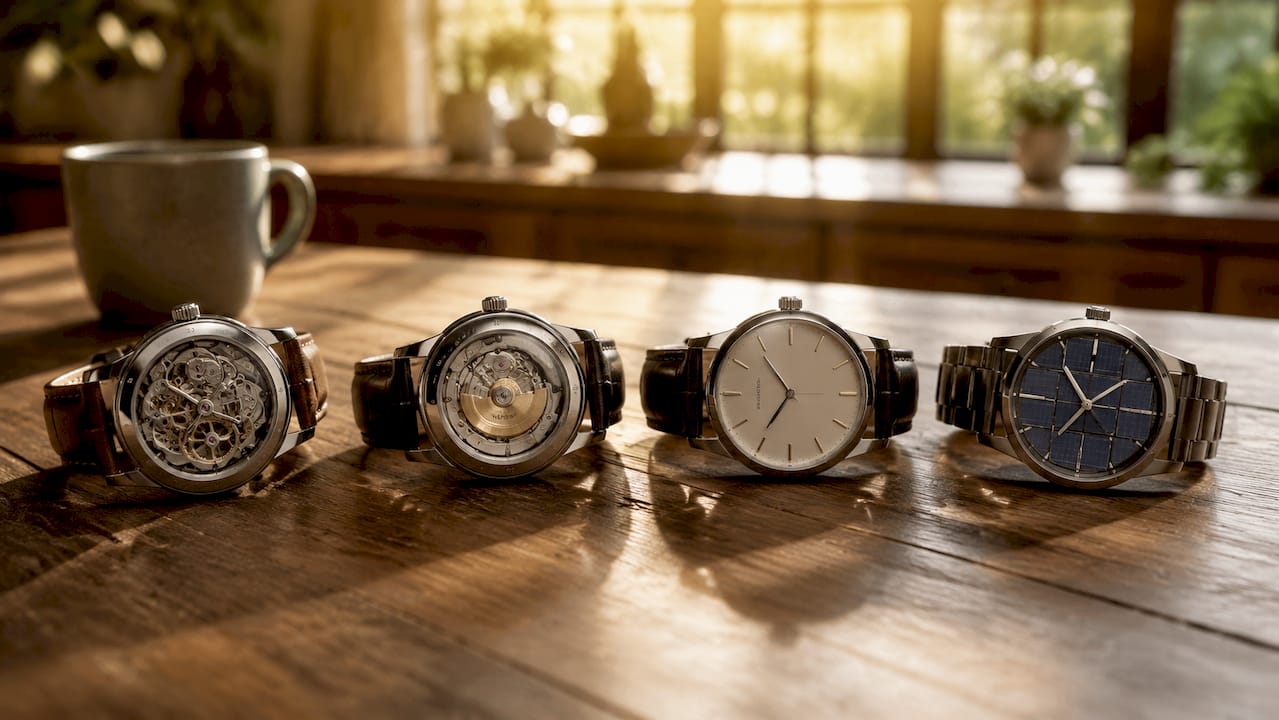
1. What are watch movement types?
A watch movement, known in the trade as a “calibre,” is the mechanism that powers timekeeping. Every other element of a watch, the case, dial, and hands, exists to house and display it. The three primary categories are mechanical (manual and automatic), quartz, and solar quartz. Beyond these sit niche hybrids such as the Spring Drive and Seiko Kinetic. Your choice of movement affects accuracy, running costs, and the long-term value of your collection.
2. Manual wind movements: the purest mechanical experience
A manual wind movement stores energy in a mainspring that you wind by hand, typically once a day or every few days. The act of winding is deliberate and tactile. It connects you directly to the watch’s mechanism in a way no other type replicates. Rolex, Patek Philippe, and A. Lange and Söhne all produce celebrated manually wound calibres.
Power reserve varies by calibre, from around 40 hours in a standard movement to several days in a grand complication. When the mainspring runs down, the watch stops. That discipline is part of the appeal for collectors who treat winding as a ritual.
Mechanical watches require servicing every 5–10 years at a cost of $150–$400. That figure can rise sharply for vintage pieces where discontinued parts are scarce and sourcing extends repair times considerably.
Mechanical watches are also sensitive to magnetisation and shock, which means they demand more care than quartz equivalents. Timekeeping can vary by position, a phenomenon called positional error. Owners can exploit resting position overnight to nudge the daily rate without a service visit.
Key characteristics of manual wind movements:
Power source: mainspring wound by hand
Typical power reserve: 40–72 hours (longer in some calibres)
Accuracy: roughly ±10–30 seconds per day
Service interval: every 5–10 years
Best for: collectors who value tradition, craft, and direct engagement
Pro Tip: When winding a manual watch, you will feel the crown firm up and stop at full wind. An automatic movement uses a slipping clutch and has no hard stop. This winding feel test is the quickest way to identify which type you are holding.
3. Automatic movements: mechanical convenience
An automatic movement shares the same mechanical architecture as a manual wind calibre, but adds a rotor. The rotor spins with wrist movement and winds the mainspring continuously. You never need to wind the watch manually during regular wear. Rolex’s Calibre 3235 and the Omega Co-Axial movement are two of the most recognised examples in the market.
The craftsmanship and collector appeal of automatic watches mirrors that of manual wind pieces. The smooth sweep of the seconds hand, the visible rotor through a display caseback, and the heritage of Swiss manufacture all contribute to their desirability. Service costs and intervals are identical to manual wind: every 5–10 years at $150–$400.
If you leave an automatic watch unworn for more than a day or two, it will stop. A watch winder solves this, though purists often prefer simply resetting the time. Positional error applies here too, and the same overnight position trick works for fine-tuning the daily rate.
4. Quartz movements: battery-powered precision
A quartz movement uses a battery to send electrical pulses through a quartz crystal, which vibrates at a consistent frequency to regulate timekeeping. The result is accuracy of ±15–20 seconds per month, which is 30–60 times more accurate than a standard non-COSC mechanical movement. For anyone who needs a watch to keep reliable time without adjustment, quartz is the clear choice.
Battery life runs 2–5 years, and replacement costs just $10–$30. That makes the total cost of ownership dramatically lower than mechanical. Quartz movements also allow thinner case profiles, which is why many dress watches and fashion pieces use them.
Quartz pros:
Exceptional accuracy (±15–20 seconds per month)
Low maintenance: battery replacement every 2–5 years
Affordable servicing ($10–$30 per battery change)
Thinner case profiles possible
More resistant to magnetisation and shock
Quartz cons:
No mechanical craft or visual movement appeal
Battery-dependent: stops when power runs out
Lower collector and resale value in most cases
Risk of battery leakage if stored unused for years
Pro Tip: If you store a quartz watch for an extended period, remove the battery before putting it away. Electrolyte leakage from a dead battery can permanently damage the circuit board, an expensive repair that is entirely avoidable.
5. Solar quartz: precision with a long-life power source
Solar quartz movements work on the same principle as standard quartz, but replace the disposable battery with a photovoltaic cell and rechargeable power cell. Light, whether natural or artificial, charges the cell continuously. Citizen Eco-Drive is the most prominent example, with rechargeable cells designed to last over 20 years under normal use.
The accuracy matches standard quartz at ±15–20 seconds per month. The practical difference is that you never replace a battery. For collectors who wear their watches daily and want zero maintenance interruption, solar quartz is the most convenient option available.
Solar quartz at a glance:
Power source: photovoltaic cell charged by light
Cell lifespan: 20+ years under normal use
Accuracy: same as standard quartz (±15–20 seconds per month)
Battery replacement: none required
Best for: daily wear, eco-conscious collectors, low-maintenance preference
The environmental case is straightforward. Disposable batteries create waste; solar cells do not. Citizen has built an entire brand identity around this, and the technology has matured to the point where even brief indoor light exposure maintains a full charge reserve.
Pro Tip: Solar watches perform best with regular light exposure. Wearing one daily near a window is enough to keep the cell fully charged. Avoid storing it in a dark drawer for weeks at a time.
6. Hybrid and niche movements: Spring Drive and Kinetic
The Grand Seiko Spring Drive is one of the most technically remarkable movements in production. It uses a traditional mechanical mainspring for power but replaces the conventional lever escapement with an electromagnetic Tri-synchro Regulator. The result is a gliding, perfectly smooth seconds hand and accuracy far beyond a standard mechanical calibre. Grand Seiko positions the Spring Drive as the resolution of the long-standing trade-off between mechanical craft and quartz precision.
Seiko Kinetic movements take a different approach. A rotor, like that in an automatic watch, charges a rechargeable battery rather than a mainspring. The battery then powers a quartz oscillator. You get quartz accuracy and the self-charging convenience of an automatic, with no mainspring to service in the traditional sense.
What sets these movements apart:
Spring Drive: mechanical power, electromagnetic regulation, no battery, quartz-level accuracy
Kinetic: rotor-charged battery, quartz oscillator, no disposable battery
Both eliminate the need for battery replacement
Both offer mechanical-like wearing experience with superior timekeeping
Collectors are drawn to these movements because they represent genuine horological problem-solving. The Spring Drive addresses the craft-versus-accuracy trade-off that has defined the industry for decades. Owning one is as much an intellectual pleasure as an aesthetic one.
7. Comparing watch movement types: accuracy, cost, and suitability
Choosing between different watch movements comes down to three factors: how accurate you need the watch to be, how much maintenance you are willing to commit to, and what kind of connection you want with the timepiece.
Movement type | Accuracy | Service interval | Typical service cost | Best suited to |
Manual wind | ±10–30 sec/day | Every 5–10 years | $150–$400 | Collectors, traditionalists |
Automatic | ±10–30 sec/day | Every 5–10 years | $150–$400 | Enthusiasts, daily wear |
Quartz | ±15–20 sec/month | Battery every 2–5 years | $10–$30 | Reliability-focused wearers |
Solar quartz | ±15–20 sec/month | Cell lasts 20+ years | Minimal | Daily wear, eco-conscious |
Spring Drive | ±1 sec/day | Every 3–5 years | High | Serious collectors |
Kinetic | ±15–20 sec/month | Occasional cell check | Low | Active wearers |
The best movement depends entirely on your priorities. Quartz wins on precision and running costs. Mechanical wins on craft, heritage, and the tactile pleasure of ownership. Spring Drive wins if you refuse to compromise on either. For choosing a Swiss watch, understanding these differences is the single most important step before any purchase.
Key takeaways
The movement type is the single most important factor in determining a watch’s accuracy, maintenance demands, and long-term collector value.
Point | Details |
Mechanical service costs | Budget $150–$400 every 5–10 years for manual or automatic calibres. |
Quartz accuracy advantage | Quartz is 30–60 times more accurate than a standard mechanical movement. |
Solar cell longevity | Citizen Eco-Drive cells last 20+ years, eliminating battery replacement entirely. |
Spring Drive precision | Grand Seiko’s Spring Drive delivers near-quartz accuracy from a mechanical mainspring. |
Battery storage risk | Remove quartz batteries before long-term storage to prevent circuit damage from leakage. |
What I have learned from years with every movement type
Lewis’s view on choosing the right calibre
The debate between mechanical and quartz is often framed as craft versus convenience. After years of handling watches at Horology-kings, I think that framing misses the point entirely.
Mechanical watches, whether manual or automatic, are not just timekeepers. They are objects that reward attention. The heritage and commitment to maintenance that comes with a fine mechanical calibre is part of what you are buying. A Rolex Submariner with a 3235 calibre or a Patek Philippe with a hand-finished lever escapement asks something of you. That relationship has genuine value.
Quartz gets unfairly dismissed in collector circles. A high-quality quartz movement in a well-made case is a serious tool watch. If you need accuracy and zero fuss, quartz is not a compromise. It is the right answer.
What genuinely excites me is the Spring Drive. Grand Seiko solved a problem that the Swiss industry largely ignored, and the result is a movement that makes you reconsider what a mechanical watch can be. Collectors who overlook it because it is not Swiss are missing one of the most interesting pieces in contemporary horology.
My practical advice: factor in long-term service costs before you buy, especially with vintage mechanical pieces where parts availability is uncertain. The emotional pull of a beautiful movement is real and valid. Just go in with clear eyes about what ownership actually involves.
— Lewis
Discover watches across every movement type at Horology-kings

Horology-kings is a Hertfordshire-based specialist dealing in authenticated luxury timepieces from Rolex, Patek Philippe, Audemars Piguet, Omega, and Cartier. The collection spans classic manual wind pieces, celebrated automatic calibres, and some of the most sought-after references in the pre-owned market. Whether you are drawn to the Rolex Submariner’s automatic movement or want to explore the full range of what fine watchmaking offers, the team at Horology-kings provides expert guidance, transparent valuations, and secure UK bank transfers. Browse the full collection to find a timepiece that matches your movement preference and collecting goals.
FAQ
What is the most accurate watch movement type?
Quartz movements are the most accurate for everyday use, keeping time to ±15–20 seconds per month. The Grand Seiko Spring Drive achieves roughly ±1 second per day, making it the most accurate mechanical-based movement available.
How often do mechanical watches need servicing?
Mechanical watches, both manual and automatic, require a full service every 5–10 years. Costs typically run $150–$400, though vintage pieces with rare parts can cost considerably more.
Can I store a quartz watch without removing the battery?
Short-term storage is fine, but for storage lasting a year or more, removing the battery is strongly recommended. Battery leakage can permanently damage the quartz circuit board, turning a minor inconvenience into a costly repair.
What is the difference between manual and automatic movements?
Both are mechanical, but an automatic movement includes a rotor that winds the mainspring through wrist movement. A manual wind movement requires you to wind the crown by hand, typically daily. Service costs and intervals are the same for both.
Is a solar watch worth buying over standard quartz?
For daily wear, solar quartz is the better choice. The rechargeable cell lasts over 20 years, accuracy matches standard quartz, and you never replace a battery. Citizen Eco-Drive is the benchmark example of the technology done well.
Recommended
Comments