.png)
Watch sourcing services explained for luxury collectors

TL;DR:
Watch sourcing services use private networks to find rare, unavailable, or limited-edition timepieces.
These services offer authentication, negotiation, and discreet delivery, reducing risks and saving time.
Costs vary from 5% to 10% of the watch price, with timelines typically ranging from two to twelve weeks.
Many collectors assume that acquiring a rare Rolex Daytona or Patek Philippe Nautilus is simply a matter of walking into a boutique or browsing online. The reality is far more complex. Demand for high-end Swiss timepieces consistently outstrips supply, with waitlists stretching years and grey market premiums reaching eye-watering levels. A specialist watch sourcing service bridges that gap, offering collectors and investors a structured, trustworthy route to the pieces they genuinely want. This article breaks down exactly how these services work, what the process looks like from first enquiry to final delivery, and what every serious collector should know before engaging one.
Table of Contents
Key Takeaways
Point | Details |
Specialists add value | Watch sourcing services open doors to rare Swiss pieces otherwise unavailable to most collectors. |
Trust and transparency matter | Choosing a reputable agent means checks for authenticity, clear provenance, and reliable delivery. |
Expect costs and timelines | Sourcing incurs fees and may require patience, but delivers results when managed with clear expectations. |
Expert guidance helps | Skipping common pitfalls and leveraging specialist knowledge can protect and grow a watch collection. |
What does a watch sourcing service do?
At its core, a watch sourcing service locates and acquires specific models requested by collectors, often unavailable through retail channels, as outlined in the watch sourcing process at Horology Kings. It is not simply a search engine or a listing platform. A true sourcing specialist uses a curated network of private sellers, dealers, auction houses, and international contacts to track down exactly what a client wants, often within tight specifications around reference numbers, dial colour, bracelet type, or production year.
The typical engagement follows a clear sequence:
Initial consultation — You describe the exact watch you want, including model, reference, condition, and budget.
Market assessment — The service evaluates current availability, recent sale prices, and realistic acquisition timelines.
Active search — Specialists tap their private networks and monitor off-market channels, not just public listings.
Negotiation — Once a candidate piece is identified, the service negotiates price and terms on your behalf.
Authentication and inspection — The watch is verified for authenticity, condition, and provenance before any funds change hands.
Secure transfer — Delivery is arranged with appropriate documentation, insurance, and payment protection.
Who uses these services? Primarily serious collectors chasing specific references, investors seeking pieces with strong appreciation potential, and enthusiasts who simply lack the time or connections to navigate a fragmented global market. Understanding how sourcing works in practice reveals just how relationship-driven the process truly is.
“The rarest watches rarely appear on public platforms. Access is everything, and access is built over years of trust.”
Pro Tip: Before engaging any sourcing agent, ask for verifiable references from past clients and request a written outline of their process. Legitimate services welcome scrutiny.
For collectors interested in the nuances of scarcity, understanding limited edition watches provides essential context on why certain references are so difficult to acquire through conventional routes.
Why collectors and investors use sourcing services
Knowing what sourcing services are, it is worth examining why demand from collectors and investors continues to rise. The answer goes well beyond simple convenience.
The luxury watch market has become increasingly stratified. Authorised dealers allocate the most desirable references to long-standing clients, and even then, supply is tightly controlled by the manufacturers themselves. Rolex, for instance, deliberately limits production of its most sought-after models. The result is a secondary market where premiums of 50% to 200% above retail are not unusual for the right reference.
Sourcing services can access pieces with strong value appreciation or limited release, as demonstrated by rare Swiss watch value data showing significant gains in recent years. This makes them particularly attractive to investors who view high-end timepieces as a genuine asset class rather than simply a luxury purchase.
The key benefits collectors consistently cite include:
Access — Pieces that never appear on public platforms, sourced through private networks.
Authenticity assurance — Professional verification reduces the risk of acquiring a counterfeit or undisclosed-service piece.
Negotiation expertise — Experienced agents understand market value and can secure fairer prices than a private buyer acting alone.
Discretion — High-value transactions often require confidentiality, which reputable services provide as standard.
Time efficiency — Sourcing a specific reference independently can take months of fruitless searching.
The investment boom in luxury watches has pushed more buyers towards off-market channels, where sourcing agents operate most effectively. A collector seeking a specific steel Audemars Piguet Royal Oak, for example, may find that the authorised dealer waitlist is closed entirely. A sourcing specialist with the right relationships can often locate that exact piece within weeks.
Exploring watch sourcing strategies in depth reveals how experienced collectors approach these acquisitions systematically rather than leaving anything to chance. The value of limited editions further underscores why professional sourcing is increasingly considered essential rather than optional.
How reputable sourcing services work: steps and safeguards
With an understanding of why collectors use these services, it is essential to know how the process is structured and risk-mitigated. Reputable services ensure authenticity and trace the provenance checks of each timepiece, which is the single most important safeguard in any high-value acquisition.
The structured process typically unfolds as follows:
Enquiry and brief — You submit a detailed request specifying the exact reference, acceptable condition grades, and maximum budget.
Search and shortlisting — The service identifies candidates through its network and presents options with full details.
Negotiation — Terms are agreed with the seller, with the service acting as an intermediary.
Authentication — The watch undergoes independent verification, checking movement, case, dial, and all documentation against manufacturer records where possible.
Documentation review — Original box, papers, service history, and import records are examined and provided to the buyer.
Secure payment and delivery — Funds are transferred via protected channels, and the watch is delivered with full insurance.
Pro Tip: Always request an independent authentication report before releasing funds. Reputable services actively encourage this as part of safe watch sourcing practice.
Factor | Authorised dealer | Sourcing service |
Access to rare references | Very limited | Extensive via private networks |
Retail price availability | Yes | Rarely; market-rate pricing |
Authentication guarantee | Manufacturer-backed | Independent verification |
Waitlist requirement | Often years | Typically weeks to months |
Discretion and privacy | Standard retail process | High; bespoke service |
Negotiation flexibility | None | Yes, on your behalf |
Understanding safe watch buying practices is equally important given the sophistication of modern counterfeits. A sourcing service that skips authentication is not a service worth trusting.
What to expect: costs, timelines, and common pitfalls
Now that the process is outlined, collectors should know what to expect when setting out on their sourcing journey. Watch sourcing fees vary based on rarity and market conditions, and timelines depend upon availability and negotiation outcomes.
Fee structures vary considerably across providers. The three most common models are:
Flat fee — A fixed charge regardless of the watch’s final price, common for straightforward requests.
Commission-based — A percentage of the purchase price, typically between 5% and 10%, aligned with the service’s effort.
Hybrid — A modest upfront retainer combined with a success-based commission on completion.
Brand | Typical sourcing fee | Average timeline |
Rolex | 5 to 8% | 2 to 6 weeks |
Patek Philippe | 7 to 10% | 4 to 12 weeks |
Audemars Piguet | 6 to 10% | 3 to 10 weeks |
Omega | 4 to 7% | 1 to 4 weeks |
Cartier | 5 to 8% | 2 to 6 weeks |
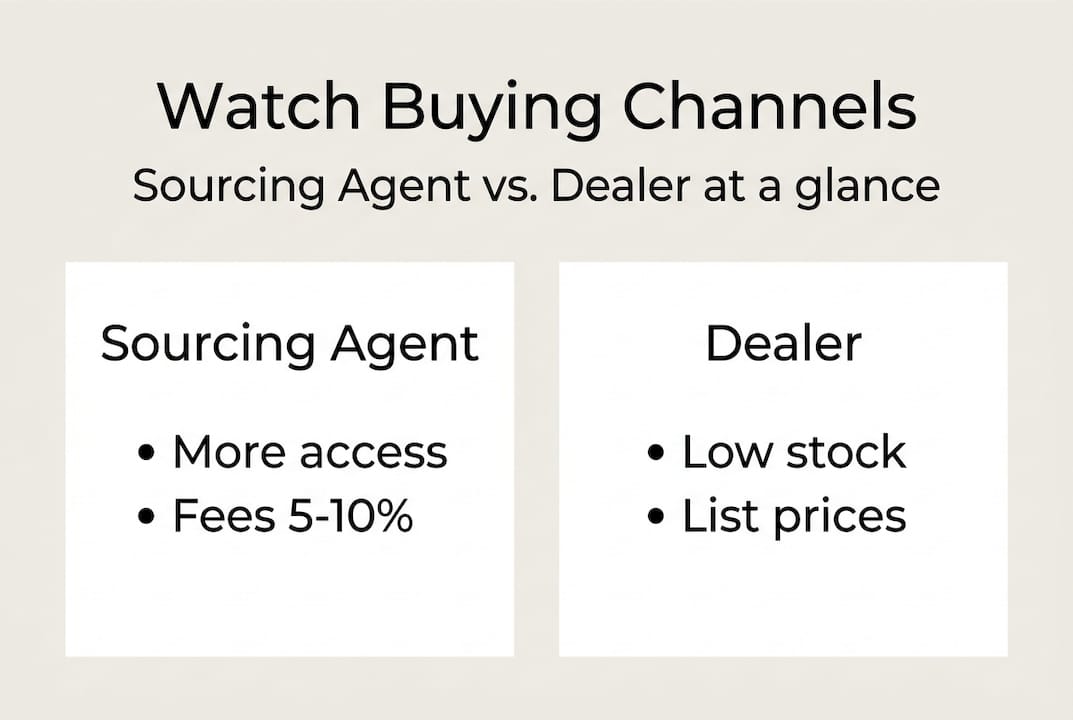
Reviewing fees and factors in detail helps collectors benchmark what they are being quoted against industry norms.
Common pitfalls to avoid:
Vague verbal agreements — Always insist on written terms before any money changes hands.
Hidden fees — Clarify whether the quoted fee covers authentication, shipping, insurance, and import duties.
Unrealistic timelines — A service promising delivery within days for a highly sought-after reference should raise immediate concern.
Lack of communication — A reputable service provides regular updates; silence is a warning sign.
Pro Tip: Before committing, request a written agreement covering fees, timelines, authentication standards, and refund terms. Consulting watch valuation guidance beforehand ensures you understand fair market value for your target piece. Additional sourcing tips can further sharpen your preparation.
The realities most collectors overlook
Beyond procedures and fees, there is a deeper lesson that only experience reveals. Most collectors focus on the mechanics of sourcing: the process, the paperwork, the price. What they underestimate is that the best sourcing relationships are built on trust accumulated over time, not a single transaction.
A sourcing specialist who genuinely understands your collecting goals will prioritise pieces that align with your long-term vision, not simply the easiest commission. That alignment of incentives matters enormously. It is the difference between a service that finds you a watch and one that finds you the right watch.
Provenance and aftercare are equally overlooked. A watch acquired without traceable history may be authentic today but difficult to sell or insure tomorrow. Understanding what defines collector timepiece value means recognising that documentation, service history, and originality are not optional extras. They are fundamental to long-term value.
Finally, patience is not a weakness in this market. Rushing a sourcing decision to meet an arbitrary deadline almost always results in compromise, whether on condition, provenance, or price. The collectors who build the strongest portfolios treat sourcing as a considered, ongoing practice rather than a one-off transaction.
Find your next Swiss masterpiece with expert help
For those looking to take the next step with peace of mind, professional sourcing partners are invaluable. At Horology Kings, we specialise in connecting collectors and investors with the exact Swiss timepieces they are searching for, from sought-after Rolex references to rare Patek Philippe complications.
Our team handles every stage of the process with full transparency, from initial brief through to authenticated delivery via secure UK bank transfer. Whether you are ready to begin sourcing your next watch, want to explore buy and sell options across our curated inventory, or need servicing and repairs for a recently acquired piece, we are here to assist. Contact us today for a discreet, no-obligation sourcing consultation.
Frequently asked questions
How long does it typically take to source a rare Swiss watch?
Most requests take two to eight weeks, though timelines are subject to market availability and negotiation outcomes, meaning exceptionally rare references can take longer.
Are all sourcing services equally trustworthy?
No. Always research reputations thoroughly, request provenance proof, and seek independent reviews, as due diligence and provenance checks are essential to protecting your investment.
Can a sourcing service get a discontinued or vintage model?
Yes. Sourcing specialists focus specifically on hard-to-find pieces, and collectors use sourcing precisely because discontinued and vintage references are unavailable through standard retail channels.
What kind of fees should I expect for watch sourcing?
Expect a percentage of the watch price, often 5 to 10%, or a flat fee depending on complexity, as sourcing fees are determined by rarity, value, and the negotiation required to secure the piece.
Recommended
Comments