.png)

What is a chronograph watch? A complete guide
- lewisvrichards3
- Jun 3
- 8 min read
TL;DR:
A chronograph watch combines standard timekeeping with an independent stopwatch function operated by pushers and displayed through sub-dials. It originated in 1816 for astronomical timing and has since become essential in fields like aviation, motorsport, and diving. Owning a chronograph links you to a rich history and practical utility, with iconic models from brands like Rolex, Omega, and Patek Philippe maintaining strong collector value.
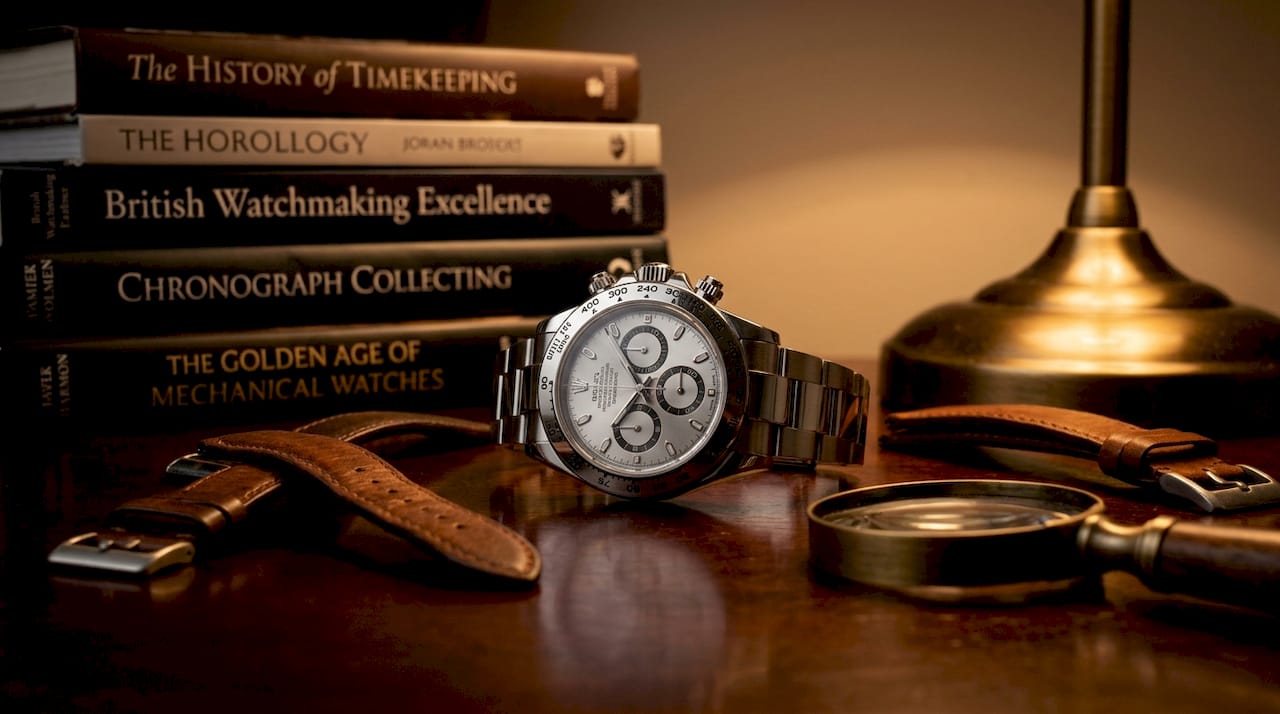
A chronograph watch is defined as a timepiece that combines standard timekeeping with an independent built-in stopwatch function, operated by pushers and displayed through dedicated sub-dials. The Omega Speedmaster, worn on every crewed NASA Moon mission, is perhaps the most celebrated example of this complication in action. Unlike a simple dress watch, a chronograph gives you the ability to measure elapsed time with precision whilst still reading the hour and minute on the same dial. That dual purpose is what makes the chronograph one of the most enduringly popular complications in luxury horology.
The chronograph layout consists of hour and minute hands for standard time, a central chronograph seconds hand, and sub-dials that record elapsed minutes and hours. Two pushers, typically positioned at 2 o’clock and 4 o’clock on the case, start, stop, and reset the stopwatch independently of the main movement. Brands such as Rolex, Patek Philippe, and TAG Heuer have each built iconic chronograph references that define the complication across different eras and price points.
What is a chronograph watch? Origins and historical significance
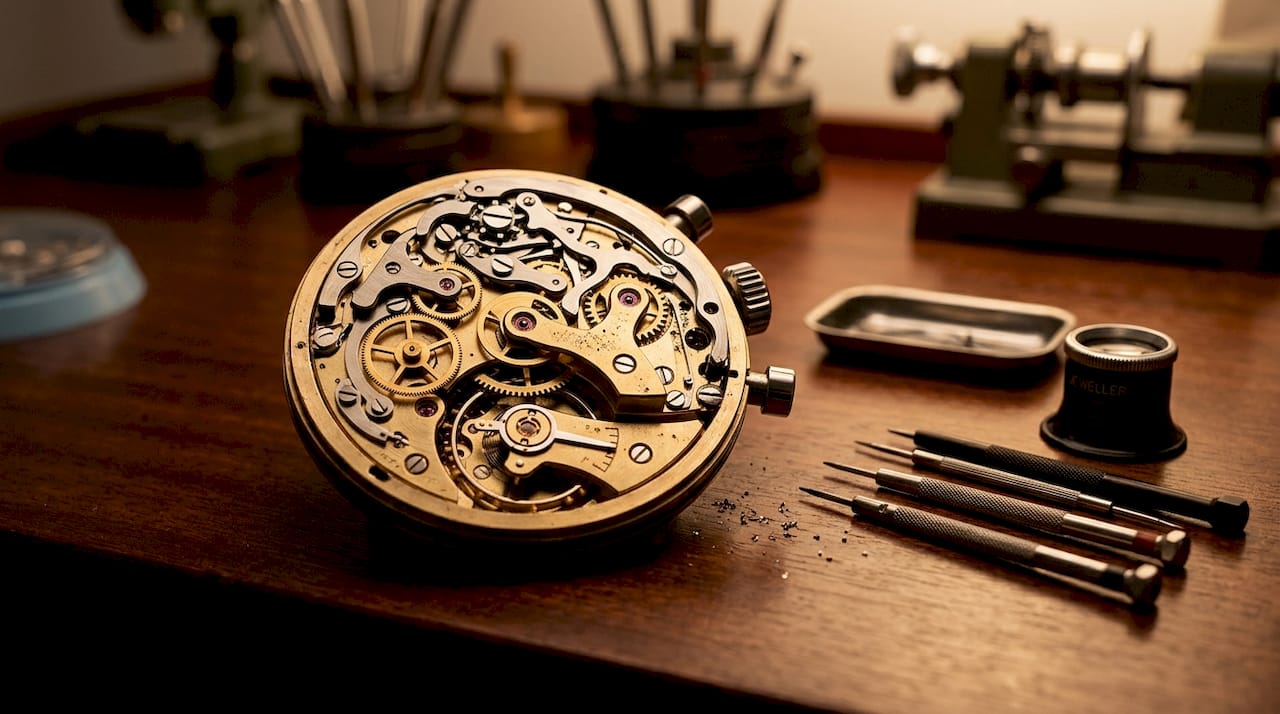
The chronograph dates to 1816, when Louis Moinet invented the mechanism for astronomical observation. Moinet’s device operated at a remarkable 216,000 vibrations per hour, completing a full dial rotation every second, which gave astronomers the repeatable precision they needed to track celestial events. That origin explains why accuracy and rapid reset have always been the defining priorities of chronograph design.
Through the 19th century, the complication moved from scientific observatories into military and industrial use. Artillery officers used chronographs to calculate projectile velocity. Railway engineers used them to schedule trains. The precision that Moinet had engineered for the stars turned out to be equally useful on the ground.
Key milestones in chronograph history include:
1816: Louis Moinet creates the first proto-chronograph for astronomical timing
1821: Nicolas Mathieu Rieussec patents a device that deposits ink drops to mark elapsed time, coining the term “chronographe”
Late 19th century: Adoption in military artillery and scientific measurement
Early 20th century: Transition from pocket watches to wristwatches, driven by aviation and motor racing
1969: Heuer, Breitling, and Hamilton-Buren simultaneously release the first automatic chronograph wristwatches
1972: Seiko introduces the first quartz chronograph
Chronographs found applications in aviation, motor racing, diving, and submarine navigation throughout the 20th century. Pilots needed to calculate fuel consumption and flight time. Racing drivers and their teams used tachymeter-equipped chronographs to measure lap speeds. Divers relied on elapsed-time tracking to monitor decompression limits. Each field shaped the design of the watches produced for it, which is why chronograph references from Breitling, Rolex, and Omega look so different from one another despite sharing the same core complication.
Pro Tip: If you are researching the history of a specific chronograph reference, the case reference number is your most reliable starting point. Manufacturers such as Rolex and Omega have maintained detailed production records that allow you to trace a watch’s history through its reference alone.
How does a chronograph work? Mechanisms and controls explained
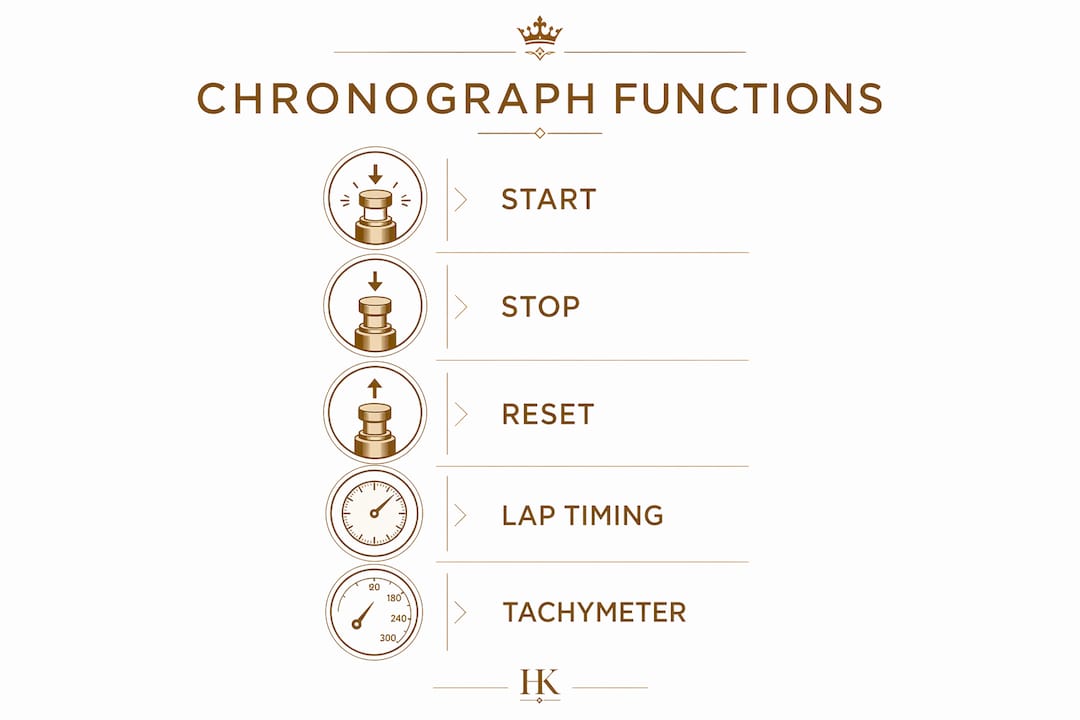
The chronograph function operates as a secondary movement layered on top of the base timekeeping calibre. Starting the chronograph engages a column wheel or cam system that connects the chronograph gear train to the running movement. Stopping it freezes the elapsed-time display without affecting the hour and minute hands. Resetting it returns all chronograph hands to zero via heart-shaped cams and reset hammers. Modern innovations include rack-and-pinion reset devices that improve reset precision and reduce the force required to press the pusher.
The pushers are the user’s primary interface. Pushers at 2 and 4 o’clock are the most common arrangement, making one-handed operation straightforward. The pusher at 2 o’clock starts and stops the chronograph; the pusher at 4 o’clock resets it. Some designs use a single pusher for all three functions, cycling through start, stop, and reset in sequence.
Mechanical vs quartz chronographs
Feature | Mechanical chronograph | Quartz chronograph |
Power source | Mainspring wound manually or automatically | Battery |
Accuracy | ±2 to ±5 seconds per day | ±0.5 seconds per day or better |
Reset precision | Heart-cam and hammer system | Electronic signal |
Collector appeal | High, due to visible movement complexity | Lower, though some vintage quartz are collectible |
Typical price range | Wide, from entry-level to six figures | Generally lower |
Sub-dials are the visual centrepiece of any chronograph dial. A standard layout includes a 30-minute counter and a 12-hour counter alongside the running seconds. More complex references add a fractional seconds sub-dial, a 24-hour indicator, or a moon phase. Modern chronographs often include tachymeter bezels that allow the wearer to calculate speed over a known distance by starting the chronograph at the beginning of a measured kilometre or mile and reading the tachymeter scale when the distance is complete.
Pro Tip: When examining a chronograph for purchase, press the reset pusher with the chronograph stopped and watch whether all hands return cleanly to zero. A misaligned reset, where one hand sits slightly off the zero marker, is a common sign of wear or a previous service carried out without proper calibration.
What is the difference between a chronograph, chronometer, and stopwatch?
Mixing up chronograph and chronometer is the most common source of confusion for anyone new to horology, and the distinction matters. A chronograph describes a function: the ability to measure elapsed time. A chronometer describes a certification: a movement that has passed rigorous accuracy testing conducted by the Contrôle Officiel Suisse des Chronomètres, known as COSC. A stopwatch is a standalone device with no time-of-day display at all.
The practical implication is straightforward. A watch can be both a chronograph and a chronometer simultaneously. The Omega Seamaster 300M Chronograph GMT Co-Axial holds COSC certification, meaning it measures elapsed time (chronograph) and has been independently verified for accuracy (chronometer). Neither term implies the other, and neither excludes the other.
Term | Definition | Key identifier |
Chronograph | A watch with an integrated stopwatch function | Pushers on the case, sub-dials on the dial |
Chronometer | A movement certified for accuracy by COSC or equivalent body | “Chronometer” printed on the dial, COSC certificate |
Stopwatch | A standalone timing device with no time-of-day display | No hour or minute hands for standard time |
Identifiable features that separate these categories at a glance:
A chronograph always has at least one pusher on the case and at least one additional sub-dial beyond the standard seconds
A chronometer certification is printed on the dial, typically below the brand name, and accompanied by a COSC certificate
A stopwatch has no crown for setting time and no standard time display
What are the practical benefits of owning a chronograph watch?
Chronographs remain popular because they offer genuine utility across a wide range of activities, not merely as a style statement. Pilots use them to calculate fuel burn rates and flight segments. Medical professionals time procedures and medication intervals. Sports coaches and athletes use them to record split times without carrying a separate device. The tactile, mechanical interaction of pressing a pusher and watching a hand sweep around the dial provides a level of engagement that a digital timer on a smartphone simply does not replicate.
From a collector’s perspective, the chronograph is one of the most studied and documented complications in watchmaking. References such as the Rolex Daytona, the Patek Philippe 5172G, and the Breitling Navitimer each carry distinct histories that add depth to ownership. A collector’s timepiece with a chronograph complication frequently commands a premium at auction precisely because of that documented heritage.
The practical benefits of chronograph ownership include:
Timing versatility: Start, stop, and reset without disturbing the main time display
Tachymeter functionality: Calculate speed over a fixed distance using the bezel scale
Professional credibility: Recognised across aviation, motorsport, medicine, and diving as a tool watch
Collector value: Strong secondary market demand for iconic references from Rolex, Omega, and Patek Philippe
Mechanical engagement: The physical act of operating pushers creates a connection to the watch that passive timekeeping does not
Durability is another underappreciated advantage. Because the chronograph function is independent of the main movement, stopping and resetting the complication does not stress the timekeeping calibre. A well-serviced mechanical chronograph from a reputable manufacturer will function reliably for decades.
Key takeaways
A chronograph watch is a timepiece that combines standard time display with an independent stopwatch function, and it is entirely distinct from a chronometer, which is a certification of movement accuracy rather than a feature.
Point | Details |
Core definition | A chronograph integrates a stopwatch into a standard watch, operated by pushers and sub-dials. |
Historical origin | Louis Moinet invented the mechanism in 1816 for astronomical precision timing. |
Chronograph vs chronometer | Chronograph is a function; chronometer is a COSC accuracy certification. Both can coexist in one watch. |
Practical utility | Used in aviation, motorsport, medicine, and diving for reliable elapsed-time measurement. |
Collector value | Iconic references from Rolex, Omega, and Patek Philippe hold strong secondary market demand. |
Why the chronograph remains the complication I recommend most
I have handled hundreds of watches across every complication category, and the chronograph is consistently the one I point enthusiasts towards first. Not because it is the most technically complex. A tourbillon or a minute repeater surpasses it on that measure. The chronograph earns its place because it is the complication you actually use.
What I find most telling is how owners describe their relationship with a chronograph versus a simple three-hand watch. With a dress watch, you glance at the time and move on. With a chronograph, you interact with it. You press the pusher. You watch the hand sweep. You reset it. That physical dialogue between wearer and watch is rare in an era when most timing is done by a phone in your pocket.
The confusion between chronograph and chronometer frustrates me more than it should, because it is entirely avoidable. If a retailer cannot explain the difference clearly and immediately, that tells you something about their expertise. At Horology Kings, we treat that distinction as foundational knowledge, not a footnote.
My honest observation after years in this market is that the chronograph references holding their value most reliably are those with documented provenance and a clear connection to a specific professional field. The Rolex Daytona’s motorsport heritage, the Breitling Navitimer’s aviation roots, and the Omega Speedmaster’s NASA association are not marketing stories. They are the reason those watches command the prices they do. Buy the history, not just the complication.
— Lewis
Find your next chronograph with Horology Kings
Horology Kings is a Hertfordshire-based luxury watch specialist with direct access to pre-owned and rare chronograph references from Rolex, Patek Philippe, Audemars Piguet, Omega, and Breitling. Whether you are buying your first chronograph or adding a specific reference to an existing collection, the team provides expert valuations, transparent pricing, and secure UK bank transfers on every transaction.
If you are looking for a specific reference that is not currently listed, the watch sourcing service draws on an established network to locate rare and sought-after models on your behalf. For watches already in your collection, professional servicing keeps your chronograph calibrated and functioning to manufacturer specification. Browse the full catalogue and speak to the team directly at Horology Kings.
FAQ
What makes a watch a chronograph?
A watch is a chronograph when it includes an independent stopwatch function alongside standard timekeeping, operated by pushers on the case and displayed through dedicated sub-dials. The presence of at least one pusher and one additional sub-dial beyond the standard seconds hand are the defining visual identifiers.
What is the difference between a chronograph and a stopwatch?
A chronograph is a watch that also tells the time, with the stopwatch function integrated into the movement. A stopwatch is a standalone device with no time-of-day display, designed solely for measuring elapsed time.
Can a watch be both a chronograph and a chronometer?
Yes. A chronograph describes a stopwatch function, whilst a chronometer is a COSC accuracy certification. The Omega Seamaster 300M Chronograph GMT Co-Axial is a well-known example of a watch that holds both simultaneously.
How does the tachymeter on a chronograph work?
A tachymeter is a scale on the bezel or dial that calculates speed over a fixed distance. Start the chronograph at the beginning of a known distance, stop it at the end, and read the tachymeter scale to find the average speed in units per hour.
Which brands are best known for chronograph watches?
Rolex, Omega, Patek Philippe, Breitling, and TAG Heuer are the most recognised names in chronograph watchmaking, each with references tied to specific professional fields such as motorsport, aviation, and space exploration.
Recommended
Comments