.png)
What is a private watch sale? Secure routes for luxury buyers

TL;DR:
A private watch sale offers maximum control and privacy but requires thorough preparation and personal risk management.
To ensure security, authenticate the watch independently, vet buyers carefully, and use secure payment methods, preferably face-to-face.
While potentially yielding higher returns, private sales demand patience, professionalism, and strict adherence to best practices to avoid scams and complications.
Selling a luxury watch sounds simple until you actually try to do it properly. The moment you start weighing your options, the landscape quickly becomes complex: dealers offering swift but conservative prices, auction houses with unpredictable timelines, consignment specialists taking a generous slice of your final sale, and private buyers who may or may not be who they claim to be. Understanding what a private watch sale truly involves, and how to navigate one securely, is what separates collectors who walk away satisfied from those who feel they left money on the table or, worse, fell victim to a scam.
Table of Contents
Key Takeaways
Point | Details |
Private sale means direct negotiation | A private watch sale puts you in control, letting you negotiate directly with the buyer and set your own terms. |
Each exit route has trade-offs | Dealer sale, auction, consignment, and private sale all balance security, price, speed, and risk differently. |
Security and preparation are vital | Fraud and scams are real risks, so proper authentication and secure processes are essential for a safe sale. |
Prepare for maximum value | Organising documentation and presenting your watch professionally helps attract genuine buyers and better offers. |
Understanding a private watch sale
A private watch sale is a direct transaction between a seller and a buyer, conducted without an auction house, retail dealer, or consignment platform acting as the commercial intermediary. The seller retains full ownership of the watch until the moment of sale, manages their own marketing or relies on word of mouth, and negotiates terms directly with the prospective buyer.
This is distinctly different from other common routes. A practical guide to the four main exit routes explains that private sale differs from consignment, auction, and dealer sale mainly in who holds and markets the watch and who takes on risk until sale. In a consignment arrangement, you hand the watch over to a specialist who handles everything but charges a commission. In a dealer sale, you receive an immediate offer but typically at a price that allows the dealer room for profit. At auction, your watch is presented to a pool of competitive bidders, but there are no guarantees on timing or final price.
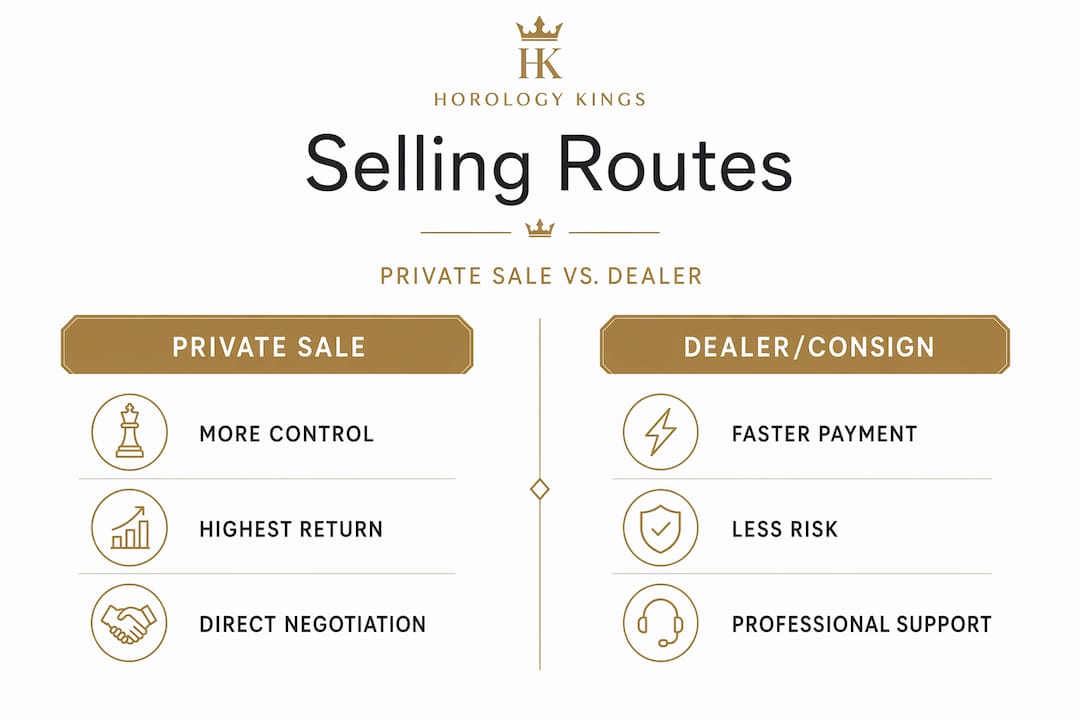
The appeal of a private sale lies in the control it offers. You decide the asking price, who you speak with, and when you complete. Privacy is another genuine draw. Many collectors and investors prefer not to have their assets publicly listed or their portfolios known. That said, control comes with responsibility. You are preparing your luxury watch, managing enquiries, vetting buyers, and organising secure payment entirely on your own terms.
Key distinctions to keep in mind:
Private sale: Seller retains the watch, negotiates directly, maximum control and privacy, highest personal responsibility
Consignment: Watch is handed to a specialist, authenticated and marketed on your behalf, commission taken on sale
Dealer sale: Immediate purchase offer from a dealer, fastest route, typically lowest return
Auction: Public competitive bidding, potentially high returns on desirable pieces, unpredictable timing and fees
“The route you choose should reflect not just price expectations, but how much time, risk, and involvement you are prepared to accept.”
Comparing private sales with other exit routes
With the private sale now clearly defined, it becomes valuable to compare it directly against the alternatives. Each exit route carries different implications for risk, control, speed, and the overall selling experience.
Selling route | Control | Speed | Privacy | Risk to seller | Typical return |
Private sale | Very high | Variable | Very high | Moderate to high | Potentially highest |
Consignment | Low | Slow to moderate | Moderate | Low | Moderate to high |
Dealer sale | Low | Fast | High | Very low | Lower |
Auction | Moderate | Moderate to slow | Low | Moderate | Variable |
Each category deserves context. Dealer sales are ideal for sellers who prioritise certainty and speed above all else. If you have an urgent need for liquidity, a reputable dealer will give you an immediate offer and transfer funds quickly. The trade-off is price. Dealers buy to resell at a margin, so their offers reflect that reality.
Consignment places your watch in specialist hands, which suits sellers who want professional marketing and authentication support without the involvement of navigating buyers personally. The cost is a commission, often between 10 and 20 percent, and you may wait weeks or months.
Auctions are worth considering for rare, highly collectible pieces where competitive bidding can push prices above market expectations. However, you will pay buyer and seller premiums, and the role of auctions in the market varies considerably depending on the brand, model, and condition of your watch.
For sellers who want maximum return and are willing to invest the time, selling online securely through a private or semi-private route offers the most financial upside, provided the risks are handled correctly.
Who suits each route?
Private sale: Experienced collectors, those with existing networks, sellers prioritising price and discretion
Consignment: Sellers who prefer a hands-off approach and trust specialist judgement
Dealer sale: Sellers needing fast, certain transactions without negotiation
Auction: Owners of rare or historically significant pieces with flexible timelines
It is also worth exploring alternate selling options if none of the primary routes feel right for your specific situation.
Pro Tip: In any private sale, never proceed without verifying the buyer’s identity. Request proof of funds before sharing detailed watch information, and consider a neutral third-party escrow service for transactions above a certain value threshold. Unvetted buyers are the single greatest source of private sale complications.
Security and trust in private transactions
Having compared the main selling routes, the most important practical consideration in any private watch sale is security. Unlike consignment, where a specialist authenticates the watch and manages the listing, taking a commission upon sale, private sellers carry the full burden of verification themselves.

Authentication is the foundation. Before any meaningful discussion with a buyer, ensure your watch has been independently verified. An expert assessment provides documentary evidence that your piece is genuine, which protects both parties and removes grounds for dispute after the transaction.
Here are the core steps for a safe, trustworthy private sale:
Get the watch independently authenticated. Use a recognised expert or authentication service before advertising or sharing detailed information with buyers.
Vet the buyer thoroughly. Request full name, contact details, and proof of funds or financial standing for high-value pieces.
Use a written agreement. Even in informal private sales, a written sales contract that specifies the price, condition, and agreed terms protects both parties legally.
Choose a secure payment method. A direct bank transfer to a verified account is the safest option. Avoid cryptocurrency, cheques, or staged payment arrangements.
Complete the handover in a safe environment. A bank branch, a secure office, or a professional intermediary’s premises are preferable to private residences or public locations.
Retain all documentation. Keep receipts, correspondence, and copies of authentication certificates indefinitely.
Following these steps significantly reduces the risk profile of a private sale. Our safe luxury watch sales guide goes deeper into each of these areas, and the authentication checklist is an invaluable reference when preparing for any transaction.
Pro Tip: The three clearest signals of a secure transaction are a written contract, verified cleared funds before handover, and a face-to-face meeting in a neutral, secure location. If a buyer resists any one of these without a credible explanation, treat it as a serious warning sign.
A brief statistic worth noting: industry data consistently shows that fraud in the watch resale market is disproportionately concentrated in informal private transactions, particularly those conducted online without any form of identity verification or escrow. The absence of a specialist intermediary means there is no safety net if something goes wrong.
Maximising the value of your private sale
Knowing how to stay secure, focus now turns to maximising your chances of a rewarding, seamless sale. The difference between a satisfying private sale and a frustrating one often comes down to preparation.
Start with the physical condition of the watch. A recent service history, original box, papers, and any supplementary documentation such as receipts or warranty cards significantly increase buyer confidence and the final agreed price. Buyers in the private market are discerning. They know what completeness looks like, and they will negotiate hard on any gaps.
Consignment routes often let the seller access a specialist who manages authentication and marketing in exchange for a commission, but in a private sale, preparing for a successful sale is entirely your responsibility. This is both a challenge and an opportunity. When done well, presentation can genuinely move the needle on price.
Marketing tips specifically tailored for luxury watches in the private market:
Use trusted, niche networks. Word of mouth within collector communities consistently produces the most qualified buyers.
Invest in professional photography. Clear, high-quality images of the dial, case, bracelet, clasp, and documentation make a substantial difference in attracting serious enquiries.
Be precise and honest in your description. Note any scratches, service history, and originality of parts. Transparency builds trust and reduces time-wasting from buyers who discover discrepancies later.
Set a realistic price based on current market data. Research recent comparable sales, not just listed prices. What watches are actually selling for is the relevant figure.
Limit your circle of potential buyers initially. Wider audiences bring more risk. Starting with your own network or a trusted intermediary filters for genuine interest.
Selling route | Typical seller return (%) | Average time to sale | Commission or fee |
Private sale | 90 to 100% of market value | Weeks to months | None or minimal |
Consignment | 75 to 88% after commission | 1 to 6 months | 10 to 20% |
Dealer sale | 60 to 80% of market value | Days to weeks | None (built into offer) |
Auction | 70 to 95% (variable) | 1 to 4 months | 5 to 15% seller’s fee |
Understanding these figures helps set realistic expectations. Private sales do carry the potential for the highest net return, but that depends on finding the right buyer at the right moment. The expert discreet processes used by reputable intermediaries combine the advantages of private discretion with the infrastructure of professional handling, which is worth considering if the full private route feels too demanding.
Timelines are another area where sellers frequently misjudge. A private sale for a Rolex Submariner or Omega Seamaster may conclude in days given market demand. A more unusual or niche reference might require weeks of patient negotiation. Build that flexibility into your planning before committing to the private route.
Our perspective: What most collectors get wrong about private sales
There is a persistent myth in the collector community that a private sale is primarily about discretion and price. It is treated as the sophisticated option, the one that knowledgeable sellers graduate towards once they have outgrown dealers and auction houses. That framing is not wrong, but it is dangerously incomplete.
Each exit route has unique trade-offs in control, marketing, and security, and experienced collectors who understand this in theory still make costly mistakes in practice. The most common error is underestimating how much process matters. Sellers who have held a watch for years and know its history intimately sometimes assume that familiarity translates to transaction readiness. It does not. Without current authentication, clean documentation, and a structured approach to the buyer relationship, even the most desirable piece can become a drawn-out, frustrating experience.
The second error is falling into the quick cash mentality, accepting the first reasonable offer out of enthusiasm or impatience. Private sales reward patience. The buyer willing to pay full value exists, but they may not arrive in the first week. Sellers who rush often realise their mistake only after the money has cleared.
Our best practice guide for second-hand sales outlines when and how to walk away from a transaction that does not feel right. The warning signs are consistent: pressure to complete quickly, resistance to verification steps, unusual payment requests, or a buyer who seems more interested in your process than the watch itself. These are not rare red flags. They appear regularly in private sale correspondence, and recognising them early saves significant time and potential loss.
The private route is genuinely the strongest option for many sellers. But it demands rigour, patience, and a willingness to treat the transaction with the same professionalism you would expect from any specialist intermediary.
Connect with trusted professionals for your next private watch sale
Private watch sales offer real advantages, but the process demands expertise, preparation, and a sharp eye for risk. Whether you are selling a Patek Philippe inherited from a family member, parting with a Rolex reference you have worn for decades, or sourcing a specific Audemars Piguet reference for your collection, having the right support changes everything.
At Horology Kings, we specialise in exactly this space. Based in Hertfordshire, we offer discreet, transparent, and secure services for buyers and sellers of high-end timepieces. From professional valuations and authentication to secure UK bank transfers and a genuinely curated selection of pre-owned watches, we remove the uncertainty that makes private sales feel risky. If you are looking to source a luxury watch or your timepiece needs attention before sale, our watch repair and servicing team ensures it arrives in the best possible condition. Speak with our team and experience what a properly managed private transaction feels like.
Frequently asked questions
Is a private watch sale safer than auctions or consignment?
Private sales can be secure if best practices are followed, but they lack the structured protections and buyer vetting that consignment specialists and auction houses typically provide as part of their service.
What paperwork do I need for a private luxury watch sale?
You should have the original box, authentication papers, service records, and proof of ownership, as proper documentation across all selling routes is widely recognised as essential for reassuring buyers and completing transactions smoothly.
How can I avoid scams in a private watch sale?
Vet the buyer carefully, insist on secure bank transfer payments, and use authentication experts or escrow services for high-value deals, since private sales require you to manage all precautions that a consignment specialist would otherwise handle professionally.
Can I get a higher price through a private sale?
Private sales can yield better net prices as there are no dealer commissions or auction fees, though actual results depend on market demand, the watch’s condition, your network, and how well you negotiate.
Recommended
Comments