.png)

What is a quartz movement? A complete watch guide
- lewisvrichards3
- Jun 30
- 8 min read
TL;DR:
A quartz movement uses a battery and a crystal oscillator to keep time more accurately and with less maintenance than mechanical watches. It is a hybrid system with electronic regulation and mechanical gear trains, making it durable and shock resistant. Proper care includes timely battery replacement, avoiding strong magnets, and regular seal checks to prevent environmental damage.
A quartz movement is defined as a watch mechanism powered by a battery and regulated by a quartz crystal oscillator that vibrates at a precise 32,768 Hz to keep accurate time. That specific frequency, expressed as 2 to the power of 15, allows an integrated circuit to divide it down to exactly one pulse per second. The result is timekeeping accuracy that mechanical movements simply cannot match at the same price point. Understanding quartz movement mechanics matters whether you are buying your first watch or adding a reliable daily wearer to a serious collection. Horology-kings has guided collectors through this question for years, and the answer is always more interesting than buyers expect.
How does a quartz movement work?
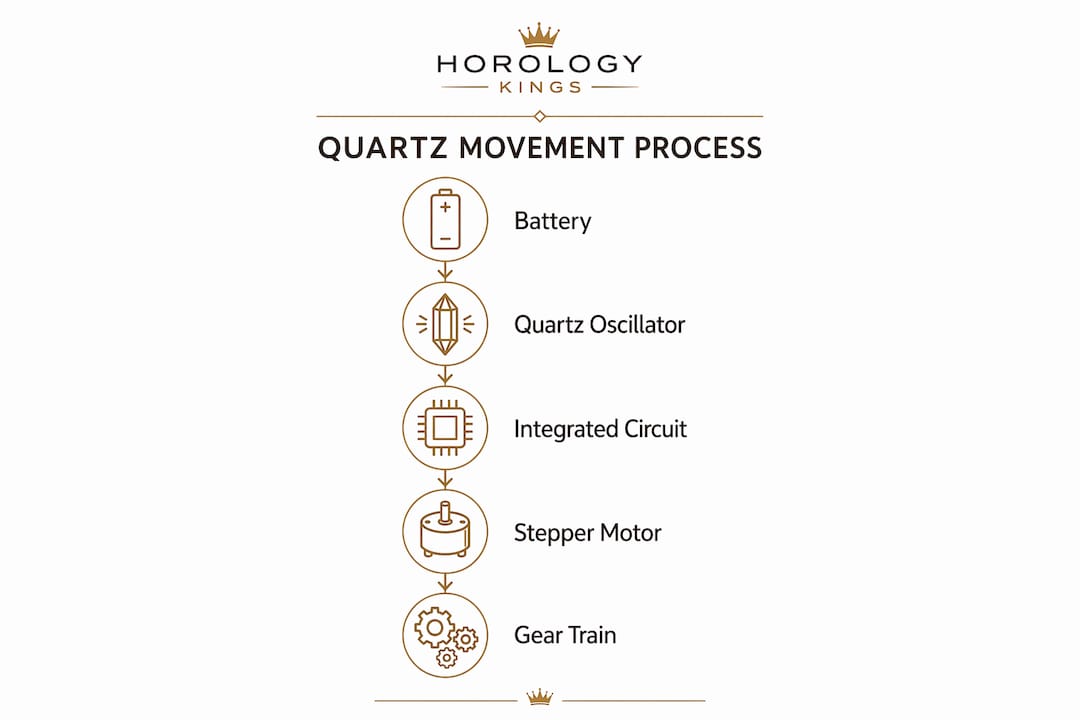
A quartz movement works by converting electrical energy into mechanical motion through a precise chain of components. Each part plays a specific role, and the system only functions correctly when all components work together.
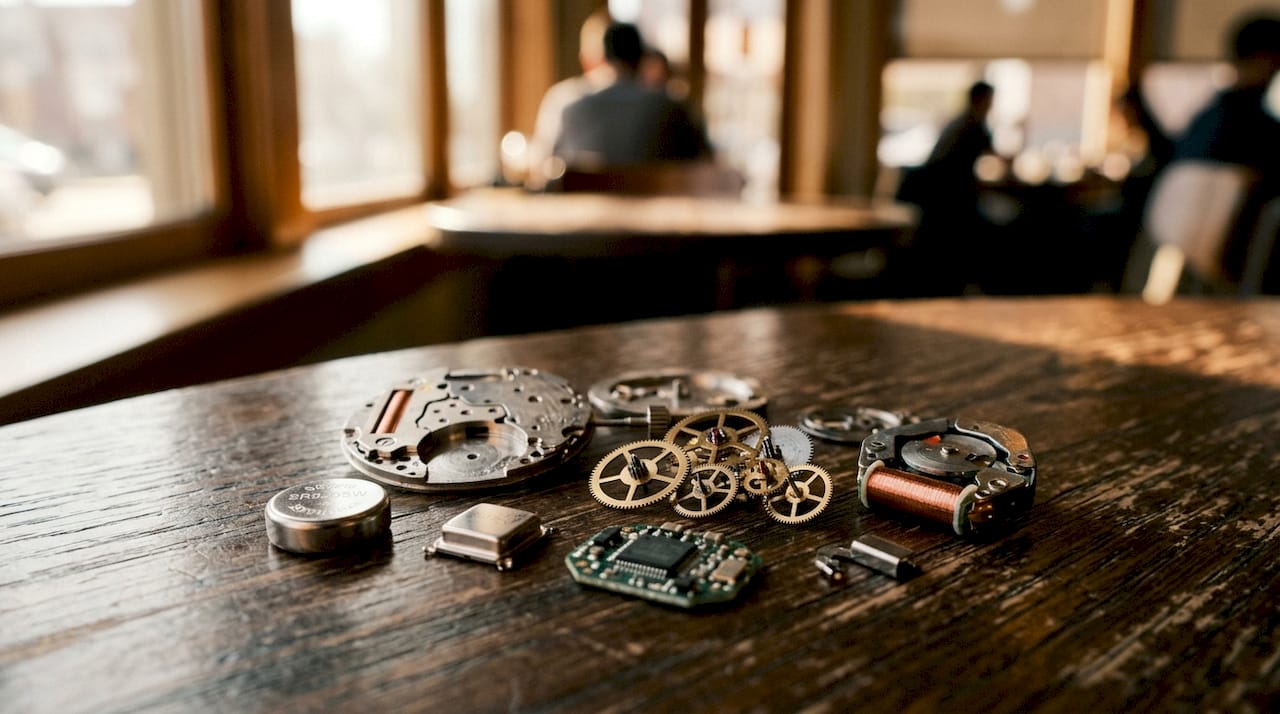
The battery supplies a small electrical current to the integrated circuit. That circuit sends the current to the quartz crystal, which begins to vibrate due to the piezoelectric effect. The piezoelectric effect is the property of quartz that causes it to oscillate when voltage is applied. The crystal vibrates at 32,768 times per second, a frequency chosen because it divides cleanly into a 1 Hz signal.
The integrated circuit counts those vibrations and divides the frequency down to one electrical pulse per second. That pulse is sent to the stepper motor, a small electromagnetic motor that rotates in precise incremental steps. The stepper motor converts pulses into mechanical rotation, which drives the gear train. The gear train then moves the watch hands across the dial.
Component | Function |
Battery | Supplies electrical power to the circuit |
Quartz crystal | Oscillates at 32,768 Hz due to piezoelectric effect |
Integrated circuit | Divides frequency to 1 Hz pulses |
Stepper motor | Converts electrical pulses to mechanical rotation |
Gear train | Transfers motor rotation to the watch hands |
Watch hands | Display the time on the dial |
The gear train is a fully mechanical system of interlocking wheels and pinions. This is the point where electronics hand off to mechanics, and it is what makes a quartz movement a hybrid system rather than a purely electronic device. Many buyers do not realise this. The regulation is electronic, but the display is mechanical.
Pro Tip: If a quartz watch stops suddenly, the stepper motor is often the first suspect. A strong magnetic field can stall the motor entirely, causing the watch to stop without affecting the crystal’s accuracy. Remove the watch from the magnetic source and it will typically resume normal function.
What are the benefits of quartz watches?
Quartz movements offer three clear advantages over mechanical movements: accuracy, low maintenance, and durability. These are not marginal differences. They are significant enough to make quartz the dominant choice for everyday wear worldwide.
Accuracy
Standard quartz movements deviate by no more than +/–15 seconds per month. A typical mechanical movement can fluctuate by 10–20 seconds per day. That is a difference of roughly 300 to 600 seconds per month versus 15. For anyone who relies on their watch to keep appointments or coordinate across time zones, quartz is the clear choice.
Maintenance and cost
Battery replacement every 2–5 years is the primary maintenance requirement for most quartz watches. Some high-efficiency models run for up to 10 years on a single battery. Mechanical watches, by contrast, require professional servicing every 5–7 years to lubricate and adjust the movement. Entry-level quartz watches start at around €30–50, while mechanical movements begin at €150–200 or higher. That cost gap is substantial for buyers who want reliable timekeeping without a large upfront investment.
Durability
Quartz movements contain far fewer moving parts than mechanical calibres. Fewer moving parts means fewer points of failure. Quartz watches offer higher shock resistance than mechanical equivalents, making them well suited to active lifestyles, physical work, and travel. A mechanical movement can be disrupted by a sharp knock to the wrist. A quartz movement absorbs the same impact with far less risk of damage.
Key benefits at a glance:
Accuracy within +/–15 seconds per month
Battery life of 2–5 years, with some models reaching 10 years
Lower servicing costs and less frequent professional maintenance
Greater shock resistance due to fewer moving parts
Lower entry price compared to mechanical equivalents
Pro Tip: When comparing quartz watches for accuracy, look for movements labelled “high-accuracy quartz” or “thermo-compensated quartz.” These regulate the crystal against temperature changes and can achieve accuracy within a few seconds per year.
What misconceptions exist about quartz movements?
The most common misconception is that a quartz watch is entirely electronic and contains no mechanical parts. This is incorrect. A quartz movement is a hybrid of electronics and mechanics. The regulation is electronic, but the gear train, motion works, and hands are all mechanical components that move, wear, and require care.
This hybrid nature has practical consequences. The mechanical parts of a quartz movement are subject to the same environmental threats as any other mechanical system. Moisture, dust, and physical wear all affect the gear train and hands over time. If the watch’s seals fail, moisture and dust can damage the mechanical components even though the electronic regulation remains unaffected. A watch that keeps perfect electronic time can still display it incorrectly if the gear train is worn or contaminated.
Magnetism is another area of confusion. Many buyers assume that because quartz movements are electronic, they are immune to magnetic fields. Strong magnetic fields do not affect the quartz crystal’s oscillation rate. However, they can stall the stepper motor, causing the watch to stop temporarily. Remove the watch from the magnetic source and the motor resumes. This is different from the effect on a mechanical movement, where magnetism causes the balance spring to stick and the watch to run fast or slow indefinitely.
Battery neglect is the most damaging mistake quartz watch owners make. Leaving a depleted battery in a watch can cause electrolyte leakage. That leakage corrodes the integrated circuit and can destroy the movement beyond repair. This is a particular risk with vintage or infrequently worn quartz pieces. Replace the battery promptly when the watch slows or stops. Do not leave a dead battery sitting in the case for months.
Common misconceptions to avoid:
Quartz watches are not purely electronic. They contain mechanical gear trains and hands.
Magnetism does not cause accuracy drift in quartz, but it can stop the stepper motor.
Environmental damage to seals affects the mechanical parts, not the electronic regulation.
A depleted battery left in the case risks irreparable corrosion of the circuit.
How to choose and maintain a quartz movement watch
Choosing the right quartz watch starts with understanding your use case. A dress watch worn occasionally needs different specifications than a field watch worn daily in demanding conditions. For active use, prioritise water resistance ratings and shock-resistant case construction. For dress wear, focus on movement quality and finishing. You can explore the full range of movement types and their uses to identify which calibre suits your lifestyle.
Follow these steps to maintain a quartz watch correctly:
Replace the battery on schedule. Do not wait for the watch to stop completely. Many quartz movements give an end-of-life signal, such as the seconds hand jumping in four-second intervals. Act on that signal immediately.
Use the correct battery type. Most quartz movements use silver-oxide batteries. Check the movement reference or have a watchmaker confirm the correct specification before fitting a replacement.
Keep the watch away from strong magnets. Speakers, magnetic clasps, and MRI equipment can stall the stepper motor. Store the watch away from these sources.
Protect the seals. Water resistance ratings degrade over time as gaskets age. Have the seals tested annually if you wear the watch in water regularly.
Book professional servicing when needed. If the hands move erratically, the seconds hand stutters without a battery issue, or the case shows wear, consult a qualified watchmaker. Horology-kings offers watch repair and servicing for quartz movements, including battery replacement and full mechanical inspection.
For luxury timepiece maintenance, the same principles apply regardless of movement type. Clean the case and bracelet regularly, store the watch in a cool and dry environment, and avoid exposing it to extreme temperature changes.
Key takeaways
A quartz movement is the most accurate and low-maintenance timekeeping system available at most price points, combining electronic regulation with mechanical display components.
Point | Details |
Core definition | A quartz movement uses a battery and a 32,768 Hz crystal oscillator to keep time. |
Hybrid system | Electronic regulation drives a mechanical gear train and hands. |
Accuracy advantage | Quartz deviates by no more than +/–15 seconds per month versus 10–20 seconds daily for mechanical. |
Battery care | Replace the battery promptly. A depleted battery left in the case can corrode the circuit irreparably. |
Maintenance schedule | Battery replacement every 2–5 years; professional servicing when mechanical wear appears. |
Quartz movements and the collector’s perspective
I have spent years handling watches at every level of the market, from entry-level quartz pieces to six-figure mechanical complications. The question I hear most often from new buyers is whether quartz is somehow a lesser choice. My honest answer is no. It is a different choice, and for most daily wear situations, it is the better one.
Quartz movements fascinate me precisely because of their hybrid nature. There is genuine engineering elegance in the way a crystal oscillating billions of times over its lifetime drives a mechanical gear train with such consistency. Most people wearing a quartz watch have no idea that a tiny stepper motor is ticking away inside, converting invisible electrical pulses into the sweep of a hand across a dial.
Where I think collectors sometimes go wrong is in treating quartz and mechanical as a hierarchy rather than a spectrum. Mechanical watches earn their place through artisanal craftsmanship and heritage. Quartz watches earn theirs through reliability and precision. The collector’s choice between the two reflects a philosophy, not a ranking. I wear quartz when accuracy matters and mechanical when the ritual of winding matters. Both have a place on the wrist and in any serious collection.
— Lewis
Quartz watches at Horology-kings
Horology-kings is a specialist luxury watch dealer based in Hertfordshire, with deep expertise across quartz and mechanical timepieces from Swiss brands including Omega and Cartier.

Whether you are buying your first quality quartz watch or sourcing a specific model for your collection, the team at Horology-kings provides expert guidance, transparent valuations, and secure transactions. The watch repair and servicing offering covers battery replacement, seal testing, and full mechanical inspection for quartz movements. For those looking for a specific piece, the sourcing service draws on an expert network to locate watches that are not readily available on the open market. Visit Horology-kings to browse the current collection or speak with the team directly.
FAQ
What is the difference between quartz and mechanical movements?
A quartz movement uses a battery and crystal oscillator for electronic regulation, while a mechanical movement is powered entirely by a wound mainspring. Quartz is significantly more accurate and requires less maintenance than a mechanical calibre.
Are quartz watches accurate enough for daily use?
Standard quartz movements deviate by no more than +/–15 seconds per month, making them highly accurate for everyday timekeeping. High-accuracy and thermo-compensated quartz variants achieve even tighter tolerances.
How often does a quartz watch battery need replacing?
Most quartz watch batteries last 2–5 years under normal use, with some high-efficiency models running for up to 10 years. Replace the battery as soon as the watch shows an end-of-life signal to avoid leakage damage.
Can a quartz watch be damaged by magnets?
Strong magnetic fields can stall the stepper motor inside a quartz movement, causing the watch to stop temporarily. Removing the watch from the magnetic source typically restores normal function without any lasting accuracy loss.
Does a quartz watch have any mechanical parts?
A quartz movement is a hybrid system. The regulation is electronic, but the gear train, motion works, and hands are all mechanical components that can wear over time and benefit from periodic professional inspection.
Recommended
Comments