.png)

What is a signed crown watch: a guide for collectors
- lewisvrichards3
- a few seconds ago
- 13 min read
TL;DR:
A signed crown is a manufacturer’s logo or motif on a wristwatch winding knob, serving as an authenticity indicator and branding detail. Its presence and condition influence resale value, especially on vintage and luxury models, but must be assessed alongside documentation and overall watch provenance. Proper inspection involves verifying logo sharpness, era matching, fit, wear, and service history to confirm originality.
A signed crown is the winding and setting knob on a wristwatch that carries the manufacturer’s logo, emblem, or motif, applied by embossing, engraving, or printing directly onto the crown face or side. For collectors, an original signed crown is a useful authenticity indicator and can influence resale value, but it is one of several provenance markers rather than the definitive test on its own.
The British Horological Institute recognises the crown as a functional component with significant bearing on water resistance and mechanical integrity. UK collectors increasingly treat it as a provenance detail too. At Horology-kings, we see the signed crown come up in nearly every authentication conversation we have with buyers and sellers of pre-owned Rolex, Omega, and Patek Philippe timepieces.
Table of Contents
What exactly counts as a signed crown?
A signed crown is any winding crown that bears a manufacturer’s mark, as opposed to a “blind” crown, which carries no markings at all. The distinction sounds simple, but the execution varies considerably across brands and eras.
The mark can appear in two positions:
Top face: the flat or domed surface you press or grip when winding. This is the most common placement and the most visible.
Side face: the cylindrical wall of the crown, where a logo or text may be engraved around the circumference.
How the mark is applied also varies:
Embossed: the motif is raised above the crown surface, giving a tactile quality.
Engraved: the mark is cut into the metal, creating a recessed impression.
Printed or applied: less common on high-end pieces; more typical of mid-range production watches.
Crown materials range from stainless steel and gold to titanium and ceramic, and the finish (polished, brushed, PVD-coated) affects how clearly a signature reads over time. Screw-down crowns, which thread into the case to create a water-resistant seal, typically carry the brand motif on the top face. Push-pull crowns, found on dress and entry-level sports models, may carry the mark on either face or both.
The mark itself can take several forms: a full wordmark, an abbreviated initial, a pictorial emblem (such as a coronet or Greek cross), or a textured motif that functions as a brand identifier without being a literal logo.
A signed crown is not merely decorative. It is a small but deliberate statement that every component leaving the factory met the brand’s visual standard — right down to the knob you use to set the time.
Pro Tip: When examining a crown in photographs, request both a top-face shot and a side-wall shot. Many replacement crowns replicate the top motif but carry subtly different geometry or finish on the side, which is where inconsistencies tend to appear first.
Why manufacturers use signed crowns
Signing the crown is a branding decision as much as a manufacturing one. As luxury watchmaking matured through the twentieth century, brands recognised that every visible component was an opportunity to reinforce identity. The crown, though small, is handled every time the watch is wound or the time is set.
Signed crowns became more prevalent as brands emphasised visual identity during the mid-to-late twentieth century, particularly on luxury sports models where the crown is exposed and prominent. A plain crown on a prestige piece began to read as an oversight rather than a choice.
The reasons manufacturers sign crowns fall into a few clear categories:
Brand continuity: a signed crown extends the visual identity from dial to case to crown, creating a coherent object.
Model stratification: within a single brand’s range, signed crowns often appear on higher-specification or flagship models, signalling tier.
Anti-counterfeiting: a precisely executed motif is harder to replicate accurately than a plain surface, adding a layer of authentication.
Collector appeal: brands understand that enthusiasts scrutinise components, and a signed crown rewards that attention.
The decision to sign a crown is, in effect, a brand’s promise that the detail work extends beyond what the casual wearer will ever notice.
The historical trajectory is clear. Mid-century tool watches from military contracts often used plain crowns because function was the brief. As the same brands moved into civilian luxury markets, signed crowns followed. Today, the presence or absence of a signed crown on a given reference is a deliberate positioning choice, not an accident of production.
How a signed crown affects authenticity and resale value
The signed crown’s role in valuation is nuanced. Original signed crowns are cited as one of several small provenance markers in resale checks, alongside service records, dial originality, hands, and caseback condition. No single component is decisive on its own.
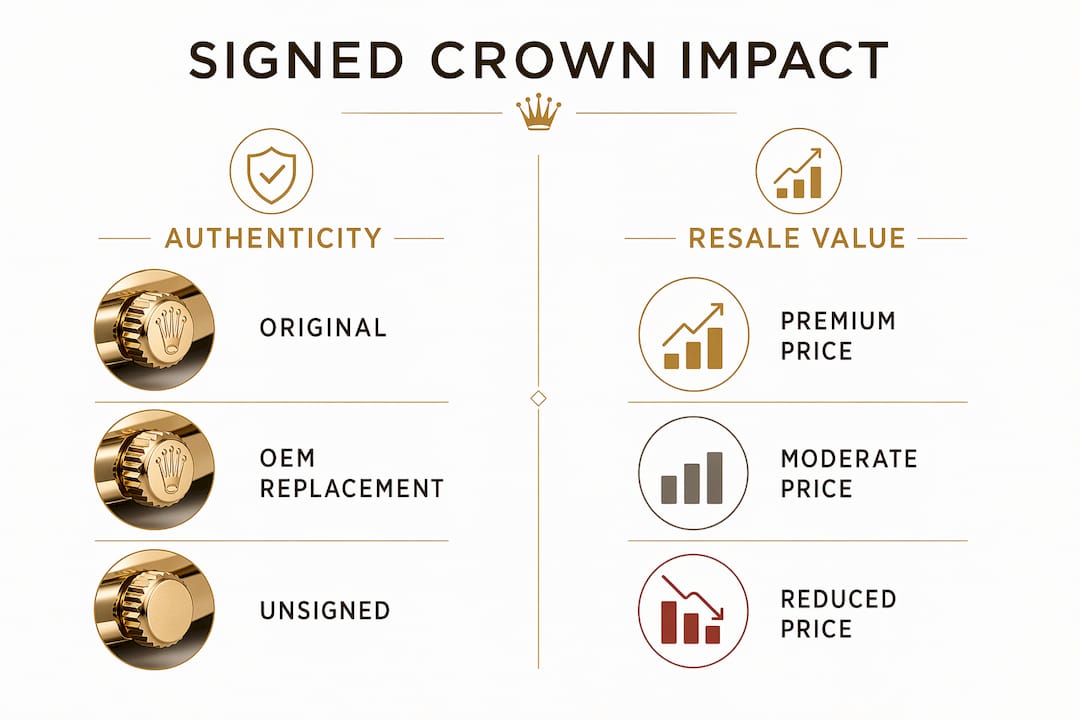
That said, the crown carries particular weight for one practical reason: it is a small, frequently replaced part. During routine servicing, crowns are often swapped out, especially when the original shows wear or when a service centre substitutes a generic part. Retaining the original signed crown therefore reduces uncertainty about a watch’s service history and signals that the piece has not been heavily worked on.
When a signed crown meaningfully affects value:
Vintage references where the original crown is known to be difficult to source
Limited editions or special references where the crown carries a unique motif
Watches where the crown design changed across production runs, making era-matching critical
High-value pieces where every original component contributes to a provenance score
When it is less material:
Tool and military watches where a plain crown was factory-standard
Well-documented authorised service replacements using OEM parts, with paperwork
Watches where crown style varied across production without affecting reference classification
Crown scenario | Impact on collectibility | Sourcing difficulty | Likely price effect |
Original signed crown, matching era | High positive | Low (already present) | Positive uplift |
Authorised OEM replacement, documented | Moderate | Moderate | Neutral to slight negative |
Unsigned replacement, undocumented | Negative | N/A | Discount applied |
Period-correct plain crown (tool/military) | Neutral | Low | Neutral |
Collectors report difficulty sourcing original signed replacements and a willingness to pay premiums for watches that retain all factory components. For vintage pieces in particular, an original signed crown can be the detail that separates a strong auction result from an average one.
How to tell an original signed crown from a replacement
Assessing a crown’s originality requires a methodical approach. The checklist below works for both in-person inspection and photograph review.
Logo crispness. An original crown carries a sharp, well-defined motif with clean edges. Aftermarket crowns often show a softer impression, slightly blurred lines, or inconsistent depth across the engraving.
Correct motif for the reference. Confirm the logo matches the specific reference and production era. A Rolex coronet from the 1960s differs in proportion and detail from a modern one; the same applies across Omega and Seiko.
Proportion and scale. The motif should sit centred and correctly scaled relative to the crown diameter. Replacements sometimes use a motif that is marginally too large or too small.
Fit and seating. The crown should sit flush against the case when pushed in or screwed down. A crown that sits proud or at a slight angle may indicate incorrect stem length or a mismatched replacement.
Threading and stem fit. On screw-down crowns, the threading should engage smoothly with no cross-threading or excessive play. Poor threading is a mechanical concern and a provenance flag simultaneously.
Wear patterns consistent with the case and dial. A watch showing honest wear on the case and dial should show corresponding wear on the crown. A crown in suspiciously pristine condition on an otherwise aged piece warrants scrutiny.
Patina match. On gold or gold-plated crowns, the colour tone should match the case metal. Mismatched patina often indicates a replacement from a different production batch or a different alloy.
Service records and part numbers. Authorised service documentation should list replaced components. If the crown was changed, it should appear in the service invoice with an OEM part number.
For photographic verification, compare close-up images against the brand’s official parts catalogue or archived reference photographs. Many collector forums maintain image libraries for exactly this purpose.
Pro Tip: When buying remotely, send the seller this one-line request: “Please send a macro photo of the crown top face, crown side wall, and crown seated against the case, plus any service paperwork listing replaced parts.” Most genuine sellers comply immediately; hesitation is itself informative.
When you have photographs, check the crown against authentication guidance for the specific brand before making a decision.
When an unsigned or replacement crown is acceptable
Not every unsigned crown is a problem. The blind crown has a legitimate place in watchmaking history, and context determines whether its presence is a red flag or simply a period-correct detail.
Acceptable cases:
Military and tool watches where a plain crown was the factory specification. Many mid-century British military-issue watches left the factory with unsigned crowns as standard.
Documented authorised-service replacements where the service invoice confirms an OEM part was fitted. The paperwork transforms an unsigned crown from a concern into a known quantity.
Entry-level and daily-wear pieces where the collector priority is functionality over originality, and the price reflects the replacement.
Red-flag cases:
An unsigned or mismatched crown on a high-value vintage reference with no service documentation.
A crown that does not match the era of the case, dial, or hands, suggesting a non-period replacement.
A crown whose proportions or finish are inconsistent with the reference, pointing to an aftermarket part.
A practical rule of thumb: if the crown’s story can be told with paperwork, it is usually acceptable. If the seller cannot explain why the crown is unsigned or mismatched, treat it as an open question that affects the price you are willing to pay.
Pro Tip: For vintage watches, cross-reference the crown against the hidden markings guide for the reference. Some models have known service histories where unsigned crowns are common and already priced in by the market.
What to look for with Rolex, Omega, and Seiko
Brand-specific knowledge is where the inspection checklist becomes genuinely useful. The three names UK collectors ask about most frequently are Rolex, Omega, and Seiko, and each has its own crown conventions.
Rolex
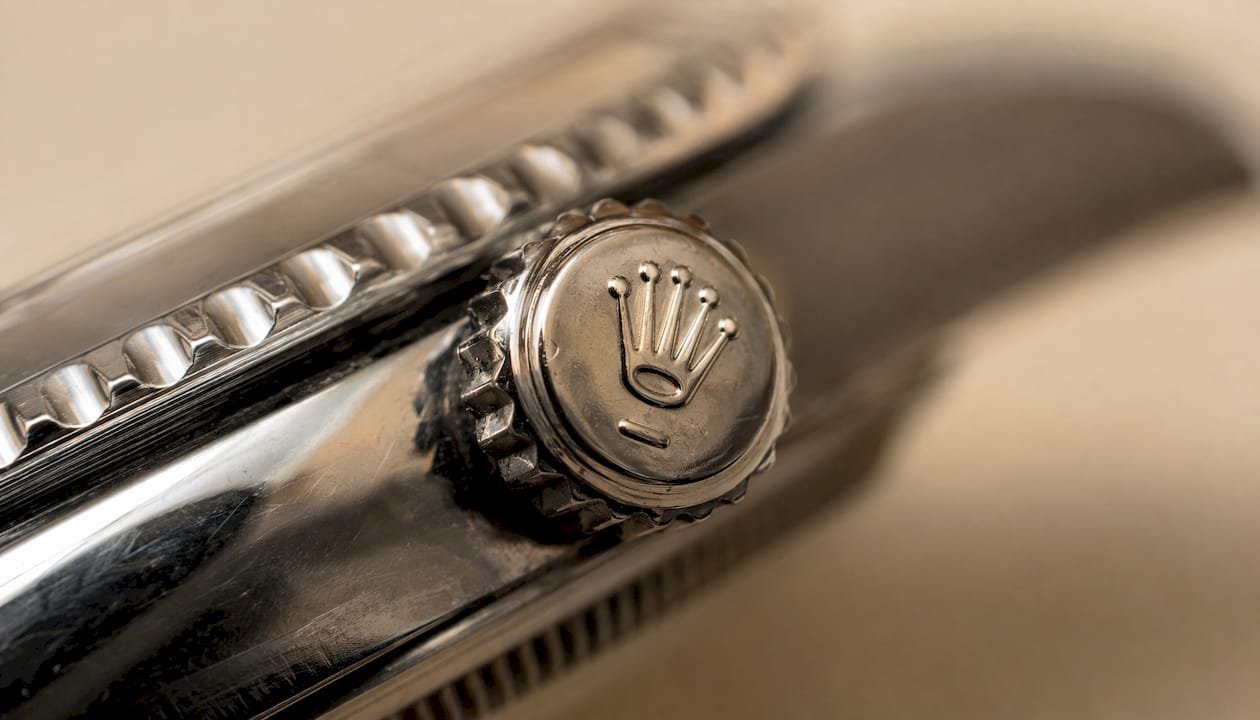
The Rolex coronet, a five-pointed crown motif, appears on the top face of the screw-down Triplock and Twinlock crowns used across the Submariner, GMT-Master, and Datejust families. On vintage references, the coronet’s size, depth, and exact proportions changed across decades. Collectors prize original coronets on vintage Submariners in particular because the crown is a frequently serviced component and originals are harder to source. A replacement coronet on a 1960s Submariner is not unusual, but it should be documented and priced accordingly.
Omega
Omega’s crown signatures have evolved considerably. Mid-century models carried a simple Ω emblem, while later references introduced more elaborate treatments. The key for collectors is era-matching: the motif style, engraving depth, and crown geometry should correspond to the reference’s production period. Omega used both signed and unsigned crowns across different lines, so confirming the correct specification for a given reference is the first step before any inspection.
Seiko
Seiko’s approach is the most variable of the three. Some ranges, including certain Grand Seiko and Prospex references, use signed crowns with the Seiko “S” motif. Others, particularly older tool and diver references, used unsigned crowns as standard. The Seiko mod community has created a secondary market for signed replacement crowns, which means a signed crown on a vintage Seiko does not automatically indicate originality. Checking whether the specific reference was factory-signed is the critical first step.
Brand | Crown motif | Screw-down? | Era-matching critical? | Replacement market |
Rolex | Coronet (five-point) | Yes (sports models) | Yes | Limited OEM; aftermarket common |
Omega | Ω emblem (varies by era) | Selected models | Yes | Moderate OEM availability |
Seiko | “S” motif (selected ranges) | Selected models | Yes | Active aftermarket |
Pro Tip: For Rolex vintage references, the collector forums maintain detailed photographic records of coronet proportions by decade. Cross-referencing a seller’s macro photo against these archives takes minutes and can save thousands of pounds.
Horology-kings guidance for UK buyers
At Horology-kings, authentication is the foundation of every transaction. When a watch comes through our doors in Hertfordshire, the crown is part of the physical inspection alongside the dial, hands, caseback, and movement. We treat it as one data point in a broader evidence picture, not a pass-or-fail test on its own.
For UK buyers navigating the pre-owned market, the servicing path matters as much as the purchase decision:
Authorised service centres are the right choice for watches still within the manufacturer’s service network, particularly modern references where OEM parts are readily available and warranty considerations apply.
Independent certified watchmakers are appropriate for vintage pieces where authorised centres may no longer stock period-correct components, and where a specialist’s knowledge of the reference is more valuable than brand affiliation.
In both cases, ask for a written service report listing every replaced component by part number. This document becomes part of the watch’s provenance record.
Original crowns feed directly into professional valuations. An auction house or specialist dealer assessing a vintage Rolex or Omega will note crown originality as part of the condition report, and it can influence the estimate. The role of certificates in resale value extends to service paperwork: a complete service history with OEM part confirmation is worth preserving carefully.
Pro Tip: Request non-destructive authentication checks before any service work begins. A watchmaker should be able to assess crown originality, fit, and condition without removing the crown from the stem. If removal is necessary, confirm it will be documented in the service report.
Quick buyer checklist: questions and photos to request
Before committing to a purchase where the crown’s originality is in question, work through this checklist with the seller.
Questions to ask:
Has the watch been serviced, and if so, by whom and when?
Were any components replaced during servicing, including the crown?
Can you provide the original service invoice listing replaced parts and OEM part numbers?
Is the crown the original factory-fitted component, to the best of your knowledge?
Does the watch come with any original paperwork, box, or warranty card?
Photos to request:
Top face of the crown at macro magnification (10x or higher if possible)
Side wall of the crown showing the full circumference
Crown seated against the case, showing fit and alignment
Serial number on the caseback or between the lugs
Any service stamps or paperwork
Answers that should prompt caution:
“I don’t know” in response to service history questions, with no paperwork to support the claim
Vague responses such as “it was serviced at some point” without dates, names, or invoices
Reluctance to provide macro photographs of the crown specifically
A crown that the seller acknowledges is a replacement but cannot document
For a broader authentication framework, the watch authentication checklist covers the full range of components to assess before purchase.
Key takeaways
A signed crown is a meaningful provenance indicator, but its value to a collector depends entirely on context: the reference, the era, and the quality of the surrounding documentation.
Point | Details |
Signed crown definition | The winding crown bearing a manufacturer’s logo or motif, applied by embossing, engraving, or printing. |
Impact on value | Original signed crowns can uplift value on vintage and limited-edition references; documentation matters equally. |
Inspection priority | Check logo crispness, era-correct motif, fit, wear consistency, and service records before drawing conclusions. |
Unsigned crowns | Acceptable on military/tool watches and with documented OEM service replacements; a red flag without paperwork. |
Horology-kings | Offers authentication, sourcing of original parts, and certified servicing for UK collectors assessing crown originality. |
Why the crown deserves more attention than it usually gets
The signed crown is one of those details that separates a careful collector from a casual buyer. Most people focus on the dial, the movement, and the caseback, and those are all correct priorities. But the crown is the component most likely to have been quietly swapped during a service, precisely because it is small, functional, and easy to overlook.
What strikes me about the collector debate around signed crowns is that it often misses the real point. The question is not whether a signed crown is aesthetically preferable to a plain one. The question is what the crown tells you about the watch’s history. An original signed crown on a vintage piece is evidence that the watch has not been heavily serviced or that, when it was, the original parts were retained. That is provenance information, and provenance information has monetary value.
The counterargument, that a well-documented OEM replacement is just as good, is largely correct for modern watches. For vintage pieces, particularly those where the original crown design changed across production runs, the argument weakens considerably. A period-correct original crown on a 1960s Rolex Submariner is not interchangeable with a correctly documented 1980s replacement, even if both carry the coronet. The era-match matters to serious collectors, and serious collectors set the market price.
The practical takeaway is straightforward: treat the crown as part of the evidence, request the photographs, and ask for the paperwork. A seller who cannot or will not provide either is telling you something important.
Horology-kings: authentication, sourcing, and certified servicing
When the crown on a watch you are considering raises questions, the right next step is a professional assessment rather than a guess. Horology-kings offers exactly that: expert authentication of pre-owned luxury timepieces, sourcing of original and period-correct parts, and certified servicing by qualified horologists based in Hertfordshire.
For collectors who need a specific reference or an original signed crown sourced, our watch sourcing service draws on an established network of trusted dealers and private sellers across the UK. For watches that need crown restoration, stem work, or a full service with documented OEM parts, our repair and servicing team provides a written report covering every component assessed or replaced. Every transaction is handled with secure UK bank transfers and full transparency on condition and provenance. Contact Horology-kings to request a valuation or start a sourcing enquiry.
Useful sources and further reading
The following sources informed this article and are worth bookmarking for deeper research.
WatchCrunch: Signed crowns — important? A collector community discussion weighing the provenance significance of signed crowns across different reference types.
WatchUseek: Signature crown obsession Forum thread covering sourcing difficulty and the premium collectors place on original signed crowns.
WatchForum: Signed vs unsigned crowns Balanced debate on aesthetic versus practical considerations, with photographic examples.
Barrington Watch Winders: What is a blind crown? Clear explanation of unsigned crowns and the contexts in which they are factory-standard.
Crystal Times: The importance of the watch crown Horologist-led overview of crown function, prioritising mechanical integrity over cosmetic detail.
Watch&Style: Seiko crown collection Useful reference for Seiko crown specifications, signed versus unsigned options, and fitment details by model family.
WhatIsThisMark: Crown logo stamp Reference resource for identifying crown markings and manufacturer stamps.
Horology-kings: How to authenticate a luxury watch Step-by-step authentication guidance covering all major components, including the crown.
For final verification of any specific reference, consult the manufacturer’s official parts catalogue or contact an authorised service centre directly. Brand archives and authorised dealers hold the definitive specification records for crown designs across production runs.
Recommended