.png)

Watch reference guide for collectors: decode any ref
- lewisvrichards3
- 3 hours ago
- 16 min read

TL;DR:
A watch reference number identifies a specific model configuration and is crucial for authenticity and valuation. It encodes details like collection, case material, movement, and dial, and is typically found between the lugs or on paperwork. Knowing how to read and verify reference numbers helps collectors avoid errors and confirms the watch’s provenance.
A watch reference number is a manufacturer-assigned alphanumeric code that identifies a specific model configuration precisely. Every watch produced to that exact specification shares the same reference. It is not the same as a serial number, which is unique to a single watch. Think of the reference as the model’s DNA and the serial as the individual’s fingerprint.
What a reference number tells you at a glance:
The collection or model family (e.g. Submariner, Speedmaster, Nautilus)
Case material (steel, yellow gold, rose gold, platinum)
Movement or calibre fitted at the factory
Dial colour and configuration
Bezel type (ceramic, aluminium, gem-set)
Bracelet or strap specification
How collectors use reference numbers:
Confirming authenticity against original papers and service records
Sourcing correct replacement parts from service centres
Establishing provenance and production era
Calculating accurate market value for buying, selling or insurance
Avoiding visually similar but less valuable variants in auction listings
Reference numbers are documented in several authoritative places: the manufacturer’s own production records, the warranty card or punched papers supplied with the watch, and printed brand catalogues. On the watch itself, you will typically find the reference engraved between the lugs at 12 o’clock, on the caseback perimeter, or inside the case. Knowing where to look, and how to read what you find, is the foundation of every serious collector’s identification workflow.
Table of Contents
What do the characters in a reference number actually encode?
A reference number is rarely a random string. Most manufacturers build a logical structure into their codes, so once you understand the pattern for a given brand, you can decode a reference in seconds.
The typical anatomy of a reference code breaks down into three or four segments:
Collection or model prefix: the opening digits or letters identify the watch family. A Patek Philippe reference beginning with “5” places it in the modern era; Breitling’s opening two letters often signal the collection (e.g. “AB” for Navitimer).
Case size and material code: a middle segment frequently encodes the case diameter and the metal used. Omega’s Seamaster Planet Ocean references, for instance, carry a numeric block that includes the case size in millimetres.
Dial, colour, and bezel suffixes: trailing letters are where the detail lives. In Rolex nomenclature, “LN” denotes a black bezel (noir) and “LV” a green one (vert). Patek Philippe uses “J” for yellow gold (jaune), “G” for white gold (gris), and “R” for rose gold.
Movement or calibre indicator: some brands embed the calibre reference within the model code; others keep it entirely separate in technical documentation.
Exceptions exist. Vintage references are often shorter and less systematic than modern ones. Some brands, particularly older Longines and Cartier, used purely numeric strings with no suffix letters, relying on catalogue cross-referencing to distinguish variants. When suffix letters appear, always check whether they denote colour or material — in some systems the same letter does both depending on context, which is why cross-checking against original paperwork matters.
A note on longer strings: Breitling’s modern references run to eight characters or more, encoding collection, case material, dial, and bracelet in a single unbroken code. Shorter codes from earlier decades often required a separate sub-reference for the bracelet. Neither system is inherently superior; they simply reflect the era and the brand’s cataloguing philosophy.
How major brands structure their reference numbers
Understanding watch terminology brand by brand is the fastest way to read a listing accurately. The table below gives a quick-reference summary; the notes beneath expand on each brand’s quirks.
Brand | Typical format | Worked example | What it encodes |
Rolex | 5–6 digits + letter suffix | 126610LN | Model (126610) + bezel colour (LN = black) |
Omega | Numeric string, 13–14 digits | 210.30.42.20.01.001 | Collection, case, movement, dial, bracelet |
Patek Philippe | 4–5 digits + letter suffix | 5711/1A-011 | Model (5711) + material (1A = steel) + dial |
Audemars Piguet | 5 digits + letter codes | 15500ST.OO.1220ST.01 | Model + material + bracelet + dial variant |
Breitling | 2-letter prefix + 6 digits | AB0138241B1A1 | Collection + case + dial + bracelet |
Longines | Numeric, 4–9 digits | L3.741.4.56.6 | Collection, case size, movement, dial, strap |
TAG Heuer | 3-letter prefix + digits | CBN2A1A.BA0643 | Collection + case + movement + bracelet |
Cartier | Alphanumeric, brand-specific | WSSA0030 | Collection + material + variant code |
Rolex
Rolex reference numbers are typically five or six digits, with letter suffixes added from the late 1980s onwards to denote bezel and dial variants. The 126610LN is the current Submariner in Oystersteel with a black ceramic bezel; swap “LN” for “LV” and you have the green-bezelled “Kermit.” Earlier references such as the 16610 used no suffix at all, meaning dial and bezel variants must be identified through paperwork and physical inspection. Rolex changed its reference format significantly around 2010, moving from five to six digits.
Omega
Omega’s modern references are among the most detailed in the industry, running to thirteen or fourteen digits separated by full stops. Each segment encodes collection, case diameter, movement type, dial, and bracelet in sequence. The Seamaster Diver 300M reference 210.30.42.20.01.001 breaks down as: 210 (Seamaster family), 30 (sub-collection), 42 (case diameter in mm), 20 (steel case), 01 (dial variant), 001 (bracelet). Older Omega references from the 1960s and 1970s were far shorter, typically four to six digits, and require catalogue cross-referencing to decode fully.
Patek Philippe
Patek Philippe uses a four or five-digit base number followed by a slash, a material code, and a dial suffix. The 5711/1A-011 identifies the Nautilus (5711), steel case (1A), with a specific dial configuration (011). Material suffixes follow a consistent logic: J for yellow gold, G for white gold, R for rose gold, and P for platinum. Patek’s system is one of the most consistent in the industry, making it relatively straightforward to decode once you know the suffix key.
Audemars Piguet
Audemars Piguet references are longer and denser than most. The Royal Oak 15500ST.OO.1220ST.01 encodes the model number (15500), case material (ST for stainless steel), dial colour (OO is a placeholder here), bracelet reference (1220ST), and variant number (01). The length can look daunting, but each segment is consistent across the Royal Oak family, so the pattern becomes readable with practice.
Breitling
Breitling’s two-letter prefix identifies the collection: “AB” for Navitimer, “A13” for older Chronomat variants. The digits that follow encode case material, dial, and bracelet. The Navitimer B01 Chronograph 43 reference AB0138241B1A1 is a good example of how Breitling packs considerable specification into a single string. Breitling also uses a separate “movement code” in some documentation, so cross-checking the full reference against the warranty card is advisable.
Longines
Longines uses a numeric reference separated by full stops, similar in structure to Omega’s modern system. The L3.741.4.56.6 identifies the collection (L3 for Conquest), case size, movement, dial colour, and strap. Longines’ system is consistent and well-documented in the brand’s own catalogues, making it one of the more accessible formats for newer collectors.
TAG Heuer
TAG Heuer references open with a three-letter collection code. “CBN” identifies the Carrera; “WAZ” the Aquaracer. The digits and letters that follow encode case material, movement, and bracelet. The Carrera Heuer-02 reference CBN2A1A.BA0643 breaks into collection (CBN), case variant (2A1A), and bracelet code (BA0643). TAG Heuer’s documentation is thorough, and the brand’s own website lists full reference breakdowns for current models.
Cartier
Cartier’s references are shorter and less segmented than most Swiss sports-watch brands. The Tank Must reference WSTA0041 encodes collection (W for Cartier’s internal coding), material, and variant in a compact string. Cartier relies heavily on its own catalogue and authorised dealer network for reference confirmation, so original papers are particularly important when buying pre-owned Cartier.
Authoritative print resources such as Wristwatch Annual and illustrated compendia remain valuable for confirming catalogue-listed formats across all these brands, particularly for vintage references where online databases are incomplete.
Where do you find the reference number on a watch?
Knowing where to look saves time and prevents damage. The location varies by brand and era, but the following places cover the vast majority of watches you will encounter.
On the watch itself:
Between the lugs at 12 o’clock: the most common location on modern Rolex, Patek Philippe, and many other Swiss brands. Remove the bracelet or strap to expose the engraving. Modern Rolex references are engraved here, with the serial number between the lugs at 6 o’clock.
Caseback perimeter: many brands engrave the reference around the edge of the caseback, readable without removing the bracelet.
Inside the case: on some vintage watches, the reference is stamped on the inner caseback or on the movement plate, visible only when the case is opened by a watchmaker.
On the dial: a small number of vintage references, particularly from the 1950s and 1960s, include the reference printed on the dial itself.
On paperwork and packaging:
Warranty card or punched papers (the most reliable single source)
Original purchase invoice
Box label or hang tag
Service receipts from authorised service centres
When physical engravings are worn or the caseback is plain, original paperwork and service receipts are the most reliable way to confirm the reference. Never rely on a seller’s verbal description alone.
Pro Tip: Photograph the lug engraving perpendicular to the surface under even, diffuse light. A worn stamp that looks illegible to the naked eye often becomes readable in a well-lit macro photograph. Label the image with the watch’s serial number and date of photography before you file it — this creates a timestamped record useful for both insurance and future sale.
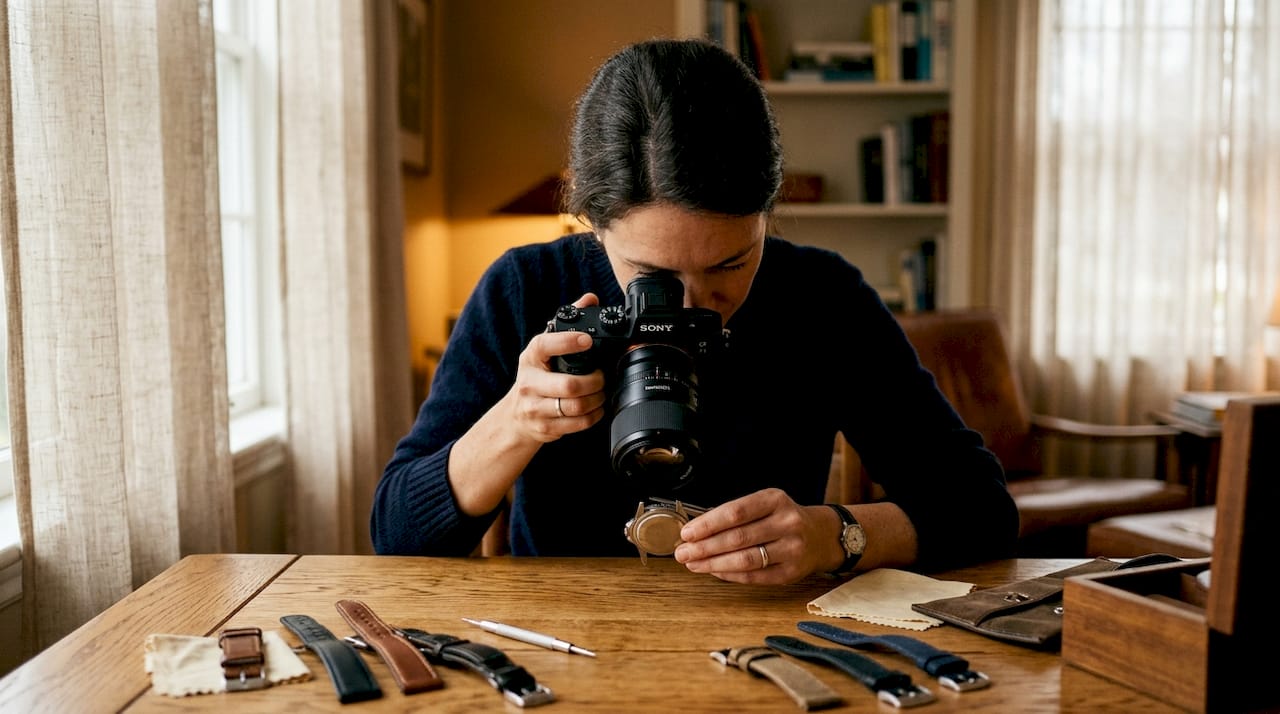
For accessing lug engravings safely, use a professional-grade spring-bar tool and protect the case flanks with a microfibre cloth or protective shim. Incorrectly removing a bracelet is one of the most common causes of case damage at collector level. If you are uncertain, ask a watchmaker or a trusted dealer to do it for you.
Reference number versus serial number: what is the difference?
These two numbers serve entirely different purposes, and confusing them is one of the most common mistakes newer collectors make.
The reference number identifies the model; the serial number identifies the individual watch. Two Rolex Submariners with the same reference are identical in specification. Their serial numbers will be different — and those serials tell you when each watch was made, and can be cross-referenced against service and ownership history.
The serial number is a unique identifier assigned to a single watch during manufacture. Rolex serial numbers, for example, can be cross-referenced against published production tables to establish an approximate year of manufacture. This matters enormously for vintage collecting, where a watch described as a 1960s piece should carry a serial consistent with that decade. A mismatch between the serial’s implied production year and the reference’s known production period is a significant red flag.
On modern watches, the serial is typically engraved between the lugs at 6 o’clock on Rolex, or on the caseback on many other brands. On vintage pieces, it is often on the movement itself, visible only when the case is opened. The reference, by contrast, is a shared code: every Submariner 126610LN ever made carries that same reference, regardless of when it was produced.
For authentication purposes, you need both. The reference confirms the watch is the correct model and specification. The serial confirms when it was made and allows you to cross-check service history. Neither alone is sufficient for a thorough verification.
Why do reference numbers matter so much to collectors and dealers?
Reference numbers are the industry’s primary shorthand for discussing specific variants without ambiguity. A dealer listing a “Rolex Submariner” could mean any one of dozens of variants spanning sixty years of production. A listing for a “126610LN” is unambiguous.
The practical consequences of this precision are significant:
Authentication: a reference that does not match the dial, bezel, or case material visible on the watch is an immediate alert. Parts may have been swapped, or the watch may be a composite assembled from multiple donors.
Parts sourcing: service centres use the reference to pull the correct parts list. The wrong reference means incompatible spare parts and a potentially misstated repair cost. Dealers use references as a direct path to the right parts and the expected market price range.
Valuation: small suffix differences can represent substantial price differences. A Rolex Daytona in white gold carries a different reference from the steel version, and the price gap between them runs to tens of thousands of pounds. Knowing the reference prevents both overpaying and underselling.
Provenance documentation: when a watch changes hands, the reference on the papers must match the reference on the watch. A discrepancy undermines provenance and reduces resale value. For more on this, the guide to wristwatch provenance covers the documentation chain in detail.
Limited editions and dial variants: some of the most sought-after references differ from standard production only in a dial colour or a bezel material. Without the reference, these distinctions are invisible in a photograph.
The secondary market prices references, not just models. A Patek Philippe 5711/1A-011 in steel commands a premium that the same watch in yellow gold does not, purely because collector demand follows the reference.
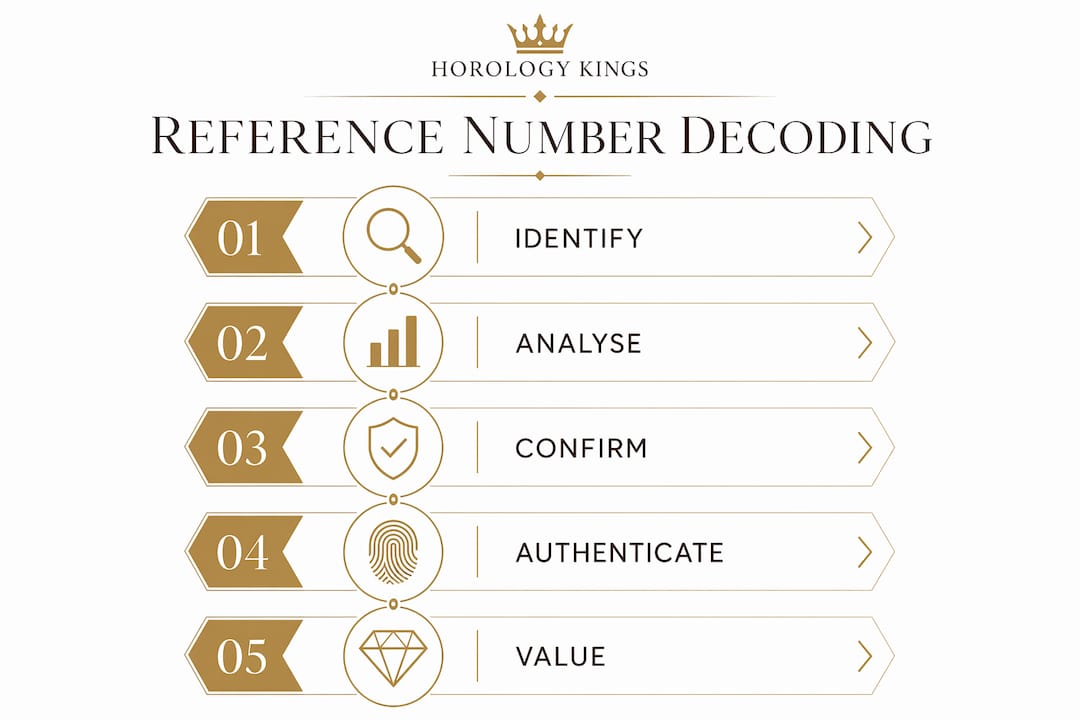
How to decode a reference number: a step-by-step method
A consistent decoding workflow prevents errors and saves time. Apply these steps to any reference you encounter.
Photograph the reference. Take a macro photograph of the engraving, perpendicular to the surface, under even light. Do the same for the caseback and any paperwork. A clear image is the starting point for every subsequent check.
Transcribe the reference exactly. Copy every character, including slashes, full stops, and letter suffixes. A single transposed character can lead you to a completely different variant.
Consult the original papers first. The warranty card or punched papers are the most authoritative source. If the reference on the papers matches the engraving, you have a strong starting point.
Cross-reference against the brand’s own catalogue. Most major brands publish current reference lists on their websites. For historical references, printed catalogues such as Wristwatch Annual or The Watch Book Compendium provide the most complete coverage.
Search a reputable database or dealer archive. Specialist databases and dealer records can confirm production periods, known variants, and any documented issues with a specific reference.
Check the movement. Where possible, have a watchmaker confirm that the movement inside the case is consistent with the reference. A movement swap is one of the harder frauds to detect without opening the case.
Compare against known examples. Auction house archives, particularly those of major UK and Swiss houses, publish detailed lot descriptions with photographs that allow direct comparison.
Worked example 1: Rolex 126610LN The base number 126610 identifies the current Submariner Date in Oystersteel. The suffix “LN” confirms the black ceramic bezel (noir). Papers should show this exact string. The serial, found between the lugs at 6 o’clock, will begin with a letter followed by digits, consistent with post-2010 production.
Worked example 2: Patek Philippe 5726A-001 The base 5726 identifies the Annual Calendar Nautilus. The “A” suffix confirms a stainless steel case. The “001” is the dial variant code. Cross-referencing against Patek’s catalogue confirms the slate-grey dial with moon phase.
Worked example 3: Omega 210.30.42.20.01.001 Reading left to right: 210 (Seamaster), 30 (Diver 300M sub-collection), 42 (42mm case), 20 (steel), 01 (blue dial), 001 (steel bracelet). Every segment is documented in Omega’s published reference system.
Quick decoding checklist:
Photograph the reference engraving and all paperwork
Transcribe every character exactly, including punctuation
Match against original papers
Confirm against brand catalogue or reputable database
Verify movement consistency with a watchmaker
Compare photographs against documented auction examples
Practical checklist and red flags when buying or selling
Before any transaction, run through these checks. They apply whether you are buying, selling, or submitting a watch for valuation.
Transaction checklist:
Reference on the watch matches reference on the papers exactly, character for character
Reference is consistent with the dial colour, bezel type, and case material you can see
Serial number is consistent with the reference’s known production period
Service history documents reference the same model and reference number
Seller can provide original box, papers, and at least one service receipt
Questions to ask a seller or broker:
Can you confirm the reference number from the engraving and the papers?
Has the watch been serviced, and do the service records reference the same model?
Has any part been replaced? If so, with what, and by whom?
Are the papers original to this watch, or were they sourced separately?
Red flags:
Papers show a different reference from the engraving on the watch
Lug engravings look re-stamped, unusually deep, or inconsistently spaced
Caseback shows signs of having been opened repeatedly without service records to explain it
Seller provides only generic stock photographs rather than images of the actual watch
Reference is consistent with a more valuable variant but the price is significantly below market
Collectors should not rely solely on an engraved reference for rare or vintage watches, because parts may have been swapped over decades of ownership. Cross-checking engravings against original paperwork and service records is the minimum standard. For high-value pieces, professional authentication is the appropriate step. The watch authentication checklist at Horology-kings covers the full documentation chain in practical detail.
Notable reference numbers every collector should know
Some references carry weight beyond their specification. These are the ones that appear repeatedly in auction catalogues, forum discussions, and dealer listings, and understanding why they matter helps you read the market accurately.
Rolex 6239 (Daytona): the first Daytona reference with a pump-pusher chronograph, produced from 1963. Dial variants, particularly the “Paul Newman” exotic dials, have sold for record sums at auction. The reference alone does not confirm the dial — physical inspection and paperwork are essential.
Rolex 1680 (Submariner Date): the first Submariner to carry a date complication, produced from 1969. Red “Submariner” text dials from early production are among the most sought-after vintage Rolex references.
Patek Philippe 2499: a perpetual calendar chronograph produced from 1950 to 1985 in four series. Each series carries subtle differences in case and dial that are only distinguishable by reference sub-variant and physical examination.
Audemars Piguet 5402ST: the original Royal Oak reference from 1972, designed by Gérald Genta. Steel examples in original condition are among the most valuable AP references on the secondary market.
Omega 2915-1 (Seamaster 300): an early Seamaster 300 reference from 1957, notable for its “broad arrow” hands and military associations. Condition and originality of the dial are critical to value.
Breitling 806 (Navitimer): the reference associated with the AOPA (Aircraft Owners and Pilots Association) logo dial, produced from 1954. Logo presence and dial originality define value within this reference.
Small suffix differences within a single base reference can represent significant price variation. A Rolex Daytona 116520 in steel differs from the 116519 in white gold not just in material but in collector demand and market price. For deeper research on any of these references, the secondary market guide at Horology-kings provides context on how reference variants drive pricing.
How Horology-kings uses reference numbers in sourcing, valuation and authentication
At Horology-kings, the reference number is the first thing we check and the last thing we confirm. Every watch that passes through our hands is verified against its paperwork, its physical engravings, and where appropriate, its movement, before it is offered for sale or valued for a client.
In practice, this means:
Every sourcing enquiry begins with the client specifying the exact reference they want. Sourcing a “Nautilus” is not the same as sourcing a 5711/1A-011. The reference determines whether the watch we find is the one the client actually wants.
Valuation requests are processed against the specific reference, not the model family. A Submariner with full papers showing the correct reference commands a different price from one where the papers are missing or mismatched.
Authentication checks at Horology-kings compare the case engraving, the movement serial, and the documented service history against the reference. A mismatch at any point triggers a deeper investigation before the watch is accepted.
For sellers, supplying the correct reference documentation — original papers, box, and service receipts — consistently produces faster sales and stronger prices. Buyers at Horology-kings can be confident that every reference has been verified before listing.
If you want Horology-kings to source a specific reference for you, the sourcing service is the right starting point. For authentication or valuation of a watch you already own, contact us directly and we will guide you through the process.

Key takeaways
A watch reference number is the single most important code for identifying, authenticating, and valuing a specific watch configuration — every collector should know how to find and decode it.
Point | Details |
Reference vs serial | The reference identifies the model and specification; the serial identifies the individual watch and its production era. |
Where to find it | Check between the lugs at 12 o’clock, the caseback perimeter, and the original warranty card or punched papers. |
Decoding method | Photograph the engraving, transcribe exactly, match against papers, then confirm with a brand catalogue or dealer. |
Red flags | Mismatched papers, re-stamped engravings, and generic seller photographs are the three most common warning signs. |
Immediate next step | Photograph the reference engraving and papers of every watch you own or intend to buy, and file them with the serial number recorded. |
Why reference numbers deserve more respect than they get
There is a tendency among newer collectors to treat the reference number as a formality — something to note down and move on from. Having worked with hundreds of watches across the full spectrum of Swiss brands, I think that underestimates what the reference actually does.
The reference is not just a catalogue code. It is the point where specification, provenance, and market value converge. A watch without a legible reference and matching papers is not just harder to sell — it is harder to authenticate, harder to service correctly, and harder to insure at the right value. The reference is the thread that connects the physical object to its documented history.
What surprises many collectors is how often a reference discrepancy reveals something genuinely significant: a dial that has been refinished, a case that has been swapped, or papers that belong to a different watch entirely. These are not rare occurrences in the pre-owned market. They are common enough that treating every reference check as routine, rather than optional, is simply good practice.
At Horology-kings, we encourage every client, whether buying, selling, or simply curious about a watch they own, to start with the reference. Get in touch if you want a second opinion on a reference you are unsure about, or if you are looking for a specific variant and want us to source it correctly.
Further reading and trusted sources for reference research
Building a reliable research library takes time, but a small number of sources cover the vast majority of what collectors need.
Print references:
Wristwatch Annual: published annually, this catalogue lists current and recent references with specifications and prices for all major brands. Useful for confirming modern reference formats and tracking year-on-year changes.
The Watch Book Compendium: an illustrated volume with technical photographs and specification listings. Particularly useful for matching visible features to reference listings when paperwork is absent.
Wristwatches: A Handbook and Price Guide (Schiffer Books): a collector-focused reference with historical survey, glossary, and guidance on fakes and hybrids. Covers both mechanical and quartz references across a broad range of brands and eras.
Online and specialist resources:
SmallSeconds glossary: a clear, accessible definition of reference number terminology and brand-specific format notes. A good starting point for collectors new to decoding.
Brand official websites: Rolex, Omega, Patek Philippe, Audemars Piguet, Breitling, Longines, TAG Heuer, and Cartier all publish current reference lists and, in some cases, historical catalogues through their authorised channels.
Horology-kings resources:
Resource | What you will find |
Identify watch models: a luxury collector’s guide | Practical identification workflow using references and physical features |
How to authenticate a luxury watch | Step-by-step authentication using reference and serial checks |
Less-obvious locations for references and serials across major brands | |
Watch authentication checklist | Concise transaction checklist for buyers and sellers |
How references feed into valuation methodology and price-setting |
Recommended
Comments