.png)
What is a skeleton watch? A horologist's guide
TL;DR:
A skeleton watch is an engineering marvel that intentionally removes material from the movement to showcase its intricate mechanics. It balances structural integrity with visual transparency, demanding precise craftsmanship and regular maintenance, while symbolizing horological innovation and prestige. Despite misconceptions, a well-engineered skeleton watch is as durable and accurate as a traditional timepiece, serving as a testament to watchmaking mastery.
Few timepieces generate as much genuine curiosity as the skeleton watch. Ask most people what is a skeleton watch and you will get vague answers about see-through dials or exposed gears. The reality is far more nuanced. A skeleton watch is an engineering achievement that deliberately removes material from the movement itself, transforming a precision instrument into a work of wearable art. It is not a gimmick, and contrary to popular belief, it is not fragile. This guide covers the history, mechanics, design philosophy, and practical ownership considerations that any serious enthusiast should understand.
Table of Contents
Key takeaways
Point | Details |
Skeletonisation is structural | Up to 70% of non-essential material is removed while preserving the movement’s mechanical integrity. |
Origins date to the 1760s | André-Charles Caron pioneered the technique; modern production was transformed by wire EDM in the 1990s. |
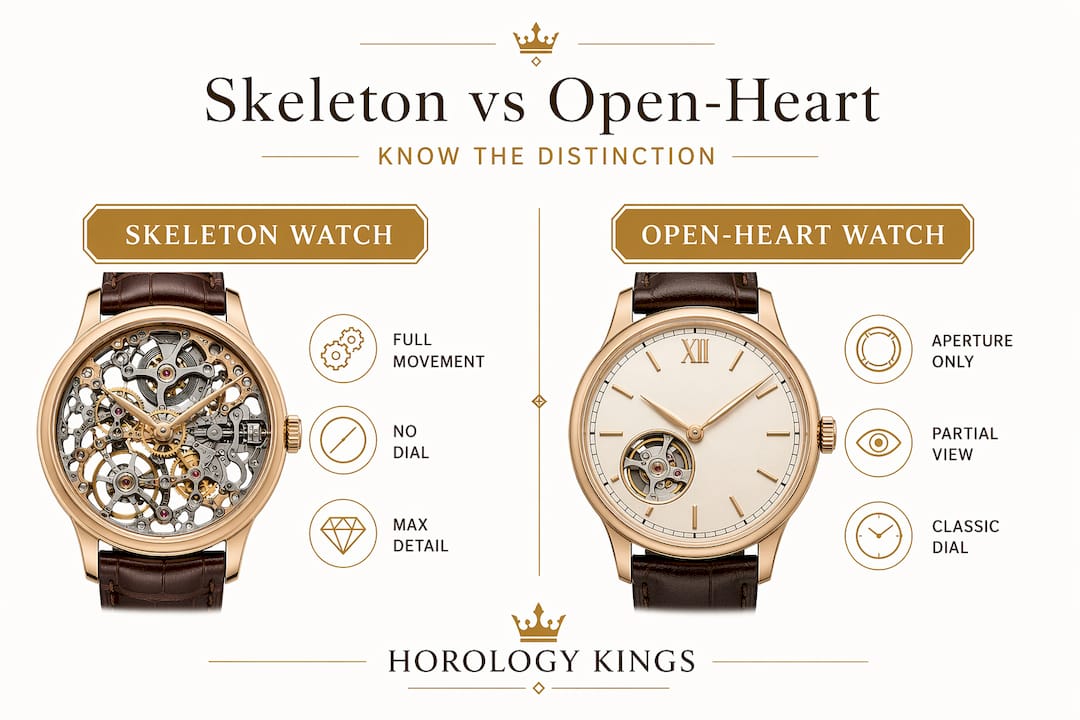
Distinct from open-heart designs | Skeleton watches expose the entire movement; open-heart watches reveal only a small aperture. |
Maintenance demands are higher | Ultrasonic cleaning and re-lubrication every 3 to 5 years are recommended due to exposed components. |
Collector appeal is significant | Skeleton watches represent craftsmanship, mechanical transparency, and prestige in one package. |
The history of skeleton watches
The story of the skeleton watch begins not in a modern Swiss manufacture, but in 18th-century Paris. Skeletonisation dates to the 1760s, pioneered by André-Charles Caron, a French watchmaker who also happened to be the father of the playwright Beaumarchais. Caron’s ambition was straightforward: he wanted the aristocratic patrons of the age to see every component of the movement working in concert. It was theatre and horology combined.
For the next two centuries, skeletonised pocket watches circulated among European nobility as objects of status. The technique was laborious and expensive. Craftsmen used hand saws and files to cut away bridges and mainplates, then spent hours finishing each surface so the exposed parts looked as refined as they functioned. Moving these ideas into wristwatches required new thinking about scale, since the components became far smaller and the structural challenges more acute.
The genuinely transformative moment came later. Precision machinery adoption in the late 1990s brought wire EDM (electrical discharge machining) into mainstream watchmaking. This technology uses a thin electrically charged wire to cut through metal with extraordinary precision, producing complex skeletonised forms that hand tools could never achieve. Suddenly, skeleton watches moved from the exclusive domain of high-end ateliers into broader luxury production.
Several key milestones shaped the modern category:
18th century pocket watches for European royalty and aristocracy, produced entirely by hand
19th century refinement of skeletonised movements in Swiss and French horological centres
Mid-20th century adaptation of the technique to wristwatches as the pocket watch declined
Late 1990s adoption of wire EDM enabling greater precision and more accessible production volumes
21st century experimentation with materials including titanium, carbon fibre, and ceramic in skeletonised calibres
Today, brands across the spectrum from independent artisan workshops to major Swiss manufacturers treat skeletonisation as one of the clearest signals of technical ambition. Cartier’s role in luxury horology is a compelling example of how heritage brands continually push what skeleton design can express.
How a skeleton watch works
Understanding how a skeleton watch works requires understanding what skeletonisation actually involves. The process is not decorative in the way that adding an engraved caseback might be. It is a structural intervention. Up to 70% of non-structural material can be removed from the bridges and mainplates that hold the movement together. What remains must do exactly the same mechanical job as the original full component, just with far less mass.
This creates an engineering problem that is genuinely difficult to solve. Remove too much and the movement flexes under torque, causing accuracy to suffer. Remove too little and you compromise the visual transparency that makes the watch worth making. The solution involves strategic ribbing and tension relief, where the remaining metal is shaped to carry stress along specific paths, much like the structural ribs in an aircraft wing.
The practical steps in creating a skeletonised movement typically follow this sequence:
The watchmaker or engineer identifies which sections of the bridge and mainplate carry no structural load under normal operation.
Material is removed using wire EDM, laser cutting, or traditional hand sawing depending on the manufacture and budget.
Each remaining surface is chamfered, polished, or anglaged by hand, since every visible edge is now on display.
The movement is reassembled and timed, then adjusted until accuracy meets the required specification.
Front and rear sapphire crystals are fitted so the owner can observe the movement from both sides.
Wire EDM and laser cutting allow levels of precision and complexity that traditional hand cutting cannot match. This matters not just aesthetically but structurally, since cleaner cuts reduce stress concentrations in the remaining material. High-end manufactures that re-engineer movements specifically for skeletonisation, rather than hollowing out a standard calibre, produce results that are visually and mechanically superior.
Features of skeleton watches typically on display include: the mainspring barrel, the gear train transmitting power, the escapement regulating the release of energy, the balance wheel oscillating at a set frequency, and the jewels reducing friction at pivot points. Sapphire crystals front and back offer an unobstructed view of all of this working simultaneously.
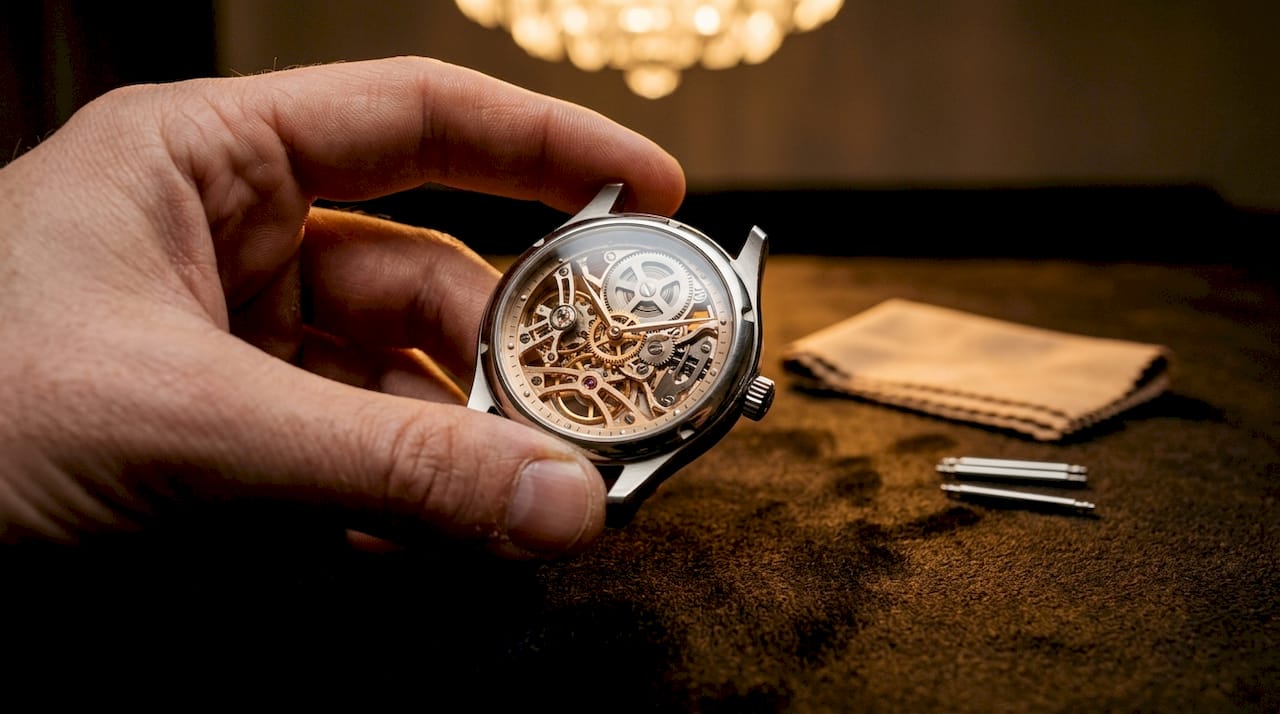
Pro Tip: When examining a skeleton watch in person, look at the finishing on the bridges rather than just the movement’s activity. Bevelled edges, mirror-polished surfaces, and perlage finishing on visible plates are the marks that separate genuine high-end skeletonisation from budget alternatives.
Skeleton vs open-heart: knowing the difference
The terms skeleton watch and open-heart watch are frequently confused, and the distinction matters if you are making a purchase decision.
An open-heart watch reveals only a small aperture in the dial, typically positioned at six o’clock or twelve o’clock, through which you can see a specific part of the movement. Usually this is the balance wheel or escapement. The rest of the dial remains intact and fully legible. An open-heart is the most conservative approach to movement visibility.
A skeleton watch, by contrast, exposes the entire movement. The dial is either completely absent or reduced to minimal indices and hands. You are looking through the watch rather than at a window within it. Partial skeletonisation sits between these two positions, removing significant material from certain zones while retaining more conventional dial architecture elsewhere.
Style | Material removed | Movement visible | Legibility |
Standard watch | None | None | Excellent |
Open-heart | Minimal | Partial (one component) | Good |
Partially skeletonised | Moderate | Several zones | Moderate |
Full skeleton | Up to 70% | Entire movement | Challenging |
Choosing between these styles comes down to what you value most:
Open-heart watches suit those who want a hint of mechanical theatre without sacrificing day-to-day readability
Partial skeleton designs offer a compromise that works well across different wearing occasions
Full skeleton watches prioritise the engineering spectacle above all else and reward the wearer who enjoys that experience
One point worth making plainly: skeleton watches maintain accuracy and power reserve comparable to conventional watches when properly engineered. The legibility trade-off is real. The accuracy trade-off is largely a myth.
Owning and maintaining a skeleton watch
Skeleton watches explained purely in technical terms can make them sound intimidating to own. They are not. However, they do require a different level of attention than a solid-dial mechanical watch.
The most significant consideration is maintenance frequency. Ultrasonic cleaning and re-lubrication every 3 to 5 years are recommended because exposed movements accumulate dust and particulate matter faster than enclosed calibres. The lubricants on pivots and jewels also degrade, and with skeleton watches there is less protection from the case and dial assembly. Find a watchmaker who has worked with skeletonised movements specifically, since reassembly requires careful attention to the reduced structural mass.
Key ownership considerations worth bearing in mind:
Avoid environments with high dust or humidity for extended periods, as the open architecture offers less protection
Consider water resistance ratings carefully; many skeleton watches carry lower ratings than conventional models
Store the watch in a closed watch box or pouch when not in use to minimise particulate exposure
When having the movement serviced, confirm the watchmaker has experience with skeletonised calibres
Read the movement, not just the time. The experience of wearing a skeleton watch rewards attention to the mechanics
Pro Tip: If you are adding a skeleton watch to an existing collection, treat it as a fair-weather companion initially. Wear it to formal occasions, events, and situations where you are inclined to be more careful. Build your familiarity with its particular character before wearing it daily.
Styling skeleton watches is genuinely enjoyable. The visual complexity of the movement reads as dressy without being formal, so they pair naturally with business attire, event wear, and smart-casual settings. On a leather strap, a skeletonised movement projects classic horology. On a bracelet or NATO strap, the same movement can read as more contemporary.
For guidance on building a considered collection that includes complex pieces, the luxury collectors’ guide at Horology Kings covers the practical decisions that matter.
Skeleton watches in collector culture
There is a reason skeleton watches combine technical mastery, design artistry, and historical significance in a way that few other watch styles achieve. For collectors, they occupy a unique position: they are simultaneously one of the oldest expressions of watchmaking ambition and one of the most technically demanding to produce today.
The art and science of luxury watches reaches its most visible form in a skeleton movement. Every decision made by the engineer and finisher is permanently on display. There is nowhere to hide a poor chamfer or an uneven polish. This transparency, literal and figurative, is precisely what collectors respond to.
“A skeleton watch does not merely tell the time. It shows you, continuously and without reservation, exactly how the time is being told.”
Modern brands have pushed the category further by introducing skeletonised movements in unconventional materials. Titanium bridges reduce weight while maintaining strength. Carbon fibre composite plates add visual drama and lower the centre of gravity. Ceramic components offer extraordinary hardness in exposed positions. Skeletonisation blends tradition and modernity, and the material experimentation of the past decade has reinforced that tension productively.
For enthusiasts considering their first skeleton watch, the question is rarely whether to own one. It is which one. The craftsmanship and prestige of mechanical watchmaking is most legibly expressed when there is no dial to obscure it.
My perspective on what skeleton watches really represent
I have spent years studying and handling skeleton watches across every price point, and the one thing I come back to consistently is this: most people underestimate how much engineering is concealed in what looks like deliberate exposure.
When you remove 70% of a movement’s material and the thing still runs accurately, maintains its power reserve, and holds its structural integrity under daily wear, that is not a design choice. That is a demonstration of structural engineering at a very high level. The aesthetic result is striking, but the achievement underneath it is what I find genuinely impressive.
The misconception I encounter most often is that skeleton watches are delicate or impractical. In my experience, a properly engineered skeleton movement from a credible manufacture is no more fragile than a comparable solid-dial piece. The maintenance intervals are shorter, yes. The legibility is sometimes a challenge. But the watch itself is not precarious.
What owning and studying skeleton watches has taught me is that they reveal something important about horology as a discipline. The craft has always been about solving problems with the minimum of material. A skeleton movement simply makes that constraint visible. If you want to understand what watchmaking actually is, a well-made skeleton watch explains it better than any book.
— Lewis
Explore skeleton watches with Horology Kings

At Horology-kings, we work with collectors and enthusiasts across the UK who understand what separates a genuinely crafted skeleton watch from one that merely looks the part. Our team in Hertfordshire has handled skeleton pieces from Patek Philippe, Audemars Piguet, Cartier, and beyond, and we know precisely what to look for in terms of finishing quality, movement engineering, and long-term value.
Whether you are looking to buy or sell luxury watches or you have a specific skeletonised reference in mind, our watch sourcing service gives you access to an expert network built around finding the right piece. We handle valuations, transactions, and sourcing with the discretion and security that high-value timepieces deserve.
FAQ
What is a skeleton watch?
A skeleton watch is a timepiece in which non-essential material has been removed from the movement’s bridges and mainplates, exposing the internal mechanics through transparent sapphire crystals front and back. Up to 70% of non-structural material can be removed during the process.
How does a skeleton watch work?
A skeleton watch functions identically to a conventional mechanical watch. The skeletonisation process removes material from structural components without altering the movement’s mechanism, so the mainspring, gear train, escapement, and balance wheel all operate normally.
Are skeleton watches less accurate than regular watches?
No. Modern skeleton watches are engineered to maintain accuracy and power reserve comparable to solid-dial watches. The legibility of the dial is often reduced, but accuracy is preserved through careful structural re-engineering.
What is the difference between a skeleton and an open-heart watch?
An open-heart watch reveals only a small aperture in the dial, typically showing the balance wheel. A skeleton watch removes the dial almost entirely, exposing the full movement. The open-heart is a more conservative and more legible variation.
How often should a skeleton watch be serviced?
Experts recommend ultrasonic cleaning and re-lubrication every 3 to 5 years for skeleton watches, more frequently than many solid-dial pieces, because the exposed movement accumulates dust and contaminants faster.
Recommended
Comments