.png)
What is Swiss chronometry: the collector's guide
TL;DR:
Swiss chronometry certifies the precision of mechanical watch movements through rigorous testing by COSC, which grants the “Chronometer Officially Certified” label after a 15-day protocol. It serves as a verifiable standard of quality indicating the movement’s accuracy, though it does not guarantee precise daily performance in real-world use. Modern standards now emphasize testing the entire finished watch, reflecting real-world conditions and higher accuracy levels.
Swiss chronometry is the certified precision testing of mechanical watch movements, administered primarily by the Official Swiss Chronometer Testing Institute, known as COSC. A movement earns the right to carry the “Chronometer Officially Certified” label only after passing a rigorous 15-day protocol governed by ISO 3159. The term “chronometer” is legally protected in Switzerland, meaning no brand can use it without genuine COSC certification. For collectors buying Rolex, Patek Philippe, or Omega, this label is not marketing copy. It is a verifiable, standardised guarantee of mechanical precision.
What is Swiss chronometry and how does COSC certify it?
Swiss chronometry refers to the formal measurement and certification of a mechanical movement’s timekeeping accuracy against internationally recognised standards. COSC, founded in 1973 and based in Switzerland, is the body that administers this process. The institute tests nearly 1.8 million movements annually, with approximately 94% passing. That volume tells you something important: chronometry is not a niche ritual for a handful of prestige brands. It is an industrial-scale quality standard embedded in Swiss watchmaking.

The certification applies to the bare movement before it is placed into a case. This distinction matters. A movement that passes COSC testing may behave slightly differently once cased, because the case introduces new physical constraints. Brands like Rolex go further by testing the finished watch to their own internal standards, but the COSC certificate itself covers only the uncased calibre.
The word “chronometry” derives from the Greek chronos (time) and metron (measure). In watchmaking, it describes the science of measuring time with the highest possible accuracy. Swiss chronometry specifically refers to the national framework Switzerland has built around that science, combining ISO standards, independent testing, and legal protections into a single coherent system.
How is chronometry measured according to Swiss standards?
The COSC testing protocol is precise, repeatable, and demanding. Every movement submitted must pass a 15-day sequence of tests conducted across five positions and three temperatures. The five positions replicate how a watch sits on the wrist throughout the day: crown up, crown down, crown left, crown right, and dial up. The three temperatures used are 8°C, 23°C, and 38°C, covering the range a watch typically experiences in daily wear.
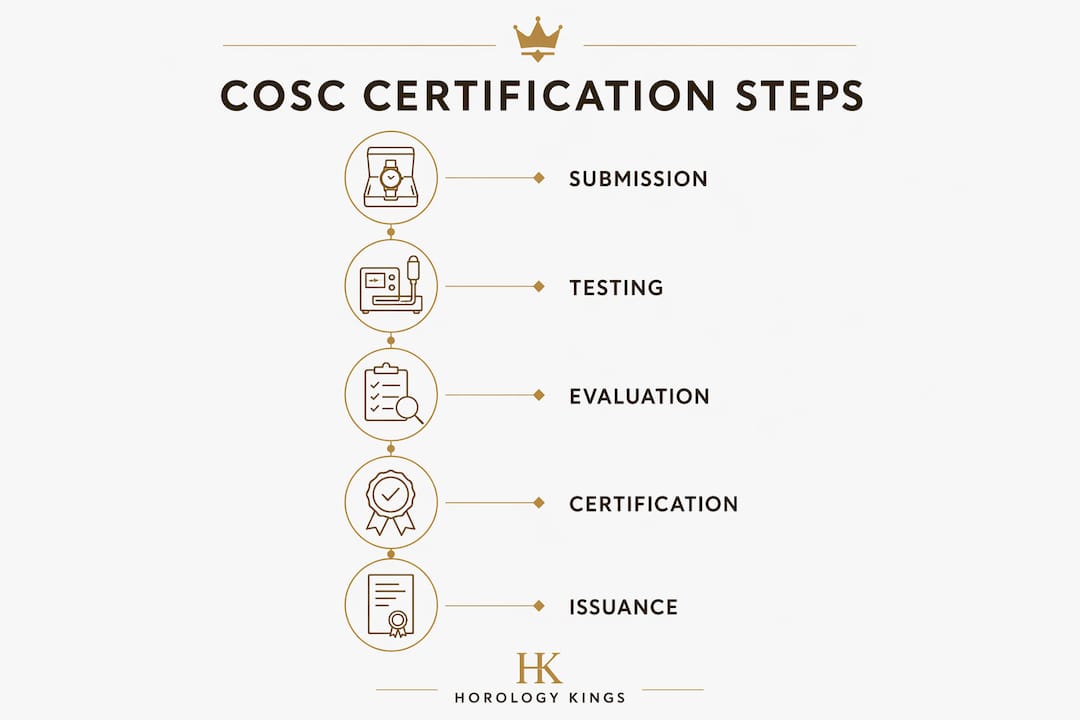
ISO 3159 requires that the average daily rate stays within a tolerance of -4 to +6 seconds per day. That is a tight window for a purely mechanical device with dozens of moving parts operating under constant physical stress.
The testing criteria COSC applies across the 15-day protocol are as follows:
Mean daily rate across all positions and temperatures: within -4/+6 seconds per day
Mean variation in rates between positions: no more than 2 seconds per day
Mean variation in rates between temperatures: no more than 0.6 seconds per day
Greatest variation in rates between positions: no more than 5 seconds per day
Difference between rates in the first and last days of testing: no more than 5 seconds per day
Criterion | Tolerance |
Average daily rate | -4 to +6 seconds |
Variation between positions | ≤ 2 seconds |
Variation between temperatures | ≤ 0.6 seconds |
Greatest positional variation | ≤ 5 seconds |
Rate change over 15 days | ≤ 5 seconds |
Pro Tip: The COSC tolerance is deliberately asymmetric, allowing a watch to run up to 6 seconds fast but only 4 seconds slow. The logic is practical: a watch running slightly fast means you are early, not late.
What distinguishes Swiss chronometry from other precision standards?
COSC certification is the most widely recognised standard, but it is not the only one. Several alternatives have emerged, each addressing limitations in the traditional movement-only approach.
The key distinctions between the major certification standards are:
COSC standard certification: Tests the bare movement over 15 days. Tolerance of -4/+6 seconds per day. Applies to mechanical and chronograph movements separately.
COSC Excellence Chronometer: Tests the finished, cased watch. Tighter tolerance of -2/+4 seconds per day. Includes magnetic resistance testing up to 200 gauss.
METAS certification (used by Omega): Tests the finished watch in its case. Requires accuracy of 0/+5 seconds per day on the wrist. Includes magnetic resistance testing up to 15,000 gauss.
Geneva Seal (Poinçon de Genève): Focuses on finishing and construction quality as much as accuracy. Requires movement to be made in Geneva canton.
OC+ label (Geneva Observatory): A newer standard combining accuracy with finishing criteria.
Standard | Tested on | Daily rate tolerance | Magnetic resistance |
COSC standard | Bare movement | -4/+6 seconds | Not tested |
COSC Excellence | Finished watch | -2/+4 seconds | 200 gauss |
METAS | Finished watch | 0/+5 seconds | 15,000 gauss |
Geneva Seal | Finished movement | Accuracy + finishing | Not specified |
The historical shift from observatory contests to standardised industrial testing is worth understanding. In the 19th and early 20th centuries, Swiss and British observatories held annual competitions where watchmakers submitted their finest pieces for accuracy trials. Kew Observatory in England and the Neuchâtel Observatory in Switzerland were the most prestigious venues. Those contests rewarded exceptional individual craftsmanship. COSC replaced that model with full case testing protocols designed for mass certification, trading bespoke excellence for consistent, verifiable quality across millions of movements.
Why does Swiss chronometry matter for watch collectors?
Chronometer certification serves as a mark of manufacturing seriousness rather than merely a functional necessity. A brand that submits movements to COSC is committing time, cost, and production capacity to an independent verification process. That commitment signals something about how seriously the manufacturer takes quality control.
For collectors, the practical implications are clear:
Resale confidence: A certified chronometer carries documented proof of precision. Buyers at auction or through dealers can verify the certification independently, which supports watch resale value and reduces negotiation friction.
Buying guidance: When comparing two watches at similar price points, COSC certification on one is a meaningful differentiator. It tells you the movement passed independent scrutiny, not just the manufacturer’s own checks.
Heritage connection: Swiss chronometry connects modern mechanical watches to a centuries-old tradition of scientific precision. Owning a certified chronometer places you in a lineage stretching back to marine navigation and observatory timekeeping.
One common misunderstanding is worth addressing directly. COSC certification does not guarantee your watch will run within -4/+6 seconds per day on your wrist. The test is conducted on the bare movement under controlled laboratory conditions. Real-world accuracy depends on how you wear the watch, how often you service it, and whether the case introduces any additional positional variation. A certified movement is a strong foundation. It is not a promise about the finished watch’s daily performance.
Pro Tip: When buying a pre-owned certified chronometer, ask to see the original COSC certificate. Each certificate carries the movement’s serial number, making it traceable and verifiable.
How is Swiss chronometry evolving with modern innovations?
The COSC Excellence Chronometer represents the most significant recent development in Swiss precision standards. Introduced to address the gap between movement certification and real-world performance, it tests the fully assembled watch rather than the bare calibre. The tolerance tightens to -2/+4 seconds per day, and the protocol includes magnetic resistance testing up to 200 gauss.
The shift toward finished-watch testing reflects a broader acknowledgement that casing a movement changes its behaviour. The Excellence Chronometer testing simulates common wristwatch wearing positions and durations over 24 hours, producing results that better represent how the watch actually performs on a wrist.
Material science is driving precision improvements across the industry:
Silicon escapements: Used by Patek Philippe, Rolex, and others. Silicon is non-magnetic, lightweight, and requires no lubrication, reducing friction-related rate variation.
Titanium components: Lighter than steel, reducing the energy required to maintain oscillation and improving positional consistency.
Anti-magnetic alloys: Brands like Omega use non-ferrous alloys in their movements to resist magnetic interference, which is one of the most common causes of rate deviation in daily wear.
Ongoing challenges in chronometry include gravity, shocks, magnetic fields, and temperature variation. These are not new problems. They are the same forces that troubled 18th-century marine chronometer makers. What has changed is the precision of the tools available to fight them. Modern watchmakers use computer-aided design, atomic clock calibration, and advanced metallurgy to achieve accuracy levels that would have been unimaginable to John Harrison or Abraham-Louis Breguet.
Despite quartz and digital technologies, mechanical chronometry retains its prestige. A quartz movement accurate to ±15 seconds per year is objectively more precise than any COSC-certified mechanical calibre. Collectors know this. They choose mechanical chronometers anyway, because precision in this context is as much about craft and heritage as it is about seconds per day.
Key takeaways
Swiss chronometry is the formal certification system that separates a verified precision movement from an uncertified one, with COSC and ISO 3159 setting the benchmark every serious collector should understand.
Point | Details |
COSC is the primary certifier | COSC tests nearly 1.8 million movements annually, with a 94% pass rate under ISO 3159. |
Testing covers 15 days | Movements are assessed across five positions and three temperatures before certification is granted. |
Tolerance is asymmetric | The -4/+6 second daily tolerance is deliberate, favouring slightly fast running to avoid user lateness. |
Certification covers bare movements | Standard COSC tests the uncased movement; Excellence Chronometer tests the finished watch. |
Certification signals quality | A chronometer certificate is independent proof of manufacturing rigour, supporting resale value and buyer confidence. |
Why Swiss chronometry still earns its place on the dial
I have handled hundreds of certified chronometers over the years, and the question I hear most often is whether the COSC stamp actually means anything in practice. My honest answer is: it means exactly what it says, no more and no less.
The certificate tells you that an independent body tested the movement under controlled conditions and it passed. It does not tell you the watch will keep perfect time on your wrist. It does not tell you the brand is better than one that skips COSC certification. What it does tell you is that the manufacturer cared enough to submit their work to external scrutiny. In a market where marketing claims are everywhere, that is genuinely worth something.
What I find more interesting is the direction the industry is heading. The Excellence Chronometer and METAS protocols are asking a harder question: how does this watch perform in the real world, not just in a laboratory? That shift feels right to me. A watch lives on a wrist, not in a testing chamber. Standards that reflect that reality are more useful to collectors than ones that do not.
The brands I respect most are the ones pushing their own internal standards beyond what COSC requires. Rolex, for example, certifies finished watches to tolerances tighter than ISO 3159 demands. That is not marketing. That is a manufacturer holding itself to a higher standard than the law requires. For a guide to choosing Swiss watches with this kind of depth in mind, the certification question should always be part of your research.
— Lewis
Certified Swiss chronometers at Horology-kings
Horology-kings is a specialist luxury watch dealer based in Hertfordshire, with direct access to certified Swiss chronometers from Rolex, Patek Philippe, Audemars Piguet, Omega, and Cartier. Every piece is authenticated before sale, with full documentation including original COSC certificates where available.
Whether you are buying your first certified chronometer or adding to an established collection, Horology-kings offers expert valuations, discreet transactions, and secure UK bank transfers. The team can also source a specific watch on your behalf, drawing on an expert network to locate rare and sought-after certified models. Browse the current collection and speak directly with the team at Horology-kings.
FAQ
What is Swiss chronometry in simple terms?
Swiss chronometry is the certified testing of a mechanical watch movement’s accuracy, governed by ISO 3159 and administered by COSC. A movement that passes earns the right to be called a chronometer.
How accurate does a watch need to be to pass COSC testing?
A movement must maintain an average daily rate of -4 to +6 seconds across a 15-day test at five positions and three temperatures to receive COSC certification.
Is a COSC chronometer more accurate than a quartz watch?
No. A standard quartz movement is objectively more accurate than a COSC-certified mechanical calibre. Collectors value mechanical chronometers for their craftsmanship and heritage rather than raw timekeeping precision.
What is the difference between COSC and METAS certification?
COSC tests the bare movement to a tolerance of -4/+6 seconds per day. METAS, used by Omega, tests the finished watch to 0/+5 seconds per day and includes magnetic resistance testing up to 15,000 gauss.
Does a chronometer certificate affect resale value?
Yes. A verifiable COSC certificate with a matching movement serial number supports buyer confidence and can strengthen resale value, particularly for pre-owned pieces from Rolex, Omega, and Patek Philippe.
Recommended
Comments