.png)

What is transparent pricing? A complete 2026 guide
- lewisvrichards3
- 5 days ago
- 8 min read

TL;DR:
Transparent pricing involves openly displaying all costs before purchase, including fees and taxes. It builds trust, reduces disputes, shortens sales cycles, and complies with UK regulations. Businesses that adopt clear, balanced disclosures gain a competitive advantage and foster customer confidence.
Transparent pricing is the practice of openly disclosing every cost associated with a product or service before any purchase commitment is made. This means the base price, taxes, fees, and add-ons are all visible upfront, with nothing buried in the small print. The UK’s Competition and Markets Authority (CMA) and the Digital Markets, Competition and Consumer Act 2024 (DMCCA) now mandate accurate total price display, making pricing transparency a legal obligation as much as a commercial virtue. For buyers and sellers alike, understanding what is transparent pricing is the first step towards making genuinely informed decisions.
What is a transparent pricing model and how does it work?
A transparent pricing model is a structured approach where every element of a price is disclosed before the customer commits. That includes the base cost, any setup or administration fees, applicable taxes, and optional add-ons. Nothing is revealed at checkout for the first time. The goal is to give the buyer a complete picture so they can compare options and decide with confidence.

Pricing transparency exists on a spectrum. At the minimal end, a business might display only the headline price and disclose taxes at checkout. At the full end, every cost component is itemised on the product page itself. Research shows that carefully curated low-transparency disclosures can sometimes outperform full transparency by avoiding information overload. That finding matters. Presenting forty line items of cost breakdown can paralyse a buyer just as effectively as hiding fees entirely.
The table below illustrates how disclosure levels differ in practice.
Disclosure level | What is shown | Typical outcome |
Minimal | Headline price only | High cart abandonment risk |
Partial | Base price plus taxes | Moderate trust, some friction |
Standard | All fees listed at checkout | Acceptable clarity, low disputes |
Full | All costs itemised on product page | Highest trust, fastest decisions |
One of the most underappreciated mechanisms in a transparent pricing model is self-selection. When prices are published clearly, prospects who cannot afford the product remove themselves from the process before contacting the business. Sales teams then spend their time only with serious, budget-qualified buyers. That efficiency gain is not trivial.
Pro Tip: Display your total price, including VAT and any delivery charges, on the product page itself rather than at checkout. Buyers who reach checkout already knowing the full cost convert at a significantly higher rate.
What are the benefits of transparent pricing for customers and businesses?
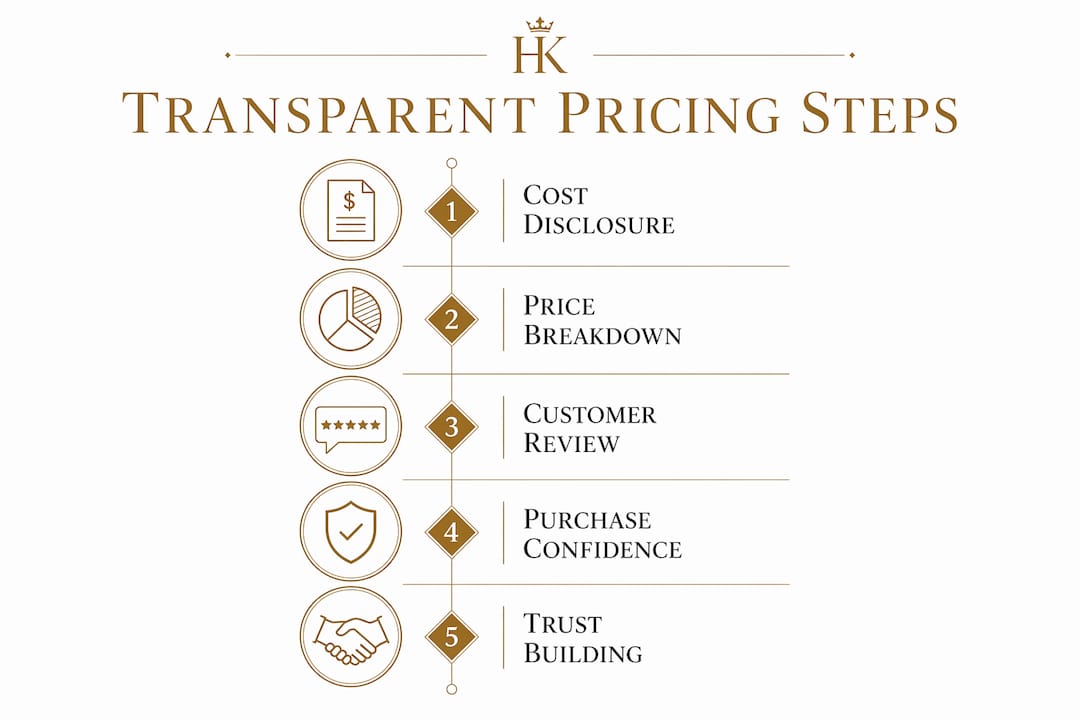
Transparent pricing builds trust faster than almost any other commercial practice. A study of small and medium-sized enterprises found that 65% of surveyed SMEs rated pricing transparency as having a high impact on building customer trust, with a mean trust score of 4.3 out of 5. That figure reflects something buyers already know intuitively: when a price is clear, the seller feels honest.
The advantages of clear pricing extend well beyond first impressions. Key benefits include:
Reduced buyer’s remorse. Customers who knew the full cost before purchasing are less likely to feel deceived after the fact.
Shorter sales cycles. Clear upfront pricing reduces sales cycle length by up to 30% by eliminating price negotiations and buyer confusion.
Lower dispute volumes. When every fee is disclosed in advance, post-purchase billing disputes drop sharply.
Stronger customer retention. SMEs combining transparency with subscription pricing models achieved the highest retention rates, with a mean rating of 4.4 out of 5.
Regulatory compliance. Businesses that meet DMCCA 2024 standards avoid CMA enforcement action and the reputational damage that follows.
Competitive differentiation. In markets where hidden fees are common, a business that publishes all costs stands out immediately.
For individual buyers, the advantages of clear pricing are equally direct. You can compare two offers accurately only when both show the same cost components. Hidden fees make genuine comparison impossible. Transparent pricing restores that ability and puts the buyer in control of the decision.
How do businesses implement transparent pricing effectively?
Transitioning to transparent pricing is not simply a matter of publishing a price list. The process requires a structural shift in how a business thinks about its costs and how it communicates value.
The first step is moving away from opaque cost-plus pricing. Transitioning to value-based or tiered pricing reveals internal inefficiencies and forces a business to justify every charge it passes to the customer. That internal discipline is one of the hidden benefits of adopting a transparent pricing strategy. Businesses often discover fees they have been charging out of habit rather than necessity.
A practical implementation follows four stages:
Audit every charge. List every fee, tax, and add-on currently applied to a product or service. Include charges that appear only in terms and conditions.
Categorise by necessity. Separate charges that are genuinely required from those that are discretionary or legacy.
Choose your disclosure level. Decide whether full itemisation or a clean all-in price better serves your customer’s decision-making process. Both can work; the choice depends on product complexity.
Test and measure. Track cart abandonment, dispute rates, and conversion rates before and after the change. The data will confirm whether your disclosure level is calibrated correctly.
Avoiding information overload is the most common pitfall. Excessive pricing information can reduce purchase probability by triggering cognitive overload. A buyer confronted with twelve separate line items may abandon the purchase not because the price is too high, but because the decision feels too complicated.
Pro Tip: If your product has multiple cost components, consider presenting a single all-in price prominently, then offering a collapsible breakdown for buyers who want the detail. This satisfies both transparency requirements and cognitive ease.
Industries from financial services to luxury retail have adopted this approach. A hotel that displays a nightly rate including all resort fees and taxes on the search results page converts better than one that reveals those charges at the final booking screen. The principle holds across sectors.
What is the regulatory context for pricing transparency in the UK?
The UK’s regulatory framework for pricing transparency is now among the most explicit in the world. The DMCCA 2024 mandates that businesses display accurate total price information, directly addressing the hidden fees that have eroded consumer confidence across digital markets.
The CMA has made pricing transparency a central enforcement priority. Its focus falls on drip pricing, where a low headline price is gradually supplemented by unavoidable fees during the checkout process, and on misleading price claims that distort consumer perception of value. Both practices are now explicitly targeted under the updated unfair commercial practices provisions.
“Price transparency is important, it affects everyone.” — Competition and Markets Authority, 2025
The economic case for transparent pricing extends beyond individual transactions. When prices are clear across a market, competition becomes more effective. Buyers can compare offers accurately, which forces sellers to compete on genuine value rather than on who can most effectively obscure their true cost. That dynamic benefits the wider economy by directing spending towards businesses that deliver real value.
Tech-powered transparency is accelerating this shift. AI and digital tools now allow businesses to display all-in costs in real time, reducing regulatory exposure and lowering billing dispute call volumes simultaneously. Businesses that treat fee transparency as an innovation opportunity rather than a compliance burden are already seeing measurable gains in customer confidence and brand differentiation.
Key takeaways
Transparent pricing is the single most effective way to build customer trust, reduce disputes, and comply with UK regulatory requirements under the DMCCA 2024.
Point | Details |
Full cost disclosure | Display base price, fees, taxes, and add-ons before any purchase commitment is made. |
Self-selection benefit | Clear pricing filters out unqualified prospects, reducing sales cycle length by up to 30%. |
Trust and retention | 65% of SMEs rate pricing transparency as highly impactful on customer trust, with top retention linked to transparent subscription models. |
Regulatory compliance | The DMCCA 2024 requires accurate total price display; non-compliance risks CMA enforcement action. |
Strategic disclosure | Balance completeness with clarity; excessive detail can reduce purchase intent as much as hidden fees. |
Transparency as a competitive edge, not just a checkbox
I have spent years watching businesses treat pricing transparency as a legal obligation they need to satisfy with the minimum possible effort. That approach misses the point entirely.
The businesses I have seen gain the most from transparent pricing are those that treat it as a trust-building tool in its own right. They do not publish prices because the CMA requires it. They publish prices because they are confident in their value proposition and want buyers to see that confidence reflected in every interaction. That posture changes how customers feel about a brand before they have spent a penny.
The luxury market is a particularly instructive example. High-value purchases carry high emotional stakes. A buyer considering a Rolex or a Patek Philippe is not just evaluating a price. They are evaluating whether the seller can be trusted with a significant sum of money. Opaque pricing in that context does not create intrigue. It creates anxiety. Clear, upfront pricing removes that anxiety and replaces it with confidence.
AI and digital tools have made full transparency more achievable than ever. There is no longer a technical barrier to displaying all-in costs in real time. The only remaining barrier is the willingness to do it. Businesses that clear that barrier now will find themselves ahead of competitors who are still hiding behind drip pricing and small-print fees.
My practical advice: start with your most common transaction type, audit every charge applied to it, and publish the complete cost on your product or service page. Measure the effect on conversion and disputes over ninety days. The results will make the case for broader adoption better than any argument I can offer here.
— Lewis
How Horology-kings puts transparent pricing into practice
Horology-kings applies transparent pricing across every transaction, from buying and selling pre-owned Rolex and Patek Philippe pieces to sourcing rare models for collectors. Every valuation is communicated clearly, with no hidden deductions or surprise charges at the point of settlement.
Clients who buy or sell watches through Horology-kings receive a complete breakdown of the offer or purchase price before any commitment is made. Payments are settled via secure UK bank transfer, with the agreed sum confirmed in writing beforehand. For those seeking a specific reference, the watch sourcing service operates on the same principle: clear terms, agreed costs, and no ambiguity at any stage of the process. That approach is not a marketing position. It is how every transaction at Horology-kings is conducted.
FAQ
What is transparent pricing in simple terms?
Transparent pricing means disclosing every cost, including fees, taxes, and add-ons, before a customer commits to a purchase. Nothing is hidden or revealed for the first time at checkout.
How does transparent pricing work in practice?
A business lists its base price alongside all applicable charges on the product or service page. The buyer sees the total cost upfront and can make a fully informed decision without encountering surprises later.
What are the main benefits of transparent pricing?
The core benefits include higher customer trust, shorter sales cycles, fewer post-purchase disputes, and compliance with UK regulations under the DMCCA 2024. Research shows trust scores averaging 4.3 out of 5 among SMEs that adopt it.
Is transparent pricing required by law in the UK?
The DMCCA 2024 requires UK businesses to display accurate total price information. The CMA actively enforces against drip pricing and misleading price claims under the updated unfair commercial practices provisions.
Does showing all costs reduce sales?
Excessive detail can reduce purchase intent if it overwhelms the buyer. The most effective approach balances full disclosure with clarity, often presenting a single all-in price with an optional detailed breakdown available on request.
Recommended
Comments